CAFES is pleased to announce a new project in partnership with Pollution Probe Foundation, focused on providing consumers with informed clean energy choices and strengthening community momentum towards energy efficiency and a low-carbon future.
As clean energy technologies such as heat pumps, electric water heaters, electric cars and bikes, induction stoves, and other energy-efficient low-carbon solutions gain traction, households are increasingly seeking to better understand their options: how these technologies work, what they cost, and how they fit into everyday life. Taken together, these individual decisions play an important role in shaping Ottawa’s clean energy transition.
Through this project, Pollution Probe will lead the development of consumer-focused research and practical resources that translate complex technical information into clear, accessible guidance. CAFES will bring this work into Ottawa’s local context by embedding it within our education and awareness efforts, supporting informed consumer choices and evidence-based clean energy action.
CAFES in Action
Over the coming months, CAFES will integrate this project into its ongoing work through activities that bring clean energy questions into public conversation, including through sustainability coffee houses and the Climate Caucus. This work will also inform CAFES’ contributions to social media, local media and broader public dialogue on clean energy.
This project is supported by funding from Innovation, Science and Economic Development Canada’s Canadian Consumer Protection Initiative. For more information about this project, please contact Zeenat Mackwani, Energy Program Lead,zmackwani@cafesottawa.ca
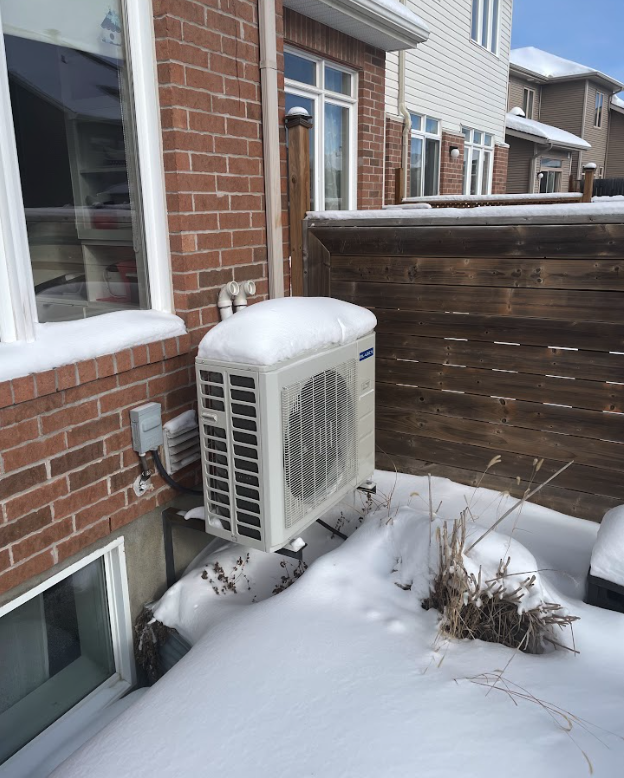
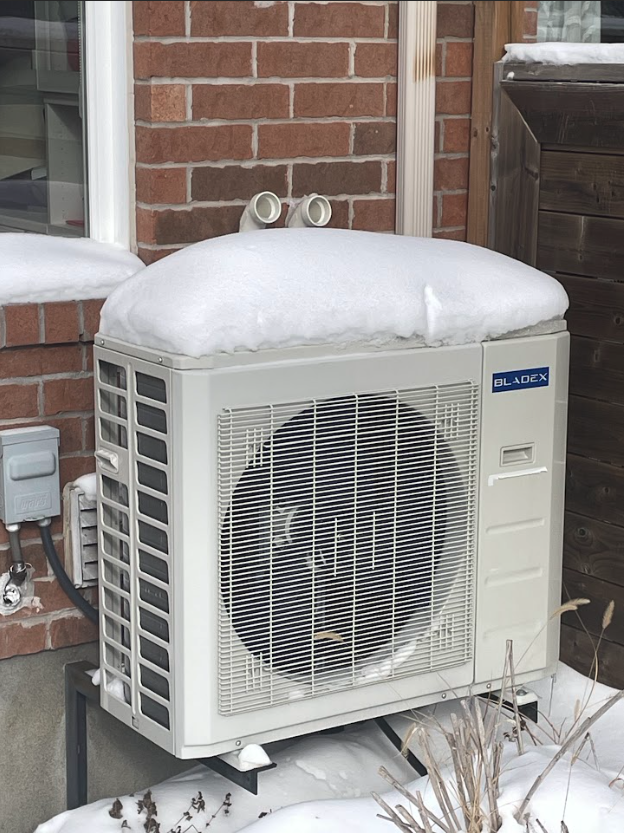
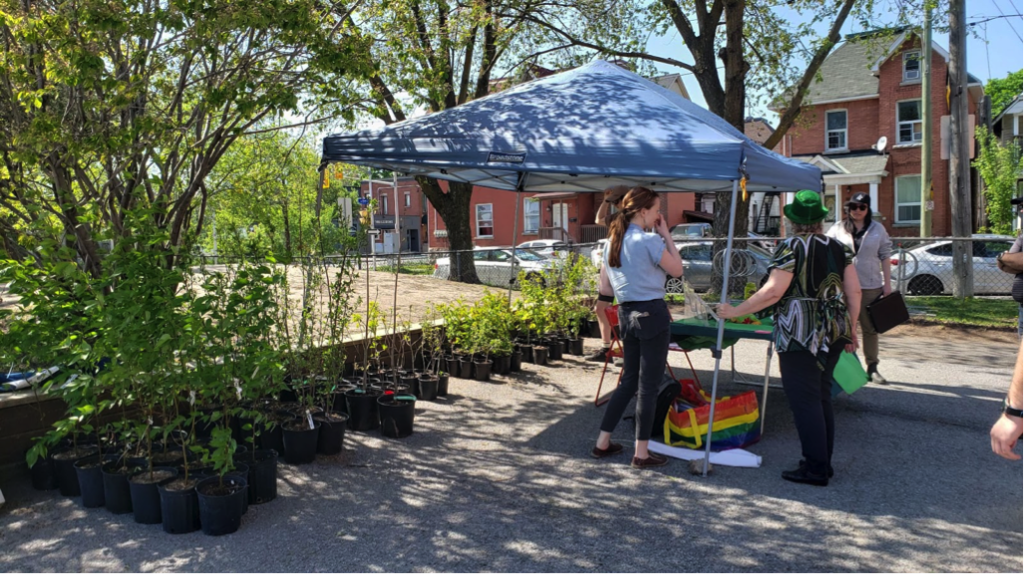
Photo credit: Mitzi MacDonald - a heat pump.
---
Accélérer les choix en matière d’énergie propre à Ottawa
CAFES est heureuse d’annoncer un nouveau projet en partenariat avec la Fondation Pollution Probe, visant à accélérer des choix éclairés en matière d’énergie propre et à renforcer l’élan communautaire vers un avenir à faible émission de carbone.
À mesure que des technologies comme les thermopompes, les véhicules électriques et d’autres solutions à faibles émissions gagnent en visibilité, de nombreux ménages cherchent à mieux comprendre leurs options — le fonctionnement de ces technologies, leurs coûts et leur intégration dans la vie quotidienne. Collectivement, ces décisions individuelles jouent un rôle important dans l’évolution de la transition énergétique à Ottawa.
Dans le cadre de ce projet, Pollution Probe dirigera l’élaboration de recherches et de ressources pratiques destinées aux consommateurs, afin de rendre des informations techniques complexes plus claires et accessibles. CAFES ancrera ce travail dans le contexte local d’Ottawa en l’intégrant à ses activités d’éducation et de plaidoyer, soutenant ainsi un dialogue public éclairé et une action fondée sur des données probantes en matière d’énergie propre.
CAFES en action
Au cours des prochains mois, CAFES intégrera ce projet à son travail en cours par le biais d’activités concrètes visant à faire progresser les conversations publiques sur l’énergie propre.
CAFES diffusera des explications claires et accessibles sur les technologies d’énergie propre dans son bulletin et sur son blogue, en s’appuyant sur les recherches de Pollution Probe pour clarifier les éléments que les ménages devraient prendre en compte et l’importance de ces choix à plus grande échelle. Ce travail alimentera également les contributions de CAFES aux médias locaux et au dialogue public sur l’énergie propre.
Le projet sera aussi présent dans les espaces communautaires de CAFES, notamment les Cafés durabilité et les Caucus climat, qui offrent des lieux ouverts et informels pour explorer les choix énergétiques à partir d’expériences vécues. Ensemble, ces activités soutiendront des échanges éclairés et renforceront l’élan communautaire en faveur de l’adoption de solutions d’énergie propre.
Ce projet est soutenu par le financement de l’Initiative canadienne de protection des consommateurs d’Innovation, Sciences et Développement économique Canada. Pour plus d’information sur ce projet, veuillez communiquer avec Zeenat Mackwani, responsable du programme Énergie, zmackwani@cafesottawa.ca
Crédit photo: Mitzi MacDonald
On this page you'll find the CAFES Heat Pump Consumer Guide, links to other heat pump experts and resources like OREC and Electrify 613, and more.
What is a Heat Pump?
Heat pumps are a proven and reliable technology. They work year-round by providing cooling in the summer, and heating in the winter -- even Canadian ones! So-called "cold-climate heat pumps" are designed to go to -30 degrees Celsius. So how do heat pumps work?
A heat pump is an electrically driven device that extracts heat from a low temperature place (a source), and delivers it to a higher temperature place (a sink).
To understand this process, think about a bicycle ride over a hill: No effort is required to go from the top of the hill to the bottom, as the bike and rider will move naturally from a high place to a lower one. However, going up the hill requires a lot more work, as the bike is moving against gravity.
In a similar manner, heat naturally flows from places with higher temperature to locations with lower temperatures (e.g., in the winter, heat from inside the building is lost to the outside). A heat pump uses additional electrical energy to counter the natural flow of heat, and pump the energy available in a colder place to a warmer one.
When energy is extracted from a source, the temperature of the source is reduced. If the source is your home, thermal energy will be removed, resulting in a cooler home. Inversely, as energy is added to a sink, its temperature increases. If the home is used as a sink, thermal energy will be added, heating your home. A heat pump is fully reversible, meaning that it can both heat and cool your home, providing year-round comfort.
There are also ground-source heat pumps, which use the earth, ground water, or both as the source and sink for heat. This means taking warm energy from the ground during the winter, and putting warm energy in the ground during the summer.
Investing in a heat pump is the most efficient way to get off a gas furnace for heating, and can also very efficiently replace air conditioning systems for cooling all in one machine.
Consumer Guide
CAFES has researched and compiled a concise Consumer Guide based on the experiences of over 70+ heat pump owners in Ottawa. You can use it to find feedback on different installers, feedback on heat pumps, and more information.
Are you already a heat pump owner? You can click the button below and help contribute to the consumer guide! Please share your experience with installers and heat pump models with your community.
Join the Ottawa Renewable Energy CO-operative (OREC) network and gain access to the OREx community exchange tool where you can hear from OREC members about green energy resources. You can search by resource category–EV, heat pump, solar and more–and filter by type, brand, location, installation date, etc.
Join the Electrify613 community and contribute to their mission to fully electrify 1,000+ homes in Ottawa. Electrify613 runs a slack channel. If you have any tricky technical questions about what your specific heat pump solution can look like, these folks will answer your questions.
Better Homes Ottawa provides a list of potential incentives to install equipment like heat pumps in your home including low-cost loans!
Hydro Ottawa has also put together a set of resources explaining the science behind heat pumps, the economic benefits, and much more!
Listen to Angela interview Aaron Sadhankar of Fern Comfort about heat pumps on our CKCU radio show!
Addressing Climate Misinformation
CAFES Climate Misinformation Volunteer Team
CAFES Ottawa wants to equip and empower you to address climate misinformation in your everyday life during conversations with family, friends and co-workers. And then we would like you to consider speaking up in public dialogue and in municipal policy-making spaces.
Climate change poses a dire, existential threat, but alongside this crisis, another is taking hold: the widespread dissemination of climate change misinformation. This intentional spread of falsehoods undermines scientific consensus, stalls public action, and leaves us more vulnerable.
The CAFES Climate Information Team hopes to help to inoculate Ottawans against misinformation and extreme beliefs.
How to Use These Backgrounders
In each backgrounder, you will find the misinformation it addresses and speaking notes to help you respond to it, with credible information to back it up. We encourage you to get curious and check out the resources. We took the time to find credible facts and sources to help you quickly gain the confidence to speak up!
In addition to our backgrounders below, which give you speaking notes to address misinformation, here are more resources to support you. When we talk about climate action in our everyday lives and municipal decision-making spaces, we are helping accelerate climate action in the City of Ottawa.
For questions and suggestions, please contact the CAFES Climate Misinformation Volunteer team at info@cafesottawa.ca
Climate science
We Won’t Solve Climate Change Unless Every Country Reduces Their Emissions, Including Canada
Use this brief to respond to climate misinformation, such as:
Canada/Ottawa’s emissions are negligible. Reducing Canada/Ottawa’s emissions isn’t worth the cost because it will have virtually no effect on global emissions.
Speaking points:
The facts. In 2021, Canada emitted 698 million tonnes of CO2 – 1.47% of global CO2 emissions. It’s not negligible, and saying it doesn’t matter would be irresponsible. In 2022, Canada's greenhouse gas emissions were 708 megatonnes of CO2, an increase of 9.3Mt (1.3%) from 2021.
The “per capita” problem. The average Canadian emits much more than the average person worldwide. In 2021, Canadians produced 14.3 tonnes of CO2 per capita, more than three times the global average.
Canada is considered in the top 10 countries historically the most responsible for climate change. If you add up all the carbon that Canada, as a country, has released since 1750, we’re ranked in the top 10 of the world’s biggest emitters. Those carbon emissions are still in the atmosphere, driving the global warming we see today.
Collectively, even 1% matters. There are almost 200 countries in the world, and most countries’ share of global emissions is less than 1%. In fact, most are less than 0.1%. If we add up emissions from all countries that emit less than 2% of the global share, they add up to 36% of the world’s CO2 emissions. If “negligible” countries like Canada don't play their part in reducing emissions, we don’t stand a chance of tackling climate change. Only six countries emit more than 2% of the global share (China, United States, India, Russia, Japan, and Iran).
Climate change, like littering, requires collective action and collaboration. Imagine a scenario where Ottawa has a littering problem. If every person in Ottawa (population: 970,000) took the stance: “I’m only one person, therefore my actions don’t matter. It makes no difference to the city if I continue to litter,” we would never solve the littering problem!
There are co-benefits to reducing emissions (health, financial, social). Air pollution from burning fossil fuels (oil, gas, and coal) contributes to 15,300–34,000 premature deaths each year in Canada. Reducing our emissions means cleaner air and saving thousands of lives. Every tonne of carbon we reduce this year saves society as a whole $261. And Canada could reduce millions of tonnes of carbon.
Show leadership. Canada is in the top 20 of the world’s major economies. This means that our actions on reducing emissions will influence what other countries do. The good news: In July 2023, Canada released a framework to phase out government subsidies for increased fossil fuel production – the first of the G20 countries to do so. The bad news: Canada is still the world’s 4th largest oil exporter, and most of Canada’s emissions come from producing oil and gas.
The world is shifting to renewables, and Canada needs to, too. Globally, investments in renewable energy are getting closer to and exceeding those in fossil fuels.
Does my country make a difference to climate change?: Francisco Garcia-Gibson, a research fellow at the London School of Economics Department of Government, explains why every country can and must take real action on climate change.
Why the UK's 1% of global emissions is a big deal:The Energy and Climate Intelligence Unit explains why the United Kingdom’s (UK's) 1% of global emissions is a big deal. It’s not just Canada – other countries like the UK and Australia have been trying to use this argument as a cop-out for climate action.
Carbon emissions are costing Canadians five times what Ottawa once thought: Minister Environment Minister of Canada, Steven Guibeault, explains the economic cost of carbon: “Every tonne of carbon we reduce this year saves society as a whole $261 — and we are talking in terms of cutting megatonnes: millions of tonnes.” This economic cost of carbon estimates the financial impact that every tonne of emissions has on everything from food production and human health to disaster repair bills and property values.
Canada: CO2 Country Profile: Statistics on Canada’s emissions from Our World in Data. Clean energy investment is extending its lead over fossil fuels, boosted by energy security strengths: Report by the International Energy Agency on how global investments in clean energy is set to surpass investment in oil and gas in 2023.
Government of Canada delivers on key climate commitment to phase out inefficient fossil fuel subsidies: News release from July 24, 2023. “Cutting pollution in our communities is good for our climate, economy, health, and well‐being. It will also help Canadians reduce the impacts of climate change that are already costing the Canadian economy billions of dollars every year.” “Eliminating inefficient fossil fuel subsidies and redoubling our focus on clean energy is a key step in building Canada’s net-zero economy by 2050 and supporting good-paying jobs for Canadians for generations to come.”
Canada's National Inventory Reports are usually released in or about April or May of each year. They report on our emissions from the year that ended about 16 months previously (i.e. the attached 2024 Report reports the emissions for 2022).
Published January 2024 -------------------- Volunteer Powered The CAFES Climate Misinformation Team created this backgrounder. We hope it is a meaningful contribution to help you respond to misinformation and prevent delays in climate action in the City of Ottawa.
The Sun’s Energy has Decreased Since the 1980s, but the Earth Keeps Warming
Use this brief to respond to climate misinformation, such as:
Climate change is caused by the sun
Speaking points:
Is climate change caused by the sun? No. The sun influences earth’s climate, but it is not responsible for the warming we’ve seen in recent decades.
How does the sun influence earth’s climate? The earth gets nearly all of its energy from the sun. The sun’s energy rises and falls on an approximately 11-year solar cycle. It also fluctuates over a century-long timescale, and even over tens of thousands of years, in what’s known as Milankovitch cycles. Today, the earth has warmed an average of 1.3 °C since the pre-industrial period (1850–1900).
Scientists have tested the hypothesis that this warming is caused by the sun. Here’s how they know why the sun is not the cause. Since the 1980s, the amount of sun energy reaching the earth has been steadily decreasing. If the sun were driving earth’s temperature, the planet would be getting cooler. Instead, earth’s global average temperature has been increasing, at a rate of 1.7 °C per century.
If the sun were causing global warming, we would expect to see warming in all layers of the atmosphere, but we don’t. Instead, the upper atmosphere (stratosphere) is cooling, while the lower atmosphere (troposphere) is warming.
If it’s not the sun, then what is causing global warming? The enormous rise in greenhouse gas concentrations since 1850–1900 has been warming the earth. Human activity of burning fossil fuels (oil, coal, gas) accounts for roughly three-quarters of the greenhouse gas emissions. The remaining come from deforestation, waste decay, and agriculture.
If the sun’s energy is decreasing, can we expect this to counter human-caused warming? No. The sun’s energy has a very small effect on global temperatures compared to greenhouse gas emissions. The Intergovernmental Panel on Climate Change (IPCC) predicts global warming of 1.8–4.4 °C by 2100, depending on how much we reduce emissions. In comparison, a Grand Solar Minimum (when the sun gives off less energy for a long period of time) would lead, at most, to a cooling of 0.1 °C.
In sum: We can’t blame the sun for the crisis we face; we have to blame our own ingenuity, in bringing about the industrial revolution. However, we can use that same ingenuity to facilitate the electrical revolution. Unless we rapidly reduce emissions, the earth will continue to warm.
Resources:
Is the Sun causing global warming?: In three short paragraphs, the National Aeronautics and Space Administration (NASA) explains why the answer is a clear “No.”
What is the Sun's role in climate change?: NASA's Global Climate Change website provides a short explainer about solar cycles, which last 11 years, and about “grand minimum,” a periodic solar event, in which there is less solar activity. The warming driven by greenhouse gases coming from the human burning of fossil fuels is far greater than the effect of the sun.
Climate change: Incoming sunlight: NOAA provides a thorough but concise summary of 11-year solar cycles, longer-term changes in solar activity such as grand minimums, and Milankovitch cycles, which last tens to hundreds of thousands of years and influence how much sunlight reaches us. The effects of the sun’s activity on global average temperatures are tiny (0.01 to 0.1 °C) compared with the human-caused effects of greenhouse gases from burning fossil fuels (>1 °C).
Sun and climate: Moving in opposite directions: Skeptical Science debunks the myth that the sun is causing today’s global warming. This is the second most common myth about climate change!
Explainer: Why the sun is not responsible for recent climate change: An explainer from Carbon Brief. “… since 1970 global temperatures have shot up by almost 0.7 °C, while the amount of solar energy reaching the earth has actually declined. Similarly, the upper atmosphere is cooling while the lower atmosphere warms, a clear fingerprint of warming from greenhouse gases rather than the sun.”
Solar activity and the so-called "Little Ice Age: Professor Mike Lockwood of the University of Reading in the United Kingdom explains in Carbon Brief why the world is not about to plunge into a “Little Ice Age.” “We found the likely reduction in warming [associated with a decline in solar irradiance to Maunder minimum levels] by 2100 would be between 0.06 and 0.1 degrees Celsius, a very small fraction of the warming we’re due to experience as a result of human activity.”
It’s the sun, stupid: If you prefer audio, The Climate Denier’s Playbook, a podcast by Climate Town, has an episode debunking the misinformation that the sun is causing global warming. This podcast is where to look if you want well-researched information, and a good laugh!
Published June 2024
-------------------- Volunteer Powered The CAFES Climate Misinformation Team created this backgrounder. We hope it is a meaningful contribution to help you respond to misinformation and prevent delays in climate action in the City of Ottawa.
Global Consensus: The Climate Emergency is Real
Use this brief to respond to climate misinformation, such as:
The Intergovernmental Panel on Climate Change (IPCC) isn’t trustworthy. As a United Nations organization, it is corrupt.
The IPCC is wrong. There is no consensus on climate change, and many scientists are in disagreement.
Speaking Points
The climate emergency is real. While there will always be a dissenting few, we know the climate emergency is real, and we need to work together to help prevent the most devastating consequences of climate change.
Don’t be fooled. If you hear someone suggest they are smarter than the IPCC, don’t be fooled! No one person is smarter than the collective wisdom of thousands of top scientists worldwide. The IPCC is a historic achievement. The IPCC is a historic achievement of the scientific community, but the IPCC doesn’t do its own research. Hundreds of scientists from 195 member countries work together to gather evidence about climate change worldwide.
The IPCC reports on the state of climate science. Volunteer experts analyze thousands of scientific papers to prepare reports. The reports identify areas of scientific agreement and, where there isn’t consensus, indicate that further research is required.
185 or more countries accept the science of the IPCC. In the landmark Paris Agreement (2016), the global community agreed to limit the temperature increase to 1.5 °C above pre-industrial levels. Over 190 countries adopted the agreement, and 185 countries ratified the agreement. It’s not about whether we need to do it, but how! There is consensus for the urgent need to take climate action, with much less consensus about how to do it and especially about who pays for it.
No more commitments. It’s time for action! Globally, nationally, provincially and locally, people have been affirming their commitment to take urgent action on climate change! In fact, we have made so many commitments and written so many plans it is mind-boggling.
Resources
Because IPCC: For a lighter read in a graphic novel format, read Because IPCC. Learn more about how scientific consensus on climate change is formally established and has been for decades, through the work of the IPCC.
About the IPCC: The objective of the IPCC, created in 1988 by the World Meteorological Organization (WMO) and the United Nations Environment Programme (UNEP), is to provide governments at all levels with scientific information that they can use to develop climate policies. IPCC reports are also a key input into international climate change negotiations.
Do scientists agree on climate change?: NASA says “yes, the vast majority of actively publishing climate scientists – 97 percent – agree that humans are causing global warming and climate change. Most of the leading science organizations around the world have issued public statements expressing this, including international and U.S. science academies, the United Nations Intergovernmental Panel on Climate Change, and a whole host of reputable scientific bodies around the world. A list of these organizations is provided here.”
Explainer: Scientific consensus: “It’s important to note that a scientific consensus is not proof for a scientific theory but that it’s the result of converging lines of evidence all pointing to the same conclusion. It is therefore not a part of the scientific method but is actually a consequence of it. When people argue against a scientific consensus, they are usually misunderstanding the term or are deliberately abusing the ambiguity of the term consensus.”
Global climate agreements: Successes and failures: Most governments accept and agree with the scientific evidence supporting climate change but differ in assigning responsibility, monitoring emissions, and supporting hardest-hit nations. Meanwhile, experts stress the need for immediate action to prevent the global temperature from rising by 1.5 °C, as it would result in catastrophic effects like extreme heat and flooding.
COP 21 Paris: The history of climate change negotiations: For a 10-minute overview presentation on the key events in the evolution of international climate policy, view this video by Down To Earth, a group committed to making changes in the way people manage their environment, protecting health, and securing livelihoods and economic security for all.
Ottawa’s climate change master plan: On p. 5 of the master plan, they summarize the calls for action at all levels of government for the urgent need to address climate action. “While the details of individual climate emergency declarations vary, one element remains constant: a commitment to take the urgent action required to avert the climate crisis.”
Municipalities and climate change: “Municipalities across Canada have set emissions targets, outlined climate strategies, and declared climate emergencies to signal their intent to address climate change in Canada. From land-use planning to transportation, the role of municipalities in helping to create a low-carbon future is clear. Yet related policies, such as energy regulation and building codes, are outside municipal jurisdiction. Climate change is provincial, national, and global in scope – both its causes and the actions needed to address it.”
Federation of Canadian Municipalities: Climate and sustainability: “Climate change is the single biggest challenge of our time. With municipalities influencing roughly half of Canada’s greenhouse gas emissions, it's essential to scale up local solutions to transition to a resilient low-carbon future by 2050. Together, we can build a greener and more prosperous Canada—one community at a time.”
Published January 2024
-------------------- Volunteer Powered The CAFES Climate Misinformation Team created this backgrounder. We hope it is a meaningful contribution to help you respond to misinformation and prevent delays in climate action in the City of Ottawa.
Plants Need CO2 to Grow, but That Doesn’t Mean That More CO2 is Better
Use this brief to respond to climate misinformation, such as:
CO2 is good for the planet
CO2 is plant food
Speaking Points
Plants need CO2 to grow. You might remember from high school biology that plants use CO2 and water, through photosynthesis, to make sugars. It’s simple and appealing to think that “If plants need CO2 to grow, then more is better,” but it’s a huge oversimplification. The real world is more complicated. While plants need CO2 to grow and increasing CO2 can increase the rate of photosynthesis, it doesn’t follow that more CO2 is good for the planet.
Plants can’t survive on CO2 alone. They also need water and nitrogen. If there’s extra CO2, but not extra water or nitrogen, plants won’t necessarily grow more. Studies show that some plants show initial growth from more CO2, but this quickly plateaus, in what is known as the “nitrogen plateau.”
Crops grown in higher CO2 are less nutritious. Major crops like rice and wheat lose significant amounts of key nutrients like iron, zinc, B vitamins, and protein when CO2 levels are higher. This could lead to nutritional deficiencies in millions of people, making them more vulnerable to illness.
Weeds are plants too. There’s clear evidence that weeds respond more to CO2 than crops, meaning that weeds can outcompete the crop and lower crop yields. In some biomes, more CO2 can favour invasive plants over native species, damaging the ecosystem and biodiversity.
Higher CO2 increases the global average temperature, and higher temperatures decrease crop yields. This is because the soil dries up and heat can interfere with plant reproduction. Warming can also lead to desertification and drylands. The negative effects of higher temperatures outweigh any benefits of increased CO2 at just 1–2 °C (we’re already at 1.3 °C).
Higher CO2 leads to more frequent and intense extreme weather events. From droughts to floods to forest fires, extreme weather is destroying crops. Farmers worldwide are struggling.
So if more CO2 isn’t better for plants, why do I hear this so often? People who benefit from burning fossil fuels – oil and gas companies and corporations that support them – love to say that more CO2 is good for the planet. It gives them a free pass to keep extracting and burning fossil fuels, which reaps billions in profits, while increasing climate disasters and creating air pollution that kills millions of people globally each year.
Resources
Plants cannot live on CO2 alone: An explainer from Skeptical Science on why more carbon dioxide in the atmosphere is not necessarily good for plants. “Assuming there are any positive impacts on agriculture in the short term, they will be overwhelmed by the negative impacts of climate change.”
How climate change could make our food less nutritious: A TED talk (2019) by Kristie Ebi, a public health researcher at the Center for Health and the Global Environment, speaking about how climate change could make our food less nutritious.
More CO2 is good for plants!: A comedic and educational podcast by the Climate Denier’s Playbook. This one dives into and debunks the misinformation that more CO2 is good for plants.
Ask the Experts: Does Rising CO2 Benefit Plants?: In 2016, Scientific American summarized interviews with several experts about topics such as the nitrogen plateau, how rising CO2 can make crops less nutritious and more.
Extreme weather events have strained farmers' mental health. But asking for help still ahurdle for many: This 2022 Canadian Broadcasting Corporation (CBC) article looks at how farmers are struggling with increasing extreme weather events. “A postdoctoral researcher who studies farmers' mental health at the University of Guelph in Ontario, says farmers she's spoken to recently cited the impacts of climate change as a major cause of anxiety and depression.”
Challenges for farmers in the face of worsening climate change: It’s not just farmers in Canada who are struggling. Farmers around the world face a number of challenges from climate change: changes in rainfall, temperature, and viability of crops and livestock; flooding; drought; new plagues, pathogens and weed problems; increasingly harsh working conditions (e.g., heatwaves); and food insecurity.
Climate change is changing weeds: Blog post from the Ontario Grain Farmer Magazine (2019) on how rising CO2 levels are increasing weed infestation in agricultural land. “Needless to say, farmers should find this concerning.”
Published January 2024
-------------------- Volunteer Powered The CAFES Climate Misinformation Team created this backgrounder. We hope it is a meaningful contribution to help you respond to misinformation and prevent delays in climate action in the City of Ottawa.
Canada’s Record-Breaking 2023 Wildfire Season Had Indirect Effects on Health and the Economy
Use this brief to respond to climate misinformation, such as:
There is no increase in extreme weather events
Wildfires in Canada are down
Wildfires in Canada are caused by arsonists not climate change
Speaking points
The statistics about Canada’s 2023 wildfire season. Fire experts have called the 2023 wildfire season “record-breaking” – but by which records?
Total land area burned. As of October 2023, the total area burned was over 18 million hectares. That’s around 44 million soccer fields, nearly double the size of Portugal, or three times the size of Nova Scotia. This is more than double the previous record set in 1995, and more than six times the Canadian average. Wildfires burn on average 2.5 million hectares in Canada each year, but the number varies greatly from one year to another.
Number of fires. 2023 saw around 6,500 fires, which is about average. Data compiled by Natural Resources Canada (1959–2021) show there were fewer wildfires in the years prior to 2021, but also some years with exceptionally high numbers of fires (1989, 1998).
Carbon emissions. The 2023 fires emitted around 1,700 megatonnes of CO2, which is more than Canada’s yearly total for human-caused CO2 emissions. According to another analysis, the 2023 fires emitted almost five time the average amount of carbon in Canada as in the previous 20 years, and a quarter of the world’s 2023 wildfire emissions.
Climate change more than doubled the likelihood of extreme fire weather conditions from May to June 2023. Climate change also made the fires 20–50% more intense. This is from the World Weather Attribution, an international team of scientists who quantify the role of human- caused climate change in weather events. Another example is the 2016 Fort McMurray fire, which was found to be 1.5–6x more likely because of climate change.
Most Canadians understand the link between climate change and extreme weather. 7 in 10 Canadians believe that climate change is playing a role in the wildfires. 7 in 10 also believe that the increase in natural disasters over the past decade are a direct result of climate change.
Wildfires are costly. Not only is there the cost of fighting the fires – we had to fly in hundreds of firefighters from overseas – but there’s the economic cost of businesses closing and people being unable to work; the health cost from the dangerous air quality; and home insurance costs are increasing.
The impacts of wildfires are far greater than the land area burned. Around 200,000 people were evacuated from their homes, and hundreds lost their homes. Millions were impacted by dangerous air quality in cities in Canada and the U.S. At the end of June, Montreal had the worst air pollution in the world. Businesses closed and many industries were impacted. Wildlife, whose population sizes have been declining for decades, mainly related to habitat loss, also have to escape wildfires and move or adapt to an area ravaged by fire.
It’s not just wildfires, and it’s not just in Canada. Human-caused climate change is making heat waves longer and more intense, hurricanes more intense, and increasing the likelihood of extreme rainfall and flooding around the world.
Resources
Fire Weather: The Makingof a Beast, by John Vaillant: Everything you (n)ever wanted to know about climate change and fire. In his 2023 book, John Valiant tells the story of the 2016 Fort McMurray fire, and its impacts on the 88,000 people who had to flee for their lives in a single afternoon. “John Vaillant warns that this was not a unique event but a shocking preview of what we must prepare for in a hotter, more flammable world.”
Lil D'bunk debunks the wildfires: Lil D’Bunk is a charismatic kid who gives straight talk debunking an active piece of Canadian mis- and dis-information, with a particular focus on the climate. In this 3-minute YouTube video, Lil D’Bunk says “Over 22 million soccer fields of forest have burned so far this summer. So why won’t some public figures point the finger at climate change?”
NASA Earth Observatory: Tracking Canada’s extreme 2023 fire season: “Wildland fire experts have described Canada’s 2023 fire season as record-breaking and shocking. Over the course of a fire season that started early and ended late, blazes have burned an estimated 18.4 million hectares—an area roughly the size of North Dakota. On average, just 2.5 million hectares burn in Canada each year. While the total number of reported fires has not been unusual—6,595 by October—a subset of the fires reached extraordinary sizes. Hundreds of fires exceeded 10,000 hectares (39 square miles) and were large enough to be considered “megafires.” These megafires were also unusually widespread this season, charring forests from British Columbia and Alberta in the west to Quebec and the Atlantic provinces in the east to the Northwest Territories and the Yukon in the north.”
Poll: 7 in 10 Canadians connect the country’s recent wildfires with climate change: Results from a survey by Clean Energy Canada conducted with 2,000 Canadian adults from June 2023. “A large majority (68%) of Canadians believe that Canada’s recent wildfires are ‘definitely’ or ‘most likely’ at least partly the result of climate change.”
Scientists uncover the role of climate change in devastating East Canada fires: Report from Imperial College London on the World Weather Attribution study. “Almost 200,000 people have been evacuated from impacted areas so far – the highest number of wildfire evacuees since at least 1980. [...] Until we stop burning fossil fuels, the number of wildfires will continue to increase, burning larger areas for longer periods of time.”
Natural Resources Canada: “The Canadian National Fire Database (CNFDB) is a collection of forest fire data from various sources.”. Data in the current spreadsheet shows historical wildfire data from 1959–2021. You can download the data yourself. The data does not yet include the 2023 wildfire season.
Wildfires, wildlife and what we can do: According to the World Wildlife Fund, “As these fires also grow in size and intensity, it becomes increasingly difficult for these animals to escape in time. The ones that do survive must either move to a new area or adapt to the fire- ravaged area and then find adequate food and shelter.”
Published September 2024
-------------------- Volunteer Powered The CAFES Climate Misinformation Team created this backgrounder. We hope it is a meaningful contribution to help you respond to misinformation and prevent delays in climate action in the City of Ottawa.
Climate Change is Increasing the Number of Heat-Related Deaths on Every Continent
Use this brief to respond to climate misinformation, such as:
More people die from cold than heat
Speaking points:
The grain of truth. Research is mixed, but it suggests that on average, more people die from the cold than from heat. However, the notion that global warming will save lives by reducing the number of cold-related deaths is false.
Climate change is affecting our planet in many more ways than just temperature. It is damaging our crops, causing malnutrition and food insecurity, increasing the frequency of floods and hurricanes, causing sea level rise, and increasing the spread of life-threatening diseases like malaria. Research suggests that food scarcity from climate change alone could cause 500,000 deaths by 2050, and could be as high as 6 billion deaths by 2100 if there is “runaway global warming” (8–12 °C).
Comparing heat-related deaths with cold-related deaths is complicated. What counts as a “heat- or cold-related death”? It depends on how you define it and the statistical method you use. Researchers have found anywhere from two to twenty times more cold-related than heat- related deaths. However, other researchers, like Weinberger et al., found that even in the United States (U.S.), heat is the leading type of weather fatality. According to the National Oceanic and Atmospheric Administration (NOAA), heat kills four times more people than cold in the U.S. Also, deaths where heat is a contributing factor, such as in heart attacks, strokes, and other forms of cardiovascular disease, are under-reported.
The ratio of heat- to cold-related deaths is not the same everywhere in the world. In Canada and Europe, there are more cold-related deaths, so warming will probably reduce overall temperature-related deaths. But in India, Pakistan, eastern China and countries in Sub-Saharan Africa and places like Bangkok, Thailand, any increase in temperature will increase the total number of temperature-related deaths.
The framing of this claim – would you rather have more heat deaths or more cold deaths? – is a false dichotomy. Global warming is not the best or only way to prevent cold-related deaths. How about: Making our grid more reliable to avoid heating outages from power blackouts during winter? Building homes with better insulation and more efficient heating? Reducing the cost of heating so everyone can afford to stay warm during winter?
So much depends on how much we adapt to climate change and how much warming there is. Will we install air conditioning in homes that don’t have it? Keep in mind that countries that are poor and already hot are going to suffer the most. What’s more, even according to researchers who have found more cold-related deaths, if warming is around 3°C, the ratio will flip, and heat will kill more people than cold. Estimates for 2100 range from 1.4–4.4°C of warming.
Risk of heat-related deaths has ‘increased rapidly’ over past 20 years: Carbon Brief looks at how the risk of heat-related deaths has increased rapidly over the past 20 years. “More than 61,000 people died as a result of searing heat across Europe in the summer of 2022. And a recent study found that more than one-third of all heat-related deaths recorded over 1991– 2018 are linked to climate change.”
U.S. heat deaths will soar as the climate crisis worsens: “Lee and Dessler’s findings suggest that, up through three degrees C of warming, increasing heat deaths and decreasing cold deaths will about balance out, with increases in total mortality driven by a growing and aging population. But with more than three degrees C of warming, they find, climate change will start pushing the number of deaths even higher.”
Heat is making our planet uninhabitable. Why isn't this the top news story around theworld?: “If global temperatures exceed 2 degrees above pre-industrial levels, 4 billion people will encounter intolerable heat and humidity on a yearly basis, often in regions where air conditioning and other forms of relief are not widely available. That could include more than 2 billion people in Pakistan and India, 1 billion in eastern China and 800 million people in sub-Saharan Africa.”
Climate change indicators: Heat-related deaths: According to this article by the U.S. Environmental Protection Agency, “While dramatic increases in heat-related deaths are closely associated with the occurrence of hot temperatures and heat waves, these deaths may not be reported as ‘heat-related’ on death certificates.”
Carleton T, Jina A, Delgado M, Greenstone M, Houser T, Hsiang S, et al. Valuing the global mortality consequences of climate change accounting for adaptation costs and benefits. The Quarterly Journal of Economics. 2022 Apr 21. https://doi.org/10.1093/qje/qjac020
Gasparrini A, Guo Y, Hashizume M, Lavigne E, Zanobetti A, Schwartz J, et al. Mortality risk attributable to high and low ambient temperature: a multicountry observational study. The Lancet. 2015 Jul;386(9991):369–75. https://doi.org/10.1016/S0140-6736(14)62114-0
Lee J, Dessler AE. Future Temperature‐Related Deaths in the U.S.: The impact of climate change, demographics, and adaptation. Geohealth [Internet]. 2023 Aug 1;7(8). https://doi.org/10.1029/2023GH000799
Richards CE, Gauch HL, Allwood JM. International risk of food insecurity and mass mortality in a runaway global warming scenario. Futures [Internet]. 2023 Jun 1;150:103173. https://doi.org/10.1016/j.futures.2023.103173
Vecellio DJ, Kong Q, W. Larry Kenney, Huber M. Greatly enhanced risk to humans as a consequence of empirically determined lower moist heat stress tolerance. Proceedings of the National Academy of Sciences of the United States of America. 2023 Oct 9;120(42). https://doi.org/10.1073/pnas.2305427120
Weinberger KR, Harris D, Spangler KR, Zanobetti A, Wellenius GA. Estimating the number of excess deaths attributable to heat in 297 United States counties. Environmental Epidemiology. 2020 Jun;4(3):e096. https://doi.org/10.1097%2FEE9.0000000000000096
Vecellio DJ, Kong Q, W. Larry Kenney, Huber M. Greatly enhanced risk to humans as a consequence of empirically determined lower moist heat stress tolerance. Proceedings of the National Academy of Sciences of the United States of America. 2023 Oct 9;120(42). https://doi.org/10.1073/pnas.2305427120
Weinberger KR, Harris D, Spangler KR, Zanobetti A, Wellenius GA. Estimating the number of excess deaths attributable to heat in 297 United States counties. Environmental Epidemiology. 2020 Jun;4(3):e096. https://doi.org/10.1097%2FEE9.0000000000000096
Published January 2024
-------------------- Volunteer Powered The CAFES Climate Misinformation Team created this backgrounder. We hope it is a meaningful contribution to help you respond to misinformation and prevent delays in climate action in the City of Ottawa.
Change the climate story from despair to possibility
Use this brief to respond to climate misinformation, such as:
It’s too late to do much about climate change, so why bother?
Every 0.1 C that we prevent has an enormous impact on quality of life, especially for our children and their children. It is too late to prevent every harm from climate change -- we are already seeing devastating impacts, from extreme weather events to species extinction. But there is so much human and non-human life in the world for which we can still make the world a better place, especially future generations.
NASA scientists said, “Humans have caused major climate changes to happen already, and we have set in motion more changes still. However, if we stopped emitting greenhouse gases today, the rise in global temperatures would begin to flatten within a few years. Temperatures would then plateau but remain well-elevated for many, many centuries. There is a time lag between what we do and when we feel it, but that lag is less than a decade” (NASA. Is it too late to prevent climate change?)
When it comes to limiting climate change, the faster we reduce our emissions, the better off we will be. The goal is to limit climate change to 1.5 C. While it may be too late to avoid or limit some of the worst effects of climate change (especially since some changes have already occurred and some are inevitable due to our past choices), the good news is that now we know what causes it and what to do to stop it. This will take courage, ambition, and a push to create change, but it can be done.
When well-known writer and climate activist, Bill McKibben, founder of both 350.org and the Third Act, spoke at Carleton University in February 2024, he also emphasized that while it is too late to fully stop climate change, it is critical that we act now to mitigate some of its worst effects.
In agreement, writers Rebecca Solnic and Thelma Young Lutunatabua state: It is late. We are deep in an emergency. But it is not too late, because the emergency is not over. The outcome is not decided. We are deciding it now.
In the City of Ottawa, we know how to do our part to limit climate change. We have to start doing it! The Climate Change Master Plan (Ottawa CCMP) is the city’s plan for mitigating and adapting to climate change. It has committed to priorities to be implemented between 2020 and 2025. For example, Energy Evolution is the plan for how Ottawa will meet its targets to reduce greenhouse gas (GHG) emissions. The problem is that we are substantially off-track and not making the changes necessary to protect our quality of life (2023 Progress Report on the CCMP).
We don’t have much time, But if we are prepared to act now and act together, we can substantially reduce the rate of global warming and prevent the worst impacts of climate change from occurring. Reaching net zero carbon emissions by 2050 is an ambitious goal, one that will require substantial effort across every sector of the economy.
Addressing climate change has two fundamental strategies (Ottawa CCMP) - Mitigation strategies seek to reduce greenhouse gas (GHG) emissions that cause climate change. GHGs are caused by burning fossil fuels - Adaptation and resiliency strategies seek to reduce the harmful impacts of climate change.
To avoid the worst effects of climate change, the world must make significant progress toward decarbonization (reducing carbon from the atmosphere and replacing fossil fuels in our economies with renewable and clean energy sources) by 2030 and commit ourselves to reaching net zero carbon emissions by 2050. This energy transition is no small feat and will require a range of solutions applied together, to reach the goal.
Similarly, the IPCC report tells us that transformation is now inevitable. The choice is between the transformations we choose and those forced on us by the climate we have altered. …where once we emphasized science and technology as the bridges to a climate-resilient future, the IPCC report recognizes a fundamental fact: climate change is a problem of people. We already have the technology we need to mitigate and adapt to climate change. (Edward R Carr).
As Katherine Hayhoe has said, “Every action matters.” You can be part of the climate change solution and activate others, too. It is important that we use our voices for climate action, changing the climate story from despair to possibility:
Tell your Ottawa City Councillor that you care about climate change and want to see policies that address greenhouse gas emissions and climate impacts. We have heard city councillors say they often only hear from the naysayers. They need to know that you support them in making unprecedented decisions to accelerate climate action in the City of Ottawa.
Talk to your family and your neighbours. We know these conversations can seem like a recipe for discord and hard feelings. It starts with meeting people where they are. The Nature Conservancy (TNC) has resources to help you break the climate silence with family and friends to help pave the way for action on climate change.
Talk about climate change where you work, and with any other organization you are part of. “The majority of Canadians are increasingly concerned about climate change and are willing to engage in a conversation about the transition away from fossil fuels” (Re.Climate. Climate Communications Playbook).
Join an organization that shares your values and priorities to help amplify your voice. Collective change begins with understanding the risks climate change poses and the actions that can be taken together to reduce emissions and build resilience. The better parts are better largely because of grassroots campaigns, popular movements and Indigenous uprisings by people who believed it was worth trying to act on their beliefs and commitments.
For more information
The Hockey Stick and the Climate Wars, Michael E. Mann, Columbia University Press (2012).
Not too Late: Changing the Climate Story from Despair to Possibility, Rebecca Solnit (Editor) and Thelma Young Tununatubua (Editor), Haymarket Goods, April 14,2023
Transformative Change Assessment, Dr. Edward Carr, Stockholm Environmental Institute.
The Great Derangement, Climate Change and the Unthinkable, Amitav Ghosh, University of Chicago Press (2016).
Doppelganger, Naomi Klein, Alfred A. Knopf Canada (2023).
Saving us, a Climate Scientist’s Case for Hope and Healing in a Divided World, Katherine Hayhoe, Atria Books (2021).
The Flag, the Cross and the Station wagon, A Graying American looks back at his Suburban Boyhood and Wonders What the Hell Happened, Bill Mckibben, Henry Holt & Co. (2022).
Published May 2024
-------------------- Volunteer Powered The CAFES Climate Misinformation Team created this backgrounder. We hope it is a meaningful contribution to help you respond to misinformation and prevent delays in climate action in the City of Ottawa.
Every Fraction of a Degree Matters. 2023 was the warmest year on record and it will get worse as greenhouse gas emissions continue.
Use this brief to respond to climate misinformation, such as:
1 degree of warming can’t be felt
Floods and heavy rainfall are part of a natural variation; it’s not related to climate change
The climate is always changing; what we see now has happened before
Climate-wise, 1° C is a lot and the impacts are being felt now, globally. Temperature fluctuations occur over time but the warming we are seeing now exceeds the natural changes of the past 800,000 years. While it is true that one might not be able to feel the difference of 1 degree in local temperature, you can observe the differences in the physical world. For example, warmer winters have curtailed or in the 2022-23 season even prevented skating on the Rideau Canal.
Globally the earth is over 1°C warmer on average than it was in the late 19th century. The rise in temperature is worldwide but it is not absolutely the same across all locations. Some places are experiencing increases well above the average.
Canada is warming at twice the average global rate. Already at 1° C warming, Canada is seeing an increased frequency and intensity of flooding, drought, and wildfire events. Arctic areas of Canada are experiencing the impacts of climate change even more acutely.
It’s not just the air that is warming, waters off all three Canadian coasts have never been warmer. We know through science that warming has many direct impacts including an increase of 7% of water in the atmosphere. This increase of water vapour in the atmosphere is part of the reason why we are seeing more frequent and intense precipitation events as more clouds means more rain and freeze-thaw events.
We are feeling climate change in Ottawa both personally and financially. Ottawa has experienced deadly and expensive damages made worse by the current warming levels. Ottawa has warmed by 1.3 degrees C since the mid-1940s. Here are some of the extreme weather conditions felt by Ottawa:
Five successive ice storms in January 1998, which caused massive damage to trees and electrical infrastructure causing widespread power outages and a shutdown of activities across Ottawa and the region for several weeks. The ice storms were the second most expensive natural disaster in Canadian history.
Over 50 cm of snow in February 2016, which caused closures throughout the city and set a new record for the biggest snowfall in a single day.
Significant flooding along the Ottawa River in the spring of 2017 and 2019 resulted in extensive property damage and health concerns.
Tornadoes in 2018 and 2019 that caused power outages and extensive damage to property.
A prolonged extreme heat event that lasted six days in July 2018. On Canada Day, at the hottest time of the day, humidex levels made it feel like 47 degrees Celsius (117° C Fahrenheit).
The Ontario-Quebec derecho in May 2022 that killed 10 people, caused widespread property damage and left hundreds of thousands of people in Ottawa without power for several days. The storm is the sixth most expensive natural disaster in Canadian history. Damages in Ontario were estimated to be over $720 million.
Heat waves in Ottawa from May to October, 2023 that impacted “vulnerable people, businesses, infrastructure and agriculture.”
A tornado damaged 125 homes in Barrhaven in July 2023.
Air quality hit “high risk” levels in June 2023 due to wildfire smoke. Over 18.4 million hectares of forest burned in 2023 compared to a 10 year average of 2.8 million hectares. Wildfire smoke-related healthcare costs for a five-day period, June 4-8, in Ontario alone were estimated at $1.28 billion.
Record breaking 77.4 millimetres of rainfall in August 2023 caused flash flooding and over $70 million in insured damages.
Ottawa’s Rideau Canal did not open for skating at all in the winter of 2022-23.
Further Reading:
IPCC 6th Assessment Summary for Policymakers. See charts and concise findings of the review. A.2.1 is about one of the startling findings, “In 2019, atmospheric CO2 concentrations were higher than at any time in at least 2 million years (high confidence), and concentrations of CH4 and N2O were higher than at any time in at least 800,000 years (very high confidence)”
Climate Resiliency. City of Ottawa. The City of Ottawa is well aware of the climate risks. Read this short report that describes current climate impacts, the future risks and how the City is trying to make itself more resilient to future events.
National Wildland Fire Situation Report. Compared to the 10-year average, 2023 saw over 1000 more wildfires. In 2023, an area of land, 6.5 times as large as the 10 year average, was burned.
-------------------- Volunteer Powered The CAFES Climate Misinformation Team created this backgrounder. We hope it is a meaningful contribution to help you respond to misinformation and prevent delays in climate action in the City of Ottawa.
Humans have flourished in the cool interglacial period of the last 10-12 thousand years. Humans are electing to destroy it.
Use this brief to respond to the following climate misinformation:
The Earth is in a cooling period. Extreme cooling is the issue, not rising temperatures.
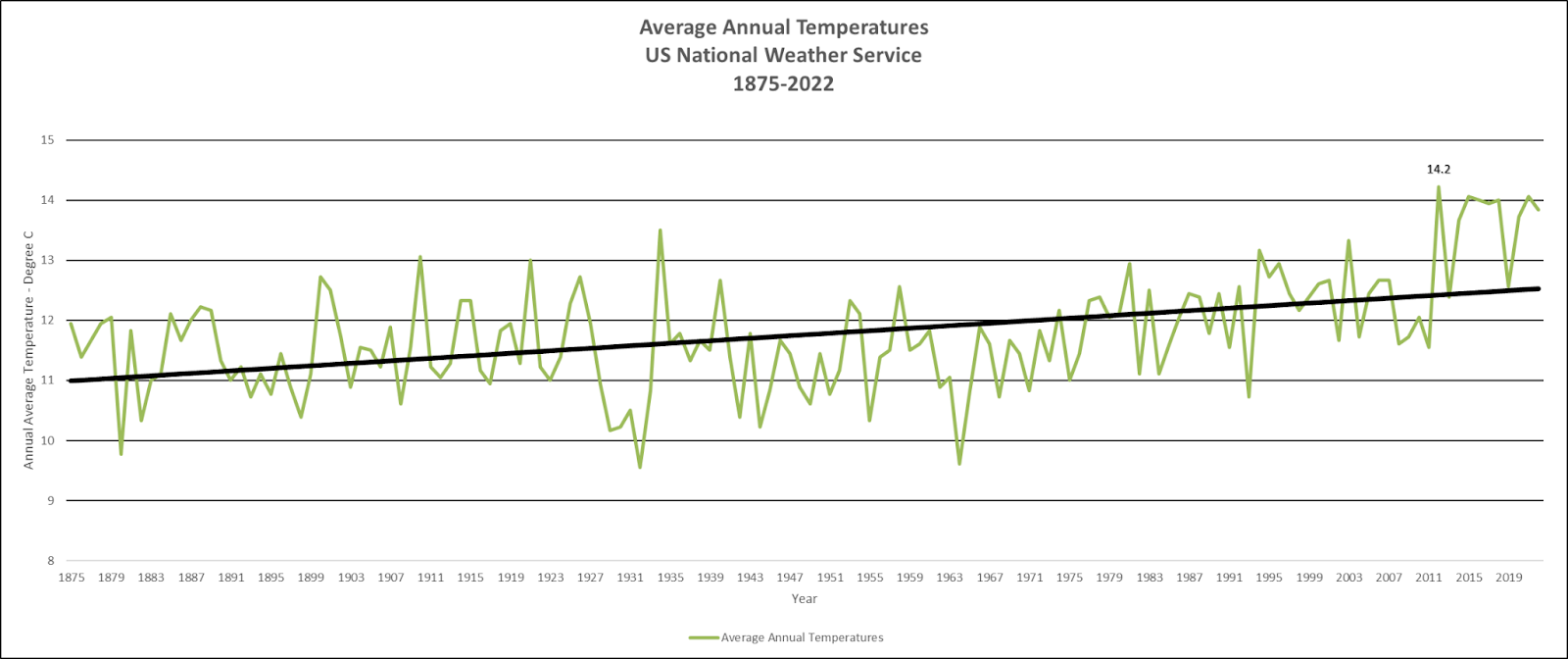
“Nope, Earth Isn’t Cooling”, says the Nasa Science Editorial Team. Between 1875 and 2022, average annual temperatures have trended upwards by over 1 degree Celsius in the US. The earth’s oceans, lands, and atmosphere are all warming but at different rates.
There are periods of fluctuation but the trendline shows that temperatures are increasing. If we zoom into small cherry-picked segments of the last 150 years, there are some years that show cooling. It is misleading to extrapolate from a very small set of data points. False conclusions will result.
Let’s stand back and look at the very big picture. Over most of the last 250 million years, the earth has been extremely hot – over 15°C warmer than the global average. However, modern humans did not exist then. In the last 10,000 years, humans have lived in an interglacial period of relatively low temperatures and climate stability called the Holocene. During this stable period, humans have flourished, developing agriculture and modern living standards. With CO2 emissions driving global climate change and warmer average temperatures, humans are altering these favourable conditions rapidly, according to the National Oceanic and Atmospheric Administration (NOAA).
Periodic or temporary events create road bumps but the trend is that global temperatures continue to rise. Sometimes we see short term or periodic temperature variations like El Niño and La Nina. Sometimes temperatures are temporarily impacted by volcanoes, aerosols, wildfire smoke, or sunspots. Regardless of all these short term variations, average global temperatures have continued to rise. Eight of the 10 warmest years since 2010 have happened between 2015 and 2023.
The City of Ottawa identifies 40 priority risks related to higher temperatures and increased precipitation. Planners and staff are creating a comprehensive plan to manage emergency situations and try to keep vulnerable people safe throughout the city. The way the city operates must change to mitigate greenhouse gasses and adapt to impacts like hotter summers, more extreme events, and wetter fall, winter and spring seasons.
For more information (Can have different lengths of responses; Freedom to choose length and depth of detail; Important!):
Nope, Earth Isn't Cooling.. NASA’s graphs are excellent at showing the brief instances of cooling amongst the long arch of the last 150 years or so of warming.
Climate Resiliency. City of Ottawa. Looking at four key pillars of climate impacts; temperature, seasons, precipitation, and extreme events, this report outlines what changes are likely to take place in Ottawa and how the City is planning to deal with this.
Global cooling - Is global warming still happening? A large spike in temperatures in 1998, due in part to El Nina, was followed by a bounce back over the next few years. If you zoom into this period, it might “seem” like temperatures had peaked and started to decline rapidly but it was just a small anomaly on the path to increasing temperatures over the subsequent 25 years.
Did global warming stop in 1998? No. You can get the wrong idea not only by cherry picking a specific timeframe, but that can be compounded by choosing too selective a location. Excluding parts of the globe, like the arctic where temperatures are increasing rapidly, can make the problem seem less problematic.
1998 was a hot year, at the time. Compared to today’s average temperatures, it doesn’t register in the top warmest years anymore. Following 1998, there were a few years of lower temperatures. Zooming into that brief period and cherry-picking a small window did lead to the incorrect assertion that climate change was over.
Periods of hot temperatures have existed when humans did not exist. Read about some of the hottest historical time periods and the likelihood that humans will do well in warming conditions.
Published September 2024
-------------------- Volunteer Powered The CAFES Climate Misinformation Team created this backgrounder. We hope it is a meaningful contribution to help you respond to misinformation and prevent delays in climate action in the City of Ottawa.
Natural gas exports will almost certainly increase global greenhouse gas emissions.
Use this brief to respond to the following climate misinformation:
Canadian liquefied natural gas (LNG) exports will reduce global emissions
LNG reduces emissions significantly compared to coal
Photo Credit: Andrew DumbrillePhoto Credit: Andrew Dumbrille
The oil and gas industry is fighting to extend its life. Global demand for fossil fuels is expected to start falling soon [1] for many reasons, including worsening economic viability, and efforts to reduce greenhouse gas pollution while improving affordability and energy security [2]. The oil and gas industry is fighting this trend with clever marketing, promoting claims that its operations, liquefied natural gas (LNG) exports in particular, are good for society and compatible with reduced emissions.
“Natural gas” is methane gas, a fossil fuel. Oil and coal are widely understood to be fossil fuels, but natural gas is one too (despite its benign-sounding name). Natural gas is primarily methane; a more accurate name would be “methane gas” or “fossil gas”. [3]
Methane is a much more potent greenhouse gas than carbon dioxide (CO2). Although it doesn’t stay in the atmosphere for centuries like CO2, a tonne of methane has over 80 times as much heat-trapping effect as a tonne of CO2 over 20 years, and about 30 times as much over even 100 years. In addition to the methane gas that is burned, methane leaks create even more pollution; studies show that leaks have been under-reported. [4]
Liquefied natural gas (LNG) is even worse. Natural gas becomes even more polluting when it is liquefied, due to the massive amount of additional energy needed to cool it (to -162 °C!) and transport it long distances, and the additional leakage at each step. [5][6]
Canadian LNG is not “clean”. Canada’s LNG exports, particularly from BC, are estimated to have an emissions intensity below the global average for LNG. That’s due to the shorter shipping distance to Asia, the colder climate (reducing the amount of energy to liquefy gas), and, most importantly, the use of low-emissions grid electricity (mostly from hydropower) for liquefaction. But the amount of clean energy needed to electrify these facilities would be huge, and would compete with the electrification of other parts of the economy, such as transportation and the heating of buildings. [8][15] And, of course, the pollution from burning the exported gas would be just as high.
Total emissions from LNG may be as high as those from coal. The gas industry claims that LNG exports can reduce global emissions, because LNG is much less polluting than coal. Although natural gas produces only half as much CO2 per unit of energy as coal when it is burned, a comparison of lifecycle emissions tells a different story. Methane leaks during the extraction, processing, and transportation of natural gas, plus the massive amount of energy needed to liquefy and transport the gas, can result in a carbon footprint even higher than that of coal. [6][7][16]
LNG exports may not reduce coal use. Even if it could be shown that LNG results in lower emissions than coal, it is difficult to prove that LNG exports replace coal. By supplanting investments in truly clean sources of energy, such as solar and wind, LNG projects are likely to increase emissions. [9][10]
The runway for “less worse” fossil fuels is very short. Assuming even the (implausible) best case scenario – that LNG is only half as polluting as coal and that it is used solely to replace coal – all fossil fuels must be virtually eliminated by 2050 (with significant progress towards that goal by 2030) in order to attain our climate targets, both domestic and global. [11][16] Meanwhile, other countries, particularly the US and Qatar, are rapidly expanding their LNG exports. For more information about why fossil fuel extraction is incompatible with our climate targets, see the backgrounder, “To meet our climate goals, we must rapidly phase out oil and gas.” (Coming soon)
Canada can’t get carbon credits for exporting “less worse” fossil fuels. Article 6 of the Paris Agreement allows a country to get emissions credits for lowering another country’s emissions. In theory, Canada could get credits for its LNG exports if it can be proven that the LNG reduces the use of coal (assuming that emissions from LNG are shown to be lower). But the importing country would need to grant the credits to Canada, instead of applying them to its own greenhouse gas inventory. It would have no incentive to do so; it is paying the market rate for gas, so why should Canada get the credits? [12]
A positive vision based on clean energy beats planning to fail. At a time when the world needs to aggressively phase out fossil fuels, Canada is building its first large-scale LNG export facilities, licensed to operate for decades. [14] Either the anticipated demand for Canadian LNG will be met, with the result that our exports reinforce the world’s dependence on fossil fuels, or Canada will be stuck with expensive stranded assets (due to reduced demand for LNG, and/or competition from other suppliers, such as the US and Qatar). [15] Instead of justifying the expansion of Canada’s oil and gas industry with dystopian scenarios – where the world fails to avoid catastrophic global heating, but Canadian fossil fuel exports somehow prevent an even worse outcome – let’s pursue a vision of clean, abundant energy for all, and make Canada a climate leader. [16]
Further Reading
World Energy Outlook 2024 – IEA “Clean energy momentum remains strong enough to bring a peak in demand for each of the fossil fuels by 2030 Demand for energy services is rising rapidly, led by emerging and developing economies, but the continued progress of transitions means that, by the end of the decade, the global economy can continue to grow without using additional amounts of oil, natural gas or coal.”
Canada’s methane leaks — underreported and overwhelming | Canada's National Observer “Recent studies using satellites reveal most nations, including Canada, have been significantly underreporting methane leaks from their oil and gas industries. [...] The most recent [...] covers methane emissions in the year 2019. [...] In both Canada and the United States, methane leaks were roughly 50 per cent higher than reported.”
Squaring the Circle: Reconciling LNG expansion with B.C.'s climate goals “Our modelling shows that a large portion of emissions reduction opportunities in the oil and gas sector comes from electrification of terminals and the upstream. As such, for B.C. to meet its 2030 oil and gas emissions reduction target, it will need to build significant new electricity generation to electrify LNG terminals and upstream natural gas production facilities. [...] Thus, the scale of proposed LNG development in B.C. presents a challenge for the province as it seeks to meet its climate targets and build new electricity infrastructure to do so. [...] Devoting large amounts of clean electricity to LNG could drive away investment in growing clean industries such as critical minerals mining and green hydrogen production. It could also impact available capacity for the electrification for other parts of B.C.’s economy such as transportation, and buildings.”
Will B.C. LNG exports reduce global carbon pollution? | Pembina Institute “Recent claims have asserted that LNG from the Pacific NorthWest LNG project in northern B.C. could displace 60 megatonnes (Mt) of carbon pollution. This figure is based on the unlikely assumption that the LNG would only displace coal. [...] In fact, the most likely scenario is that B.C. LNG will displace clean and renewable forms of electricity, resulting in a significant increase to global greenhouse gas emissions."
‘Unfettered’ Gas Exports Would Harm U.S. Economy, Energy Secretary Warns “The gas industry frequently claims that American exports of natural gas help the climate by displacing coal, which produces more carbon dioxide when burned. But Ms. Granholm noted that the study found increased L.N.G. exports would displace more wind, solar and other renewable energy than coal. The study modeled five scenarios and in every one, global greenhouse gases were projected to rise, even when researchers assumed aggressive use of technologies to capture and store carbon emissions.”
Global liquefied natural gas expansion exceeds demand for coal-to-gas switching in paris compliant pathways “[...] we find that long-term planned LNG expansion is not compatible with the Paris climate targets of 1.5 °C and 2 °C—here, the potential for emissions reductions from LNG through coal-to-gas switching is limited by the availability of coal-based generation. In a 3 °C scenario, high levels of coal-based generation through mid-century make LNG an attractive option to reduce emissions. Thus, expanding LNG infrastructure can be considered as insurance against the potential lack of global climate action to limit temperatures to 1.5 °C or 2 °C. In all scenarios analyzed, low upstream methane leakage and high coal-to-gas substitution are critical to realize near-term climate benefits.”
No, Canada cannot get credit for its low-carbon exports (climateinstitute.ca) “Countries know that reductions in their emissions have value. They won’t let others get credit for them for nothing. If the Canadian LNG comes at a reduced rate or with subsidized financing or capacity-building support, a buyer country might be willing to enter into an ITMO [internationally transferred mitigation outcome] negotiation. However, there’s little chance it would be willing to do so for a straight commercial transaction.”
Canadian liquified natural gas projects - Natural Resources Canada “LNG Canada, in Kitimat, BC, will be Canada’s first large-scale LNG export facility once complete, aiming for first exports by 2025. The majority of the other projects target beginning operations between 2027 and 2030.” If all the projects proposed and under construction are built, Canada would export over 50 million tonnes of LNG per year.
Why Liquefied Natural Gas Expansion in Canada Is Not Worth the Risk | International Institute for Sustainable Development “[...] plans to produce LNG in Canada carry excessive economic and environmental risks. Most prominently, Canadian LNG from most new facilities is at risk of entering the market during a global glut in supply, hampering the potential for export investments to be profitable and ultimately leaving investors at risk of losses from stranded assets. Meanwhile, excess LNG on the global market threatens to drive down prices and undercut the expansion of renewables abroad. Moreover, a Canadian LNG industry will come at the cost of increased domestic emissions that threaten to undermine Canada’s climate obligations.”
-------------------- Volunteer Powered The CAFES Climate Misinformation Team created this backgrounder. We hope it is a meaningful contribution to help you respond to misinformation and prevent delays in climate action in the City of Ottawa.
To meet our climate goals, we must rapidly phase out oil and gas
Use this brief to respond to the following climate misinformation:
Canada can expand its oil and gas production while meeting its domestic climate targets
Canadian oil and gas exports are compatible with international climate targets
Canada has climate targets. Canada has committed to reduce its greenhouse gas emissions by 40-45% from 2005 levels by 2030, and to reach net zero by 2050. [1] “Net zero” means that any emissions are balanced by the removal of CO2 from the atmosphere. Practically speaking, net zero means that emissions are virtually eliminated.
Global targets matter most. Global heating is a global problem. This chart is taken from the latest Production Gap Report [10] (p. 3). It shows that the world must act to reduce fossil fuel production and close the gap between where we are now and where we need to be to limit the effects of climate change. This isn’t an excuse to downplay Canada’s role, however; Canada is among the world’s top greenhouse gas emitters (for both total and – especially – per capita emissions).[2][3] And that’s excluding emissions from the burning of oil and gas that Canada exports to other countries.
Fossil fuels account for the vast majority of our emissions. In 2023, 81% of Canada’s emissions were from the production and burning of fossil fuels. (The remainder were from agriculture, industrial processes, and waste.) [5] Fossil fuel use is also the primary source of emissions worldwide (about 75%). [6]
Carbon capture cannot be scaled quickly enough to allow “business as usual”. The oil and gas industry has promoted carbon capture as a silver bullet that will allow increasing amounts of oil and gas to be extracted and used while still meeting our emissions targets. These technologies either capture CO2 from industrial sources before it enters the atmosphere or remove CO2 already in the air. Although they will be important tools, they are far too expensive and difficult to scale to compensate for emissions from current levels of fossil fuel production and use. [7][8] (Also, they capture only CO2, and do nothing to remove other pollutants that directly affect human health. Over 15,000 Canadians die prematurely from air pollution every year. [11])
Therefore, Canada’s oil and gas industry is incompatible with global climate targets. The only way to halt global heating is to virtually eliminate fossil fuels, regardless of which country produces them. Even if it were possible for Canada to meet its own climate targets while exporting vast amounts of oil and gas, the burning of those exports would contribute to catastrophic climate change. Studies show that developing any new oil and gas fields would be incompatible with the Paris Agreement target (unless existing fields were retired early, which would be economically and politically difficult). [9][10]
Canada’s oil is not “ethical” from a climate perspective. The oil and gas industry has claimed that Canadian oil is more ethical and better for the environment due to Canada’s high standards. But oil sands crude is one of the world’s dirtiest sources of oil, and oil in general is the dirtiest source of energy after coal. [12][13]
Nor is liquefied natural gas (LNG). The claim that Canada can get carbon credits from LNG exports that displace the use of even more polluting coal in Asian countries is based on fallacies. For more information, see the backgrounder, “FALSE: Canadian natural gas exports will reduce global emissions.”
Canada’s oil and gas sector is the largest contributor to our domestic emissions. 30% of our emissions were from oil and gas production in 2023 – that’s 208 out of 694 Mt (megatonnes) of CO2 equivalent (CO2e) emissions. Again, this does not include the pollution from burning its products! While some sectors have reduced their emissions (especially electricity generation), the oil and gas sector has increased its emissions by 7% from 2005 to 2023 (77% since 1990!). [4][5] According to an early estimate, its emissions increased even further in 2024, to 212 Mt. [14] That’s almost half of our 2030 target of 443 Mt, for total emissions across all sectors (including transportation, buildings, electricity, heavy industry, agriculture, and waste)! The oil and gas industry must do its share to reduce emissions.
Projections of how Canada could meet its 2030 targets while growing its oil and gas industry have already been violated. Our 2030 target depends on rapidly reducing our domestic emissions each year. Instead, emissions flatlined in 2024, only 8.5% below 2005 levels. The oil and gas sector was the worst culprit, as the oilsands contributed an extra 3 Mt, offsetting reductions elsewhere. (The electricity sector continues to decarbonize, but no longer contributes enough to our emissions to move the needle by much.) [14]The projections in Canada’s 2030 Emissions Reduction Plan (ERP) [15] have proven to be overly optimistic. The oil and gas sector, instead of being on track to reduce its emissions by 31% from 2005 levels, has been increasing its emissions; the gap, for example, between the ERP’s projection of 173 Mt for the sector in 2024 and its actual emissions of 212 Mt is huge.
In order to get back on track and meet our domestic climate targets, we need to phase out fossil fuels. There is no silver bullet that can reverse our current trajectory while allowing the oil and gas industry to maintain, let alone expand, its current operations. Canada’s carbon capture and storage (CCS) capacity has been growing more slowly than predicted, yet projections assume that it will expand from 4.4 Mt to 16.3 Mt by 2030 [16]. Canada may have far fewer places to securely store CO2 underground than previously thought [17], making CCS projections even more difficult to turn into reality. Furthermore, as we expand our oil and gas production beyond what was projected in the ERP (which did not anticipate LNG exports), an even more improbable amount of CCS will be required to meet our targets.
“The Canadian Net-Zero Emissions Accountability Act, which became law in June 2021, enshrines in legislation Canada’s commitment to achieve net-zero emissions by 2050. [...] Building on the actions in Canada’s strengthened climate plan and the Pan-Canadian Framework , the 2030 Emissions Reduction Plan reflects input from provinces, territories, Indigenous Peoples, the Net-Zero Advisory Body, and interested Canadians on what is needed to reach its Paris Agreement target to reduce emissions by 40-45 per cent from 2005 levels by 2030.”
“Japan on 2.7% and Canada, with 2.6%, close out the top 10 largest contributors to historical emissions. [...] US, Russia, Germany, the UK, Japan and Canada, account for 10% of the world’s population, but 39% of cumulative emissions. This is reflected in the weighting by current populations where Canada ranks in [...] first place [...]”
In 2023, the oil and gas sector and transport sector were the largest GHG emitters in Canada, accounting for 30% and 23% of total emissions, respectively
[...]
From 1990 to 2023:
an increase in emissions was observed for the oil and gas (+77%), transport (+33%), buildings (+15%) and agriculture sectors (+37%)
a decrease in emissions was observed for the electricity (-48%), heavy industry (-19%) and "waste and others" (-13%) sectors
In 2023, Canada’s greenhouse gas (GHG) emissions were 694 megatonnes of carbon dioxide equivalent (Mt CO2 eq), a decrease of 65 Mt (8.5%) from 2005 (excluding the Land Use, Land-Use Change and Forestry sector), and a decrease of 6.0 Mt (0.9%) from 2022
Emissions from electricity decreased by 67 Mt (-58%) over this period driven by the phase-out of coal-fired electricity generation. Oil and gas emissions increased by 13 Mt (7%), although emissions peaked in 2014 at 228 Mt and have since decreased by 20 Mt (-9%) to 208 Mt in 2023, consistent with measured decreases of fugitive methane sources in recent years
[...]
ES.3. Overview of National GHG Emissions (1990–2023)
[...]
The Energy sector (consisting of Stationary Combustion Sources, Transport and Fugitive Sources) emitted the largest share (81%) of Canada’s total GHG emissions (Figure ES–1). The remaining emissions were generated by the Agriculture and IPPU [Industrial Processes and Product Use] sectors, with contributions from the Waste sector.
“The energy sector produces the most greenhouse gas emissions by far, accounting for a whopping 75.7% worldwide.
The energy sector includes emissions from electricity and heat (29.7% of all emissions), transportation (13.7%), manufacturing and construction (12.7%) and buildings (6.6%).
It also includes fugitive emissions (greenhouse gases released during fossil fuel production or transmission) and emissions from other fuel combustion.”
“Carbon capture, utilisation and storage is an essential technology for achieving net zero emissions in certain sectors and circumstances, but it is not a way to retain the status quo. If oil and natural gas consumption were to evolve as projected under today’s policy settings, this would require an inconceivable 32 billion tonnes of carbon captured for utilisation or storage by 2050, including 23 billion tonnes via direct air capture to limit the temperature rise to 1.5 °C. The necessary carbon capture technologies would require 26 000 terawatt hours of electricity generation to operate in 2050, which is more than global electricity demand in 2022. And it would require over USD 3.5 trillion in annual investments all the way from today through to mid-century, which is an amount equal to the entire industry’s annual average revenue in recent years.”
“[...] a team of researchers in the MIT Energy Initiative (MITEI) examined those strategies [by countries who signed the Paris Agreement], and what they found was alarming: The strategies rely on overly optimistic — indeed, unrealistic — assumptions about how much CO2 could be removed by DAC [Direct Air Capture]. As a result, the strategies won’t perform as predicted.”
“The findings, from the International Institute for Sustainable Development (IISD), are based on a comprehensive review of all ‘feasible’ routes to staying below 1.5C.
They echo – and, therefore, strengthen – the conclusions of the International Energy Agency (IEA), which has said there are ‘no new oil and gas fields approved for development in our [1.5C] pathway’.”
“Governments, in aggregate, still plan to produce far more fossil fuels than would be consistent with limiting global warming to between 1.5ºC and 2ºC. [...] Analysis in the 2023 PGR [link added] indicated that countries should aim [due to the “risks and uncertainties of carbon capture and storage and carbon dioxide removal”] for a near total phase-out of coal production and use by 2040 and a combined reduction in oil and gas production and use by three-quarters by 2050 from 2020 levels, at a minimum. Growing evidence supports both the necessity and feasibility of such deep reductions.”
“Health Canada estimates that above-background air pollution, including air pollution from human sources in North America, contributes to 15,300 premature deaths per year in Canada. This includes an estimated 6,600 premature deaths in Ontario, 4,000 in Quebec, 1,900 in British Columbia and 1,400 in Alberta. National morbidity or nonfatal health outcomes include 2.7 million asthma symptom days and 35 million acute respiratory symptom days per year, with the total economic cost of all health impacts attributable to air pollution for the year being $120 billion (2016 CAD). This is equivalent to approximately 6% of Canada’s 2016 real gross domestic product.”
“After 50 years of production, the oilsands remain among the world’s most carbon intensive large-scale crude oil operations. Studies continue to back this up.”
“[...] Canada is on track to reduce emissions just 20 to 25 per cent below 2005 levels by 2030—putting the legislated target effectively out of reach.
[...]
Increased emissions from oil and gas, particularly oilsands production, leads the momentum shift, while emissions reductions from other large sectors (transport, buildings, and industry) are stagnating or slowing. Canada’s electricity sector—which has seen sustained progress over many years—can’t counteract rising emissions from other sectors, given its declining share of national emissions.”
“Modelling of the most economically efficient pathway to meeting Canada’s 2030 target projects that the oil and gas sector would make a significant contribution (see Chapter 3). Drawing on that analysis, Canada’s oil and gas sector emissions would decline by about 31% from 2005 levels to reach 110 Mt in 2030. This projected sectoral contribution represents about a 42% reduction from current levels, because overall emissions from the sector have been rising rather than falling.”
“Canada’s capture capacity is projected to grow from the current 4.4 Mt of CO2 mitigation per year to 16.3 Mt of CO2 per year by 2030, with significant further scaling required to help reach net zero by 2050.”
“We find that the initial global physical storage potential of 11,800 GtCO2 is reduced by about an order of magnitude [...] Other regions see large decreases in available storage affecting a significant portion of their total storage potential, with India, Norway, Canada and countries within the European Union experiencing the largest impact.”
Published November 2025 -------------------- Volunteer Powered The CAFES Climate Misinformation Team created this backgrounder. We hope it is a meaningful contribution to help you respond to misinformation and prevent delays in climate action in the City of Ottawa.
Economy
Implementing the Climate Change Master Plan is an investment that pays off for the City and all residents of Ottawa.
Use this brief to respond to the following climate misinformation:
Implementing Ottawa’s Climate Change Master Plan will cause financial ruin
To prevent financial ruin the City should limit climate action to corporate activities
Energy Evolution, Ottawa’s Community Energy Transition Strategy, will cost $32 billion and it will bankrupt us
Speaking Points:
What is the Climate Change Master Plan (CCMP)? The CCMP is the City of Ottawa’s framework for climate change mitigation and adaptation in response to the climate emergency declared in 2019. It aims to make Ottawa a clean, sustainable, and healthy city. The CCMP includes actions to transition to renewable energy, reduce dependence on fossil fuels, protect infrastructure, and build climate resilience.
Breaking down the costs:
The following table from Energy Evolution shows the costs and savings of climate action. The net financial benefit is projected to begin in 2032 and achieve a net return of $12.4 billion (present value) by 2050.
Will the CCMP really cost the city of Ottawa $32 billion? You may have heard the number $32 billion (or $57 billion undiscounted) thrown around, along with the idea that this spending will bankrupt the City. Firstly, the $32 billion will be invested over the course of 30 years in climate change mitigation and resiliency. Furthermore, these are not just investments by City Hall; they include spending by businesses, landlords, households, utilities, etc. across Ottawa. The plan only requires City Hall itself to spend $7.5 billion over the next 30 years. Further, this amount does not include cost-sharing for transit that would come from other levels of government.
How will this investment affect the taxpayer? Such a small percentage of the budget is allocated to climate related projects that the CCMP won't add significantly to taxes. The City of Ottawa 2024 Budget of $5.8 billion (Total of Operating of $4.6 billion and Capital of $1.24 billion on pages 1 and 9) allocated $278 million (page 34) to climate-related projects. In 2025, the proposed climate related expenditure of $375 million(page 34) is 5.6% of the overall budget of $6.66 billion (Total of Operating of $5 billion and Capital of $1.6 billion on pages 5 and 19). Additionally, the City has a CCMP Capital Fund of $6 million in 2025. These amounts were determined by applying a climate lens to the budget process, so that expenditures that would be made anyway are done with a climate-aware focus. For example, the $375 million includes $306 million for the purchase of new zero emission buses. In addition to the new buses, these monies are spent on projects (page 46) such as:
Replacing vehicles and equipment with low-emission vehicles
Implementing energy conservation measures in City facilities
Reducing GHG from solid waste
Creating bike parking facilities
Improving flow management and reducing flood risk
Assessing and rehabilitating creeks and rivers
Designing streetscaping to provide more shade and better manage rainfall
It is true that eliminating the City of Ottawa’s greenhouse gas emissions will make a very small difference to total worldwide emissions. We nonetheless should support the CCMP because
it contains a number of adaptation and resiliency measures that will protect people and property from the effects of climate change
as the capital city of a western nation, we should do our proportionate share and show leadership in developing mitigation measures to reduce our greenhouse gas emissions
many of the mitigation measures, such as replacing all streetlights with LED lights, save us money, and, in the longer term, overall, the measures in the CCMP will save money (see below)
Climate disasters are costly: If the price tag of climate action still looks daunting, consider the costs of climate damage.The financial burden of flooding, heat waves and other extreme weather events linked to climate change is already impacting Canadians. For example, the storms and flash flooding that hit Ontario in summer 2023, including the tornado that touched Barrhaven, cost over $340 million in insured losses. The increasing frequency of such weather disasters drives up the cost of insurance. About 10% of Canadian homes are located in areas with a high flood risk. The vast majority are uninsured for flood damage, because either the premiums are unaffordable or flood insurance is not available at all.
Property losses reflect only part of the damage caused by extreme weather. Among other impacts, a decrease in the labour market can be expected due to weather-related risks to the outdoor labour force, such as extreme heat, poor air quality, and disease carrying insects. The World Economic Forum estimates that job losses worldwide due to heat stress will reach 800,000 by 2030.
Healthcare systems are also under increasing strain. As climate change impacts air quality, heat exposure, and the spread of vector-borne diseases, more Canadians are ending up in emergency rooms. The Canadian Medical Association (CMA) has identified climate change as a health care crisis. The CMA estimates that ozone exposure alone (caused by extreme heat) will cost the Canadian health care system $246 billion annually by the end of the century.
CCMP is a long term investment that will save money for the City of Ottawa and improve the lives of its residents.
Energy Evolution estimates savings of over $44 billion by 2050, $12.4 billion more than the $32 billion investment (See Table 9 above). The costs of delaying climate action are growing rapidly, and the more we invest into climate action now, the more we save later.
A Climate Plan That Would Net Us $12 Billion Neil Saravanamuttoo breaks down the costs of the CCMP and explains the plan for a $32 billion investment paid collectively over the span of 30 years.
Ottawa’s Budget 2024: New Year, Same Outdated Perspective on Climate Change This article by Ecology Ottawa gives an overview of the City of Ottawa’s budget and allocation to climate change. “As this Council's first term concludes, its unwillingness to acknowledge and act on the intricate links between climate change and municipal priorities like affordable housing, mobility, resilience and a strong economy grows evident. Council consistently places environmental concerns on the back burner.”
As weather-related disasters mount, some Canadian homeowners can't get insurance coverage “In total, insured losses from extreme weather events exceeded $3 billion in Canada for the second straight year. This report underscores concerns about the growing economic cost of weather-related disasters made more frequent and severe by climate change — and the rising cost of insurance coverage for homeowners.”
Severe Storms in Ontario Cause Over $340 in Insured Damage “Severe storms and flash floods that hit parts of Ontario over the summer caused over $340 million in insured losses, according to initial estimates from Catastrophe Indices and Quantification Inc. (CatIQ). Over $80 million – or close to 25% – of these insured losses went toward replacing or repairing storm-damaged vehicles.”
A Pivotal Moment Report - Clean Energy Canada A report by Clean Energy Canada on the trajectory of the clean energy sector in Canada. Includes modeling about GDP and job creation/loss if Canada reaches net-zero by 2050. Released in March 2023. Key takeaways: “Canada will see 700,000 more energy jobs in 2050 than exist today if Canada (and the world) reaches net zero, with growth in clean energy jobs outpacing the decline in fossil fuels. While there will be a 1.5-million job decline in fossil fuels in a net-zero 2050, this is far exceeded by the 2.2-million job increase in clean energy as employment in the sector grows 7% a year out to 2050”.
The health costs of climate change: How Canada can adapt, prepare, and save lives. Report from the Canadian Climate Institute about the impacts of climate change on human health and the costs to Canada’s healthcare system, as well as reduced economic activity. This includes impacts from heat-related illness and death, heat-related losses in productivity, low air quality, and impacts to mental health. Released in June 2021.
Published September 2025
-------------------- Volunteer Powered The CAFES Climate Misinformation Team created this backgrounder. We hope it is a meaningful contribution to help you respond to misinformation and prevent delays in climate action in the City of Ottawa.
Renewable Energy and Batteries
Eliminating fossil fuel pollution from our electricity supply while maintaining grid reliability: we’ve done it before and can do it again!
Use this brief to respond to climate misinformation, such as:
Transitioning to renewable energy and electrification will lead to a much greater risk of grid failure
We phased out electricity generated from fossil fuels and increased our reliance on renewables before. We can trust them to do it again. In 2003, coal-fired electricity made up 25% of our energy supply in Ontario. By 2014, we had eliminated coal as a source of electricity. During this transition, energy supply from solar and wind power increased from 0% to 7%. “The elimination of coal stands as the single largest greenhouse gas (GHG) emissions reduction action on the continent and was primarily responsible for Ontario achieving its 2014 emissions reduction target of 6% below 1990 levels” (The End of Coal).
Coal was phased out because we came together and spoke up for the change we wanted to see! Individuals and organizations made the phase-out of coal-fired electricity generation a key election issue in 2003. “The precedent set by what has become the ‘single largest greenhouse gas reduction measure in North America’ should not be underestimated. Ontario’s success is a critical example that can inspire political will and public engagement in other parts of the world. The organizations and individuals who have made Ontario coal-free deserve every credit for demonstrating that the end of coal is feasible” (IISD Report). This example proves that when we speak up, we can effect change.
Our grid is reliable with 38% of our electricity generated from renewable sources. In 2024, 38% of our electricity was generated from wind, water, sun and biofuels (Supply Mix and Generation).The IESO states that electricity demand is expected to increase by 2% annually over the next 20 years (IESO, 2023). A growing economy, population growth, and electrification are causing the increase in demand. Renewable energy allows us to meet this demand and achieve our climate goals.
The IESO ensures a reliable electricity supply for us by managing the electrical grid 24/7 and 365 days of the year. The IESO is a non-profit corporation whose duties include procuring Ontario’s electricity supply and long-term planning for the electricity system. The IESO is also responsible for complying with, overseeing and enforcing the standards that maintain grid reliability in Ontario. For example, in 2021 we benefited from having electricity 99.987% of the time in Ottawa (Future-proofing the electricity grid).
Currently, we cannot store electricity, so if an excess is produced, it goes to waste. Second, by second, the electricity generated must match demand to maintain our electrical grid. So, when excess electricity is produced, the province must send it somewhere. “The province has continued to export surplus hydroelectric, wind, solar, and nuclear-generated electricity to adjoining power grids in neighbouring jurisdictions from 2014 to 2020 at prices much lower than the total cost of production” (Ontario Continues Wasting Clean Electricity for 7th Consecutive Year: Engineers). In Ontario, the amount of “wasted” electricity was enough to power 375,000 homes in 2014 and 780,000 homes in 2020. With BESS, we can store this electricity for when we need it!
Grid-Scale Battery Energy Storage Systems (BESS) will store the electricity from renewables for when we need it. The IESO is procuring battery storage to maintain our grid reliability as we increase our reliance on renewable sources. Some 1,300 megawatts of storage – both Ontario-wide storage and smaller storage installations that serve local communities – are expected to come online as early as 2026 to add reliability during peak demand hours (IESO, 2023). In addition to offsetting resource variability and intermittency, BESS technology is able to provide electrical reliability services (ERS) such as frequency response, ramping and voltage support. (Energy Storage, 2021 North American Electric Reliability Corporation).
For Further Reading
Regulatory Reliability Oversight The IESO provides more information on its role and the requirements it meets to maintain a reliable electricity grid in the province of Ontario.
Managing the Power System Click here for the IESO mandate and how they ensure reliability. This site shows the many factors that must be considered for this complex system. “Deciding what electricity resources to use, and when, depends on many factors: Current electricity demand, the location of generators in relation to where electricity is needed, the maximum amount of energy our transmission lines can carry, power plant maintenance schedules, the cost to produce electricity.”
IESO's LT2 Backgrounder: December 2023 This report provides more information about how our grid will change and how renewables will be integrated more fully into our supply mix.
Ontario’s electricity system moves forward with largest energy storage procurement ever in Canada “After years of stable supply, Ontario’s electricity system is in the early stages of a dramatic transformation to support decarbonization and economic growth. Electricity demand in Ontario is set to increase significantly in the next two decades as the economy grows and many fossil fuel-dependent processes switch to electricity. The IESO [Independent Electricity System Operator] forecasts electricity demand to increase two percent annually over the next 20 years.”
Skepticism persists around clean energy and grid reliability. Here’s how to fix that. Utility Dive This article is an excellent read for understanding the complexities of grid management. Experts explain how renewables, with storage, can provide the needed Energy Reliability Services (ERS). It describes how “...every machine, technology, and software supplying electricity makes different contributions to grid reliability. Not every resource must provide all types of reliability services, but the entire pie (or portfolio) must be able to respond appropriately to bring the grid back to balance.”
Three myths about renewable energy and the grid, debunked Opinion piece from Yale School of the Environment, E360, “It is entirely possible to sustain a reliable electricity system based on renewable energy sources plus a combination of other means, including improved methods of energy management and storage. A clearer understanding of how to dependably manage electricity supply is vital because climate threats require a rapid shift to renewable sources like solar and wind power. Plummeting costs have sped this transition —Bloomberg New Energy Finance estimates that solar and wind are the cheapest source for 91 percent of the world’s electricity — but is being held back by misinformation and myths.”
Doing business The Word Bank keeps data on grid reliability globally. You can look up the SAIDI values, a grid reliability measure per country. You can also lookup values for countries or states with high percentages of renewable sources.
EIA Reliability Metrics video This video resource by the U.S. Energy Information Administration (EIA) demonstrates the SAIDI measurement and how it measures grid reliability.
Adapting the energy sector to climate change Ahmad, A. (2021). Increase in frequency of nuclear power outages due to changing climate. Nature Energy, 6(7), 755–762. doi:10.1038/s41560-021-00849-y This paper discusses the energy sector's need to adapt to a changing climate. It states “that all sources of energy are projected to have some reliability concerns in the face of extreme weather events.” However, “Under the most ambitious mitigation scenario of the International Energy Agency (Sustainable Development Scenario), renewable sources will provide the bulk of global electricity in 2040 (66%). The proportions will change drastically: the share of hydropower grows only modestly to 19%; wind energy increases sevenfold to 21%; solar photovoltaic energy provides 17% and other renewables contribute 8% to the world’s power generation. This immense output growth will require large increases in generation capacities and, thus massive investments in site exploration, design and construction. Similarly to other investments, these capacity expansions will need to consider changing climatic conditions and weather patterns to avoid technical failures and economic losses.”
Wind turbines: The bigger, the better The United States Department of Energy looks at what’s driving the height and blade length increases of wind turbines. “Turbine towers are becoming taller to capture more energy, since winds generally increase as altitudes increase.”
A Renewables Powerhouse - Clean Energy Canada “New research finds that wind and solar power with battery storage is set to produce cheaper electricity than natural gas in Alberta and Ontario.” International Renewable Energy Agency, Renewable Power Remains Cost Competitie Amid Fossil Fuel Crisis, | Press Release 2022.
-------------------- Volunteer Powered The CAFES Climate Misinformation Team created this backgrounder. We hope it is a meaningful contribution to help you respond to misinformation and prevent delays in climate action in the City of Ottawa.
The Fire Risk from Battery Energy Storage Systems (BESS) has decreased dramatically
Use this brief to address misinformation about the fire risk of BESS, such as:
BESS carries a high risk of fire, also called thermal runaway, which burns for days. For example, fires in battery storage systems in New York burned for three to four days.
If a fire occurs, it may release toxic gases into the air and water, and contaminate surface and groundwater.
If a fire burns for three or four days, it will overwhelm the capacity of volunteer firefighters in rural areas.
The orange line in this graph shows that the failure rate, or risk of fire, has decreased dramatically from 2018 to 2023! At the same time, the blue shade tells us that the amount of BESS installed worldwide has grown exponentially since 2020, but the number of failures shown in the bar chart has remained almost the same. Furthermore, some of these failures occurred during testing, but all failures are thoroughly investigated and with each investigation more is learned about how to reduce the risk in the future. In other words, this graph is a good news story, illustrating how millions of people around the world are working together to make this technology safe for our communities. (Executive summary – World Energy Employment 2023 – Analysis - IEA ).
What happened with the Moss Landing Fire, California on January 16, 2025? The facility used nickel-manganese-cobalt (NMC) batteries, a high-energy-density chemistry often employed in early storage projects but known for its susceptibility to thermal runaway. Manufactured by LG, these batteries have been linked to other prominent incidents, including the 2019 Arizona explosion, the Gateway project fire in 2024, and a $2 billion Chevrolet Bolt battery recall.
However, the industry has since shifted toward safer lithium iron phosphate (LFP) batteries, which are less prone to overheating and generally more stable. BBA Engineering Consulting, a Canadian firm with over 40 years of experience as an independent, third-party expert concluded that the risk of thermal runaway (the chemical reaction which leads to potential fire) [for LFP batteries] is “extremely low.” In the safety records of four BESS vendors, there were no incidents of thermal runaway in BESS using the latest technology (Energy Storage Canada, 2023). In a fire involving LFP batteries (Tesla project fire 2022), the fire was quickly contained to a single container without spreading, demonstrating the improved safety measures in modern designs and battery chemistry.
When dealing with any form of technology, there are always potential risks. For example, hydroelectric dams pose potential risks to our communities, but it is now familiar and we do not often think about these risks in our daily lives. Nonetheless, the potential risk still exists and occasionally, accidents can happen. For example, two people were killed on the Madawaska River near Calabogie, Ontario, in 2002 due to an unexpected release of water from the hydroelectric dam upstream. We responded by learning from the incident and increasing safety measures. We did not stop using the technology.
Similar to any facility with a fire risk, there are layers of protection. Standards must be met through design and ongoing operations. Furthermore, regulations and safety standards are addressed during the review and approval processes, and response plans are developed for each facility. It is similar to the process used in BESS technology.
The risk of water contamination from extinguishing a BESS fire is considered to be minimal. A legitimate concern in rural areas where communities rely on ground sources for drinking water is that firefighting water could interact with the battery components and the runoff could contaminate surface or groundwater. While this is true for house fires, when considering a BESS fire, the response will vary depending on the specific technology. According to the City of Ottawa: “The risk of groundwater contamination from firefighting water runoff during a BESS fire is estimated to be minimal. Most contaminants will burn off, with safety monitored throughout the event, and appropriate actions taken to protect the public if necessary. As with similar incidents involving the risk of contaminated liquids reaching the soil, the situation will be evaluated, and a cleanup service will be secured if needed. These considerations will also be factored into the site plan approval process, with a focus on prevention and mitigation strategies to further minimize environmental risks.” (Battery Energy Storage Systems (BESS) Frequently Asked Questions (FAQ’s) on Fire Safety). Increasingly, the strategy is to allow a fire in an individual battery enclosure to burn out in a controlled manner (ACP–What is the risk of fire?), while preventing the spread. Water may be required for cooling, smoke control, or preventing fire spread. Safety features include fluid collection systems, to prevent contamination of groundwater. Further, batteries in sealed units have minimal leachate risk. (Dunsky–Fire Safety) While we want to keep our communities safe, we mustn't jump to conclusions..
It is unlikely that there will be toxic gases released if there is a BESS fire. The industry is aware of concerns about toxic fumes. The industry response has been to adopt standards with detailed requirements for system design, configuration, construction, performance and monitoring. Energy Storage Canada studied this risk in the context of BESS. Its report, "Battery Energy Storage: Thermal Runaway and Fire Risk, covered a unit level test that measured for the toxic components of fume release. It states that ”BBA has reviewed the UL 9540A test results for two (2) of the industry leading BESS vendors who both use lithium-iron-phosphate (LFP) cells and in each of those cases, none of those gases were present at a significant level in the measurements. This implies that those toxic fumes are likely not a significant concern based on these examples of actual measured concentrations."
All BESS proponents in Ontario are required to provide a self-certification of the process outlined in Hydro One’s BESS Fire Protection Risk & Response Assessment Standard (FPRRAS). This document outlines the three main standards including:
NFPA 855: The National Fire Protection Association is an international non-profit organization that promotes safety standards, education, and training on fire and electrical-related hazards. NFPA 855 is the Standard for the Installation of Stationary Energy Storage Systems, which serves as a guideline for Canadian fire departments. The standard outlines processes for training, pre-incident planning, hazard mitigation analysis, testing, decommissioning, and post-incident handover procedures to energy storage system owners. Conditions set in NFPA 855 are required according to the Hydro One Standard - Section 5.0 Minimum Design Documentation, specifically in the Hazard Mitigation Analysis (which includes the Fault Condition Assessment). However, mandatory permitting and inspections are set by Hydro One Standard (not NFPA 855).
UL9540: is the North American safety standard for energy storage systems, which was developed by Underwriters Laboratories (UL). Both the American National Standards Institute (ANSI) and the Standards Council of Canada (SCC) have approved UL 9540. OESC mandates UL 9540 certification, so this would be regulated in the electrical safety code. Hydro One Standard also requires proof of compliance with UL 9540.
UL9540A: is a method for evaluating “thermal runaway” and sets out requirements for battery management systems (BMS) including battery safety, performance and communications protocols. This standard was developed to verify the effectiveness of protection levels against thermal runaway and fire hazards. The OESC mandates UL 9540A certification so this would be regulated in the electrical safety code. The Hydro One Standard also requires proof of compliance with UL 9540A.”
For Further Reading
Learn how Ontario’s Energy and Battery Storage Works (Independent Electricity Sector Operator) “Storage is unique among electricity types in that it can act as a form of both supply and demand, drawing energy from the grid during off-peak hours when demand is low and injecting that energy back into the grid when it is needed most. Storage is particularly useful in supporting the wide-scale integration of renewable resources, like wind and solar, because it can help smooth out changes in energy output caused by unpredictable weather.”
Battery Energy Storage: Thermal Runaway and Fire Risk (Energy Storage Canada) “As part of Energy Storage Canada’s effort to inform the public and relevant stakeholders about battery energy storage systems (BESS), our organization is pleased to provide this comprehensive report by an independent third-party, which explores the safeguards of this technology against potential hazards. Along with the report itself, we have also included an executive summary and in the appendices, a brief Q and A of its findings, including the critically important measures that BESS manufacturers use to meet industry standards and prevent potential hazards, as well as recommendations for any future BESS applications.”
City of Ottawa Battery Energy Storage Systems (BESS) FAQ This provides more information on how safety as well as other concerns would be addressed during the review and approval process for a facility proposed within the City of Ottawa.
Battery Energy Storage Systems (BESS) Presentation This presentation by the Electric Vehicle Council of Ottawa explains the risks and benefits of battery energy storage systems for the grid and energy consumers.
Moss Landing Fire reveals Flaws in the Battery Industry’s early Designs The January fire destroyed a building housing 300 MW of battery capacity. The facility relied on nickel-manganese-cobalt (NMC) batteries, known for their high energy density but higher vulnerability to thermal runaway. Built in a repurposed 1950s-era building, the facility's design densely packed battery racks into one large, enclosed space. This design increased the risk of fire propagation and made suppression more challenging. In contrast, newer systems use modular, containerized designs that isolate potential fires and make suppression easier. When Moss Landing was designed (pre-2020), robust battery safety codes were still in development. Today, safety codes like NFPA 855 and updates to the International Fire Code (IFC) require: Improved ventilation for explosive gases; enhanced fire suppression systems; stronger compartmentalization with fire barriers.
Published March 2025
-------------------- Volunteer Powered The CAFES Climate Misinformation Team created this backgrounder. We hope it is a meaningful contribution to help you respond to misinformation and prevent delays in climate action in the City of Ottawa.
All child labour and forced labour must be stopped! Justice must be a driving principle of climate action!
Use this brief to respond to concerns, such as:
Batteries in electric vehicles (EV) require minerals mined in countries with human rights abuses.
Child labour is used to mine cobalt and lithium used in EV batteries.
Speaking Notes:
We all agree with you, child labour and forced labour must be stopped! In Canada, The Fighting Against Forced Labour and Child Labour in Supply Chains Act came into force on January 1st, 2024. It requires companies to provide the federal government with an annual report containing information about the use of forced labour or child labour in its business and supply chains. The statute will prohibit these items from being imported into Canada. The United States also has legislation proposed to help prevent child labour in their supply chains.
During climate action, we must address human rights. This is called climate justice. This is a different way of thinking about climate action. It is more than reducing our greenhouse gas emissions, it is about working together to create a better future for everyone. Climate justice calls on us to think bigger. It calls on us to think of our efforts to protect our planet as a civil rights movement.
“The race to net zero cannot trample over the poor...The renewables revolution is happening, but we must make sure that it is done in a way that moves us towards justice” (Launching new initiative to protect key minerals for clean energy transition). In April 2024, the United Nations convened a diverse group of people to embed the principles of justice, fairness and sustainability into the entire process of sourcing and using critical minerals needed for the clean energy transition. People from governments, organisations and UN bodies are organized in the newly established Panel on Critical Energy Transition Minerals. Canada is a member of the panel.
The unfortunate reality is that forced labour exists in the supply chains of many products that we consume in Canada. “This type of exploitation in the workplace is happening in virtually every country in the world, including Canada, and stretches across ethnic, cultural and religious lines…Men, women and children may be forced to harvest crops and ingredients used in food products; extract raw materials such as minerals used in electronics; manufacture products such as textiles and clothing in factories; and deliver or ship goods. Both major and lesser-known brands can be involved” (Fighting against forced and child labour in supply chains)
It is the Federal government’s role to protect human rights in the global supply chain during the energy transition. The Federal government is responsible for matters of international trade. The City of Ottawa must do their part to accelerate the energy transition and help prevent the worst impacts of climate change.
There are ongoing efforts to explore alternative battery technologies, recycling technology or relocating where materials are sourced. In Canada, Canada’s new Critical Minerals Strategy, includes recycling in addition to extraction. In the European Union, from 2024 onward new rules are being brought in to require increasingly more used batteries to be recycled and increasingly larger amounts of valuable minerals, including cobalt and lithium to be recovered. Individual corporations have also been seen to switch their supply chain.BMW relocated their supply chain to source materials from Morocco, and the remainder from Australia to supply their batteries from 2020 onward. (Making Mining Safe and Fair: Artisanal cobalt extraction in the Democratic Republic of the Congo ). Most recently in the news, a deal was made to strengthen their North American supply chain, where they’re attempting to localise it. The announced Umicore deal, Automotive Energy Supply Corporations (AESC) and BWM will be the first customers of electric vehicle battery components. BMW, AESC to be first Umicore customers in Bath | The Kingston Whig Standard. A new Ontario, Canada plant will supply cathode active battery materials to AESC and BWM. BMW secures new battery material supplier in Canada | Manufacturing Dive.
Canadian mining companies are working hard to get back in the game for lithium mining. Canada is in fact the 5th or 7th (depending on what you read) source of Cobalt in the world. And for example, “Quebec is a highly attractive investment destination for lithium production because of its supportive resource development sector, access to skilled labour, and its proximity to high-growth electric vehicle markets in North America and Europe” (Canada’s lithium is in Quebec).
Organizations are working hard to protect people and the environment during mining operations. For example, groups like MiningWatch Canada, are dedicated to ensuring that mining that goes on in Canada follows strict environmental regulations and engages Indigenous peoples. MiningWatch also keeps an eye on abuses by Canadian mining companies overseas. Internationally, “Children’s rights are enshrined in the 1989 United Nations Convention on the Rights of the Child (UNCRC), the most ratified human rights treaty in the world…Article 42 of the Convention is a commitment to educate children and adults about child rights, but it seldom happens. Ignorance of rights puts children at greater risk of abuse, discrimination and exploitation” (Children’s Human Rights)
Further reading
Climate Justice An article by the United Nations that introduces and explains climate justice. “The impacts of climate change will not be borne equally or fairly, between rich and poor, women and men, and older and younger generations. Consequently, there has been a growing focus on climate justice, which looks at the climate crisis through a human rights lens and on the belief that by working together we can create a better future for present and future generations.”
Cobalt Mining in the Democratic Republic of the Congo: Addressing Root Causes of Human Rights Abuses A well-rounded and concise discussion of the complex issue – and potential solutions.”Based on field research conducted in the DRC, the analysis details how the formalization of [Artisanal Small-Scale Mining] is a viable approach for addressing root causes of human rights abuses in cobalt mining, alleviating extreme poverty in mining communities, and meeting the projected global demand for cobalt.”
The constitutional distribution of legislative powers “In Canada, there are two orders of government: the federal government and provincial governments…Municipal government is not a constitutional order of government. Municipalities are established by the provincial legislatures which delegate some of their powers to municipal governments.”
Fighting against forced and child labour in supply chains “Starting in January 2024, many Canadian companies will have to report in writing what they did this year to prevent or reduce forced or child labour in their supply chains…According to the International Labour Organization (ILO), nearly 28 million people, including children, were in situations of forced labour in 2021, an increase of 2.7 million over 2016 global estimates.”
U.S. Seeks To Limit Products Containing Minerals Mined With Child Labour In The D.R.C. “A ban targeting working conditions which infringe on human rights and the partnerships which allow those conditions to exist would strike a firm blow against child labour and its proponents. The U.S. must stop supporting child labour and by extension, through the ownership of the mines, China, through its purchase of cobalt from the D.R.C.”
The Canadian Critical Minerals Strategy. From Exploration to Recycling: Powering the Green and Digital Economy for Canada and the World “Critical minerals are the building blocks for the green and digital economy. There is no energy transition without critical minerals: no batteries, no electric cars, no wind turbines and no solar panels. The sun provides raw energy, but electricity flows through copper. Wind turbines need manganese, platinum and rare earth magnets. Nuclear power requires uranium. Electric vehicles require batteries made with lithium, cobalt and nickel and magnets. Indium and tellurium are integral to solar panel manufacturing….It is therefore paramount for countries around the world to establish and maintain resilient critical minerals value chains that adhere to the highest ESG standards. It is also important that we partner with Indigenous peoples — including ensuring that long-term benefits flow to Indigenous communities.”
Published June 2024
-------------------- Volunteer Powered The CAFES Climate Misinformation Team created this backgrounder. We hope it is a meaningful contribution to help you respond to misinformation and prevent delays in climate action in the City of Ottawa.
We don’t have to choose between wildlife or wind energy. We can have both, and we need both.
Use this brief to respond to climate misinformation, such as:
Wind turbines kill too many birds
Wind turbines are not able to coexist with wildlife like birds and bats
Speaking notes:
Bird mortality caused by wind turbines is not a population-level concern. While concerns about bird mortality due to wind turbines have been raised, studies in recent years report that the overall mortality impact is not of population-level concern in Ontario.The Wind Energy Bird and Bat Monitoring Database ("the Database”) is described as a joint initiative established in 2008. It was established to enable the collection and analysis of bird and bat monitoring information from Canadian wind power projects (Wind Energy Bird and Bat Monitoring Database Summary, 2018).
A Bird Studies Canada committee on the Wind Energy project then concluded that, “while turbines do cause low levels of bird mortality in Canada, these levels are not significant enough to pose a threat to bird populations compared to other major sources of mortality”(Wind Energy Bird and Bat Monitoring Database Summary, 2018). This report is in collaboration with Bird Studies Canada, Canadian Wind Energy Association, Environment and Climate Change Canada and Ontario Ministry of Natural Resources and Forestry.
What about bats? You may hear about bats impacted by wind power projects. In 2023 the hoary, eastern red, and silver-haired bats were a species of concern, and were designated as Endangered. This was assessed by the Committee On the Status of Endangered Wildlife in Canada. Although wind turbines are not of population-level concern for birds, bats species are facing declines and wind turbines are playing a part. That being said…
Curtailment can reduce bat mortality. Curtailment means to restrict or reduce something. In the context of turbines, the slowing of rotating speed at certain hours when there is the highest wildlife activity (Wind Energy Bird and Bat Monitoring Database Summary, 2018).
Siting, where turbines are specifically located, can help reduce mortality. This could include avoiding areas that are known to be biodiversity hotspots, or important areas for birds or bats.
Participate in environmental assessment and Renewable Energy Approval (REA) processes to protect birds and bats. Environmental assessment is how the decisions are made to prevent and reduce mortality by a specific wind power project. By law, a Renewable Energy Approval (REA) is needed from the Ministry of the Environment, Conservation and Parks for wind projects (Renewable Energy Approvals | ontario.ca). This process includes environmental assessment and results in the technical approvals that enable and prescribe how a project may proceed to construction and operation. It determines what species are present, potential impacts and how impacts will be reduced or avoided. These processes require site assessments and studies, planning and reporting as well as consultation with municipalities, indigenous communities and the public. So get engaged to help protect what is important to you!
Further reading
Wind Energy Bird & Bat Monitoring Database - Project resources The Wind Energy Bird and Bat Monitoring Database (“the Database”) is described as a joint initiative established in 2008. It was established to enable the collection and analysis of bird and bat monitoring information from Canadian wind power projects.
Major threats to birds in Canada. Birds Canada | Oiseaux Canada If you’d like to learn more about birds, then Birds Canada is a great resource to start with. They’re one of Canada’s national bird conservation organizations dedicated to the conservation of birds. Their website offers accessible material to learn more about the leading causes of bird mortality in Canada of most concern.
-------------------- Volunteer Powered The CAFES Climate Misinformation Team created this backgrounder. We hope it is a meaningful contribution to help you respond to misinformation and prevent delays in climate action in the City of Ottawa.
FALSE: Battery energy storage systems (BESS) are dangerous
Battery Energy Storage Systems (BESS) are a vital energy and climate solution as they enhance grid stability and resiliency, lower the consumer cost of electricity, enable the integration of renewable energy, reduce reliance on fossil fuels and are proven to be safe for nearby residents when properly sited and maintained.
Use this brief to respond to misinformation that is being circulated in relation to Marchurst BESS.
Many of the opponents of the Marchurst BESS are basing their opposition on misinformation. It is probably impossible to identify exactly where the various myths started, but online research shows up some prominent sources. Other residents then repeat the misinformation.
Misinformation: “Fire risk is huge”
Example: In an online article on the “America Out Loud News” website, with the title “The terrifying possibility of thermal runaway in Battery Energy Storage Systems”, Tom Harris states that the “worst that could happen” at the formerly proposed Fitzroy Harbour BESS “would be thermal runaway causing a terrifying lithium battery fire that spreads to the whole Fitzroy Harbour BESS — 290 shipping-container-sized steel boxes of batteries.”[1]
Facts:
According to the Electric Power Research Institute (“EPRI”), “The failure rate dropped by 98% from 2018 to 2024 as lessons learned from early failures have been incorporated into the latest designs and best practices.”[2]
The EPRI Failure Event Database states that there was 300 GWh, or 300,000 MWh, of installed global BESS capacity at the end of 2024. Also according to that Database, there were eight BESS failure events in the world in 2024. Of those, two were not grid BESS (one in South Africa was backup for a cable car and one in Singapore was in an office building and provided energy for a data centre). Of the remaining six, two of the failure events were with old nickel-manganese-cobalt (NMC) technology. Two were lithium-iron-phosphate (LFP) technology and for two the battery type is not set out.[3]
Even assuming those two unknown BESS were LFP, that means that there were only four LFP grid-supporting BESS fires out of 300,000 MWh of capacity. The risk can therefore be expressed as follows:
4 [fires] / 300,000 [MWh] = 0.0000133 or 0.00133%
Sungrow is one of the leading BESS manufacturers. In the autumn of 2024, the company spent approximately $4.23 million USD for the world’s largest and longest burn test on 20MWh of its PowerTitan 2.0 liquid-cooled BESS. One of the key people to undertake the test was Mark Kellenberger, who has a PhD in engineering and who specializes in BESS safety at the independent engineering firm DNV. Dr. Kellenberger discussed the testing during his oral presentation to the Planning and Housing Committee 5 February 2025.
The test involved arranging four fully charged Sungrow PowerTital 2.0 BESS units and then deliberately setting one of them on fire. The BESS units that were tested were arranged 350 cm, 150 cm, and 15 cm away from the BESS unit that was set on fire. The fire was allowed to burn for over 25 hours, after which all the battery packs in the burned BESS were entirely burned. The fire did not spread to any of the other three BESS units, not even the one that was 15 cm away.,[4][5]
Evolugen’s “Frequently Asked & Residents Questions” website states: “Our preferred battery vendor has experienced no fire incidents with over 25,000 MWh deployed across facilities globally.”[6]
This is the reality of the BESS fire risk in 2025. It should also be noted that as experience with BESS increases, any risks identified, they can be mitigated and managed more effectively.
Misinformation: “Water runoff from a BESS fire will contaminate the ground with heavy metals”
Example: One of the residents who has repeated this fear several times is Courtney Argue, also known as Courtney Kerr. On 25 February 2025, she told CTV news: “We do have a lot at stake and things like the water, it cannot be remediated if there is toxicity,” she said. “There’s no amount of liability insurance that can save our way of life if and when things go wrong.”[7]
During her oral presentation to the City of Ottawa Planning and Housing Committee on 5 February 2025, she stated: “Fires at BESS facilities pose a serious threat to local water sources. Firefighting typically requires large amounts of water which can carry harmful chemicals into the groundwater. In rural areas like Ward 5 where many residents rely on wells for drinking water, this is particularly concerning. Contamination of the aquifer would be devastating, and difficult, if not impossible, to remediate.”[8]
Facts:
Some time after the 16 January 2025 Moss Landing BESS fire, laboratories associated with the marine science program program at San José State University did find elevated levels of nickel, manganese and cobalt in soil samples. Note, however, that this was an old, and, in the case of this installation, historically problematic, nickel-manganese-cobalt (NMC) BESS.[9]
There is no nickel, manganese, or cobalt in a lithium-iron-phosphate (LFP) BESS.,[10][11]
The BESS being proposed for Marchurst is an LFP BESS.[12]
In December 2023, Governor Kathy Hochul of New York State released the initial findings from the Inter-Agency Fire Safety Working Group, which was convened following fires at battery energy storage systems at facilities in Jefferson, Orange and Suffolk Counties that summer.
The data assembled included from the New York Department of Environmental Conservation (DEC), on-site soil sampling results from one site relayed to the Working Group by a project developer, and an independent third-party site inspection report consisting of air monitoring and surface sampling at school buildings in the vicinity of another incident.
Governor Kochul’s release concluded: “Based on the information available to date, there is no evidence of significant off-site migration of contaminants associated with the fires.”[13]
With the Sungrow PowerTitan 2.0 BESS, in the extremely tiny chance that there is a fire in a unit, there are three levels of protection against groundwater contamination. The first is that the method of controlling the fire would not involve spraying any water on the burning unit. Water would only be sprayed on nearby BESS units, in order to keep them cool and to help prevent them from catching fire, and possibly on the ground nearby if there was a risk of the fire spreading to any nearby vegetation.
This fire fighting protocol was set on the City of Ottawa’s website of Frequently Asked Questions about BESS:
"Is water to be used to respond to a fire incident involving a BESS system?
Automated prevention and suppression systems aim to mitigate the potential for a fire. In the event of a fire, fire tactics will primarily focus on protecting exposures to prevent the spread of flames. Each site will be assessed on a case-by-case basis to determine the appropriate water supply requirements, which may include municipal water supply, on-site storage reservoirs, or the installation of dry or remote hydrant systems." [14]
In an email from City of Ottawa Fire Chief to Councillor Cathy Curry, the Fire Chief cited a Q&A (Questions and Answers) that confirmed this fact:
"Is water to be used to respond to a fire incident involving a BESS system?
The current expectation is that water will be used in a limited capacity in the event of a fire, primarily to prevent the spread of fire to surrounding units or vegetation. Water storage may be available on-site, and Ottawa Fire Services is Superior Tanker Shuttle certified to maintain continuous water delivery as needed." [15]
As such, no water could become contaminated.
Second, each BESS unit has a watertight container at the bottom to trap any water that might enter it through fire suppression.
Finally, water runoff from the facility as a whole is captured by pipes and moved to a permanent holding pool on the site. Any water used in fighting a fire would be held in the permanent holding pool and would have no contact with the groundwater.[16] This fact is confirmed on Evolugen’s “Frequently Asked & Residents Questions” website: “The BESS facility will have its own dedicated and isolated stormwater management system. The drainage system is designed to contain all surface water on site, assuming severe weather scenarios.”[17]
Misinformation: “Poisonous gases will travel 18 miles and kill the residents of Kanata, a bedroom community of 100,000 souls”
Example: Tom Harris, in that same article entitled “The terrifying possibility of thermal runaway in Battery Energy Storage Systems”, conjures toxic gases travelling great distance. “And what would be the worst that could happen? It would be thermal runaway causing a terrifying lithium battery fire that spreads to the whole Fitzroy Harbour BESS — 290 shipping-container-sized steel boxes of batteries. A fire that severe would be virtually uncontrollable with normal fire suppression methods and would likely lead to explosions and the release of deadly hydrogen fluoride and other poisonous gases that would quickly kill anyone in contact. Given that the prevailing wind direction in the region is from the west and Kanata, a bedroom community of 100,000 souls, is only 18 miles to the east, the result could indeed be catastrophic.”[18]
Facts:
BESS explosions have occurred at old installations where the BESS was constructed inside a building, in which gas could not escape.[19] Modern BESS, such as the Sungrow PowerTitan 2.0, are designed to vent gas off in a safe manner. Crucially, the BESS are not constructed or operated within a building.[20]
New York State Governor Kathy Hochul Inter-Agency Fire Safety Working Group that studied the LFP BESS fires in New York State, included representatives from the Division of Homeland Security and Emergency Services (DHSES) Office of Fire Prevention and Control (OFPC), New York State Energy Research and Development Authority (NYSERDA), New York State Department of Environmental Conservation (DEC), Department of Public Service (DPS), and the Department of State (DOS).
The data assembled and analyzed by the Working Group included on-site air monitoring results collected from one site relayed to the Working Group by local officials, an independent third-party site inspection report consisting of air monitoring and surface sampling at school buildings in the vicinity of the fire at another site.
“Based on available analyses of air quality, soil, or water data collected in the days following the incidents, the Working Group concluded that there were no reported injuries and no harmful levels of toxins detected.”[21]
Results were the same at the NMC BESS fire in Moss Landing in January 2025 “The US EPA, the Monterey Bay Air Resources District, and Vistra monitored air quality in and around the fire perimeter and across Monterey County, and found that levels of Hydrogen Fluoride (HF) remained below acute Reference Exposure Level thresholds.”[22]
In his presentation to the Planning and Housing Committee on 5 February 2025, in which he described his fire testing on the four Sungrow PowerTitan 2.0 BESS units, Dr. Mark Kellenberger stated: “There was also gas monitoring and smoke monitoring that analyzed the gases in the smoke plume that came off and, downwind of the battery, there were no concentrations of harmful gases that exceeded any… safety levels.”[23]
Misinformation: “Light Pollution”
Example: During her oral presentation to the Planning and Housing Committee on 5 February 2025, Shirley Dolan stated: “I want to mention a couple of the downsides to this technology. One is light pollution. One of the reasons that I enjoy living in the rural area is because I can go outside at night and I can see the stars. As we incorporate more and more of these BESS solutions, that may be more and more difficult to do.”[24]
Facts:
Project proponent plans for South March BESS project are, “There will be no active lighting on site. There will be purpose-built lighting that will remain dark at all times and only be used should a technician need to come to the site. ”[25]
Misinformation: “Noise Pollution”
Example: In her oral presentation to the Planning and Housing Committee on 5 February 2025, Shirley Dolan also stated:
“The other [downside] is the noise pollution and I do appreciate the previous speaker talking about the mitigations for that, though I don’t know if there’s anything in the by-law that would indicate that these mitigation would have to be part of an installation.[26]
Facts:
Project proponent plans for South March BESS project state, “Noise will not exceed 40 decibels at the nearest residence and will reduce drastically as you move further from the site. The noise will be comparable to that of a fridge, and would be completely inaudible beyond the setback distance.”[27]
The Royal National Institute for Deaf People (RNID) is a United Kingdom charity that helps people with hearing loss, tinnitus, and deaf people. On its website, it describes 40 decibels as the sound of “a quiet library”.[28]
Misinformation: “A BESS will be unsightly” and “ruin the countryside”
Facts:
The site will not be visible from the public road.
An overhead photo of the proposed Marchurst BESS site shows that the BESS will be screened by existing trees from most angles.[29]
Evolugen’s drawings for the preliminary design of a BESS project show additional trees planted to screen the BESS from most of the remaining angles.[30]
Evolugen’s “Frequently Asked & Residents Questions” website states: “A main advantage of the South March location is that the site will not be visible from public roads… We will also be incorporating a natural earth berm and planting trees around the site, further decreasing any visibility.”[31]
Misinformation: “If we just practise energy conservation there would be no need for BESS”
Example: In their “Official Letter of Opposition: To the Stakeholders of the Marchurst Road Battery Energy Storage System (BESS) Proposal”, dated 18 February 2025, purporting to be “on behalf of the residents of West Carleton-March, Ward 5, City of Ottawa”, the unnamed authors of the letter state:
“Conservation of Energy:
“Aside from offering cost incentives to those who use energy during off-peak times, why are we not focusing on conserving energy? Rather we’re focusing on creating more and more instead of using what we have more efficiently.”
Facts:
This statement is self-contradictory, on its face. “Why are we not focusing on conserving energy?” Since we’ve already generated the energy, in the form of surplus electricity, “conserving” it is precisely what we would be doing by storing it in a BESS, and then returning it to the grid when we need it. This is the very definition of “using what we have more efficiently.”[32]
Beyond this logical contradiction, according to Ontario’s Independent Energy System Operator (the “IESO”): “In Ottawa, demand could grow by 33% in summer and 166% in winter by 2043 – for context and scale, Ontario’s electricity demand could grow by 75% by 2050.[33] This estimate was repeated by Marko Ciovic, Director, Sector Engagement, IESO, in his oral presentation to ARAC on 23 January 2025.[34]
Part of the reason for the projected growth in electricity demand in Ottawa is to provide electricity to the Kanata Tech Park. “The 550 hectares that make up Kanata North is home to more than 540 companies, generating more than 30,000 jobs, primarily in the tech sector. According to the Kanata North Business Association (KNBA), the park contributes more than $13-billion annually to Canada’s GDP…[T]ech represents 13.3 per cent of Ottawa’s workforce, which is a higher concentration than any other market in North America..”[35]
[11] Jian Zhao, Consumer Innovation Dept., Technology & Innovation Studies Div., Mitsui & Co. Global Strategic Studies Institute“Lithium Manganese Iron Phosphate (LMFP) Batteries Receiving Renewed Attention in China - Expected to be Installed Mainly in Middle-Class EVS”. Mitsui & Co. Global Strategic Studies Institute Monthly Report August 2023. Retrieved on 23 March 2025 from chrome-extension://efaidnbmnnnibpcajpcglclefindmkaj/https://www.mitsui.com/mgssi/en/report/detail/__icsFiles/afieldfile/2023/09/19/2308t_zhao_e.pdf
[15] Email from City of Ottawa Fire Chief Paul Hutt to Councillor Cathy Curry, 25 February 2025. Shared by Councillor Cathy Curry.
[16] University of Ottawa guest lecture on BESS by Professional Engineer Carl Haeussler, Director of Project Development and Brookfield Renewable and Mark Whelan, Engagement Lead at Evolugen by Brookfield Renewable, 18 March 2025.
[30] University of Ottawa guest lecture on BESS by Professional Engineer Carl Haeussler, Director of Project Development and Brookfield Renewable and Mark Whelan, Engagement Lead at Evolugen by Brookfield Renewable, 18 March 2025.
[31] Evolugen, Frequently Asked & Residents Questions, Site Construction Questions, Question #1.
[32] Letter dated 18 February 2025, “To the Stakeholders of the Marchurst Road Battery Energy Storage System (BESS) Proposal, This letter is intended for your consideration on behalf of the residents of West Carleton-March, Ward 5, City of Ottawa.”
-------------------- Volunteer Powered The CAFES Climate Misinformation Team created this backgrounder. We hope it is a meaningful contribution to help you respond to misinformation and prevent delays in climate action in the City of Ottawa.
Transportation
Switching to EVS can significantly reduce Ottawa’s GHG emissions
Use this brief to respond to clean transportation misinformation such as:
Eliminating all cars would leave 89% of Canada’s emissions unchanged (therefore we don’t need to move away from internal combustion engines (ICE) or gas-powered cars)
Speaking notes/Brief responses:
The goal is not to eliminate all cars. To state the trope this way is misleading. The proposal is to reduce greenhouse emissions through a number of strategies: increasing the availability of low-carbon public transport, supporting active transportation (such as walking and biking) by increasing and improving infrastructure,and transitioning to electric cars and trucks.
The emissions associated with ICE cars are actually higher than 11%. There are many different considerations that go into calculating the amount of greenhouse gases (GHGs) that are emitted by a sector or an activity. For Internal Combustion Engine (ICE) cars, are you only counting the emissions from manufacturing the vehicle? To get an accurate accounting, you need to also consider the emissions generated by burning the gasoline to power the car, as well as the emissions that are generated by repeatedly extracting, refining, and transporting the fossil fuels that the car uses. ICE vehicles also require more servicing than Electric Vehicles (EVs), so the GHGs generated by manufacturing replacement parts and lubricants also needed to be included in the tally of lifetime emissions.
An enormous amount of energy is required to refine crude oil into gasoline. When that gasoline is burned in an ICE car, 70% of the energy is dissipated as heat; only 30% of the energy is actually used to make the car move. The electrical energy required to make the fuel could be much more effectively and cleanly put to use by directly powering EVs.
When an ICE car is retired, there is an associated drop in the demand for gasoline and its production and transportation emissions.
Electrifying community and corporate vehicles would decrease the city of Ottawa’s emissions by 42%. We are not eliminating our cars, it is an energy transition. While we also want to reduce our reliance on cars, we want to transition them to electricity as their energy source.
Without a switch to EVs, emissions will continue to grow in the transport sector. From 1990 to 2021, emissions from passenger vehicles grew by 8%, even though emissions from cars fell by 45%. This was due to a doubling of emissions from light trucks, SUVs, and vans. The transport sector has the fastest growing emissions.
Purchasing an electric vehicle when replacing a current ICE vehicle is something people can do to lower overall emissions, especially when government policy provides incentives. Replacing an ICE vehicle with an EV is one change people can make to lower their emissions. While price and availability can be barriers, jurisdictions (such as BC, Quebec, and California) that have implemented both rebates and mandated targets for EV sales have seen their percentage of EV sales in the double digits versus single digits for Ontario. People want to do their part to fight climate change, but because the money needs to be paid up front, costs need to be more affordable for people.
Reducing GHG emissions from transportation has health and economic benefits. A 2022 Health Canada report found there were 1200 premature deaths in 2015 associated with Traffic Related Air Pollution (TRAP), as well as 2.7 million acute respiratory symptom days, 1.1 million restricted activity days and 210,000 asthma symptom days. The cost of treating these health effects was estimated at $9.5 billion (CAD 2015) (pp. 5, 40). Cleaner air saves lives and money.
It’s foolish to disregard an 11% reduction in Canada’s total greenhouse gases as an insignificant amount. In 2020, the transportation sector contributed almost one quarter (24%) of Canada’s greenhouse gas (GHG) emissions. Passenger vehicles made up 11% of those emissions or nearly half of the total transportation emissions. Decreasing the GHG output of a sector by half is substantial and is worth doing. For comparison, if your income were decreased by half, you would consider that highly impactful.
Further reading:
https://publications.gc.ca/collections/collection_2024/eccc/En81-4-2022-1-eng.pdf The National Inventory Report 1990-2022: Greenhouse Gas Sources and Sinks in Canada. Canada’s Submission to the United Nations Framework Convention on Climate Change. This report provides a breakdown on the GHG emissions attributed to various economic sectors and activities. Data from 1990 to 2022 is provided.
EV or Gas, What Pollutes More? A humorous yet informative video about all the pollution, much of it indirect, caused by ICE vehicles. The description includes a list of sources that back up its statements..
Climate Change Master Plan (ottawa.ca) Section 4: Mitigation includes breakdowns of Ottawa’s emissions by sector and sources, as well as historical emissions for four years (2012, 2016, 2017, and 2018) and targets for emission reductions by sector.
Climate Change Master Plan Progress Report (ottawa.ca) April 2023 report. All five projects in the transportation sector are “off track”, but some achievements since 2021 are identified in a table on p. 16. “Staff anticipate implementation challenges associated with lack of charging equipment in rentals/apartments, higher initial purchase price of electric vehicles compared to gasoline vehicles, and potential grid constraints in areas of high demand for electric vehicle charging” (p. 17).
Transportation - Ottawa Insights From the website by the Ottawa Community Foundation; has some statistics on car use in Ottawa, pie graphs showing cycling, walking, and car ownership in various regions of the city; and bar graphs the relationship between car ownership and income.
Electric Vehicles | City of Ottawa Answers to commonly asked questions about EVs, links to further information about EVs and incentives to purchase them.
In a comparison of life-cycle emissions, EVs crushed combustion cars (anthropocenemagazine.org) A study at Yale University compared tailpipe (direct emissions) and supply chain (indirect emissions) for EVs and Internal Combustion Engine (ICE) vehicles. The study demonstrated that overall emissions from ICE vehicles far surpassed the emissions from EVs. The article in Anthropocene includes a link to Nature Communications, where the study was published in December, 2021.
Buying an electric vehicle (canada.ca) Information on electric vehicles and plug-in hybrid electric vehicles; has a link for comparing fuel consumption and estimated yearly fuel costs for various makes and models of EVs and ICE cars and a short video demonstrating how battery-electric vehicles work.
ZEV-Standard-Best-Practices-EN.pdf (cleanenergycanada.org) How Canada can design a truly effective zero-emission vehicle mandate, April 2023. Report from Clean Energy Canada and Electric Mobility Canada-Mobilité Électrique Canada. Provides definitions of the different types of emission vehicles and a helpful diagram that illustrates the categorization of those vehicles. The document explains why Canada needs a zero-emission vehicle mandate and how to design one. Includes an appendix comparing mandates in four jurisdictions, including BC and Quebec.
Report_OnTheRoadToNetZero_June2023.pdf (cleanenergycanada.org) The subtitle of this document is “How BC can pave the way for zero-emission commercial vehicles across Canada, so it may not address the subtext of this target comment, which I take to refer to passenger vehicles. However, it does provide a larger view of transportation emissions and how to tackle them.
-------------------- Volunteer Powered The CAFES Climate Misinformation Team created this backgrounder. We hope it is a meaningful contribution to help you respond to misinformation and prevent delays in climate action in the City of Ottawa.
Designing Streets to Prioritize Walking and Cycling Helps Businesses
Use this brief to respond to climate misinformation, such as:
Reducing car use in the city will negatively affect businesses
Speaking points:
Cars don’t shop at businesses; people do. Cars need far more space than people, bikes, or transit, so stores that cater to car traffic, including big box stores, usually have sprawling parking lots. Fewer cars mean more space for people, including stores and other economically productive buildings.
Only a minority of customers to businesses on a typical city’s main street arrive by car. Business owners tend to significantly overestimate the proportion of customers who arrive by car. For example, store managers along a section of Toronto’s Bloor Street were surveyed, and half of them believed that 25% or more of their customers drove there, when in fact fewer than 10% of visitors reported doing so. It takes space for a single vehicle, typically carrying a single customer, to park near a business, and parking can be difficult.
People who arrive on foot or by bike visit stores more often and spend more in total. According to reports from around the world, pedestrian- and cyclist-friendly streets and cities are good for business. In an old Canadian survey of cities around the world, almost half of all the pedestrian areas developed experienced increased retail sales, while only 2% experienced decreased sales.
People prefer spending time on streets with limited motor traffic. This is especially true for restaurant and cafe patios. When streets are made safer and more pleasant for people by closing them to traffic, widening sidewalks or adding bike lanes, the number of walking and cycling trips increases. Children and the elderly are less isolated and dependent in areas with less traffic. People stop more frequently to shop when walking or biking.
Streets can even become destinations unto themselves. This results in a major boost to foot traffic. Examples include New York City’s Open Streets program and Montreal’s pedestrian-only streets.
Economic impact study of bike lanes in Toronto's Bloor Annex and Korea Townneighbourhoods: Studied how the addition of bike lanes and removal of street parking along a portion of Bloor Street in Toronto in 2016 affected businesses. It found that most customers arrived by foot or by bike, and that these customers spent more in total than those who arrived by car (they spent slightly less per visit, but visited more frequently). The number of customers increased after the bike lanes were installed. There is a blog post that summarizes the study, Bikes and business on Bloor: An economic study from Toronto.
These animated videos show just how much space cars waste in our cities: Simulations showing the relative space efficiency of each transportation mode when clearing an intersection. The parameters were tweaked to be biased in favour of cars, yet cars still perform far worse than every other mode.
CurbingTraffic: The Human Case for Fewer Cars in our Lives: A book that argues, based on both research and personal experience, that we are much happier living in cities when automobile traffic is limited. It touches on how retail businesses are affected by less car- centric planning, but is primarily about the health benefits – physical, mental, and social – of living in a safer, quieter, less polluted, and more accessible place. When we’re deciding how to design our cities, there’s a lot more at stake than the balance sheets of businesses!
What happened when they banned cars (YouTube): A video about examples of main streets where cars were banned (i.e., pedestrian or transit malls), including Market Street in San Francisco, State Street in Madison, Wisconsin, and the 14th Street Busway in New York City. Retail shops continued to be viable; in fact, in the case of State Street, removing cars helped to reverse the trend of losing shops to suburban shopping centres.
Why car-free streets may be here to stay (YouTube): A video by Bloomberg published a few months after the start of the pandemic focuses on Market Street in San Francisco and the 14th Street Busway in New York City. Again, research showed that fears of harm to retail businesses and of traffic spilling over to neighbouring streets never materialized.
Why walkable streets are more economically productive: An article by Strong Towns about the economics of walkable streets, more from the point of view of the city – its revenue and liabilities – than an individual business. But the financial well-being of the city affects that of its residents and businesses.
The value of cycling: According to this report commissioned in the United Kingdom to provide a review of the literature on the value of cycling, “Cyclists visit local shops more regularly, spending more than users of most other modes of transport… Public realm improvements, including those that cater for cycling, have been shown to result in increased trade at local businesses; up to 49% in New York City.”
The business case for active transportation: The economic benefits of walking and cycling: This 2004 Canadian report found “A survey of cities around the world, concerning their pedestrianisation schemes, revealed environmental improvement closely related to the removal of traffic. The survey also showed that 49% of all the pedestrian areas developed experienced an upward trend in retail turnover, while only 2% experienced a decrease.”
Published January 2024
-------------------- Volunteer Powered The CAFES Climate Misinformation Team created this backgrounder. We hope it is a meaningful contribution to help you respond to misinformation and prevent delays in climate action in the City of Ottawa.
The Transportation Sector is Responsible for 28% of Canada’s GHG emissions, second only to the Oil and Gas Sector!
Use this brief to respond to the following climate misinformation:
Cars built after 2005 emit 99% less pollution than an early 1970s car
Speaking points:
Engine efficiencies have improved but Canada is still one of the top global emitters of carbon pollution per capita. Transportation is a big part of the overall emissions. Canada’s greenhouse gas (GHG) emissions from the transport sector have increased by 27% between 1990 and 2021, despite improvements in fuel efficiency. Did you know that Canada has one of the highest rates of car ownership in the world, with more than one vehicle for every two people?
Emissions from transportation have increased since the 90’s because we have more vehicles and they are bigger! In 1980, SUVs made up less than 2% of new car production in America. In 2022, that number was closer to 50%. Vehicles have become bigger and heavier since the 70’s. The fuel consumption of a mid-size internal combustion engine car increases by about 1% for every 25 kg of weight. So despite some improvements in engine efficiencies that allow a vehicle to go further on a litre of gas, emissions overall are still increasing.
We have so many cars because Canada has built a car-centric infrastructure. We are forced to rely on cars. Car ownership in rural, suburban and even urban centers is personally costly and has expensive externalities borne by city property tax ratepayers. The lack of safe active transportation options and inadequate public transportation necessitate vehicle ownership. Vehicles enable people to live further away from the workplace and the services they need and want. Urban sprawl is detrimental to greenspace, agricultural lands, and the ecosystem. Urban sprawl puts more cars on the road, often in gridlock, during rush hours. The cycle repeats with ever-increasing GHG emissions, health impacts, and wasted economic potential.
Less fuel burned means less carbon dioxide pollution emitted. About 95%-99% of all of the carbon pollution from burning fuel in vehicles is released as CO2. When a litre of gasoline is burned, it produces approximately 2.3 kilograms of carbon dioxide (CO2). How can that be? The weight of a carbon ( C ) atom is much less than the weight of the carbon dioxide molecule (C+O2). Canadians drive more than 300 billion kilometres each year, consuming up to 44 billion litres of gasoline. That’s 101.2 billion kg of C02 per year!
What about that last 1% or so of emissions? We’ve made significant reductions that improve air quality and human health. It’s important to distinguish between greenhouse gases and other smog gases like carbon monoxide that harm human health. The other 1%-5% of emissions are scrubbed to a large extent by the vehicle emission control system (catalytic converter). Today, these trace smog emissions are negligible in well-maintained vehicles.
To prevent the worst possible impacts of climate change, we must reduce our reliance on the internal combustion engine to get where we want to go. We must find a way to reduce our reliance on personal vehicles or, even better, design our cities to enable us to walk, bike and take public transit to get what we need. Driving vehicles with an internal combustion engine contributed to 44% of our GHG emissions in the City of Ottawa in 2020. This is second only to burning natural gas in our buildings, contributing 45% of our GHG emissions in 2020.
Catalytic Converters. Let's Talk Science. A deep dive into the function of the catalytic converter and how it deals with criteria air contaminants (CACs). Carbon monoxide, unburned hydrocarbons, and nitrogen oxides make up 1%-5% of emissions. Learn how these CACs are processed within a catalytic converter to help prevent the release of smog causing gases.
Natural Resources Canada. (2014). Learn the facts: Emissions from your vehicle. The difference between CACs and greenhouse gases is well explained. The interesting quote is “Today’s vehicles produce 99% fewer CACs than vehicles built in the 1970s thanks to advances in engine and emission control technologies and improved fuel quality standards.” This refers to the 1%-5% of the overall vehicle emissions. This has nothing to do with the remaining 95% to 99% of vehicle emissions!
The Loophole That Made Cars in America So Big. Light duty trucks were allowed to bypass regulations that mandated improvements to fuel efficiency starting in the 1970s. SUVs were lumped into the light duty truck bucket as they were classified as off-road.
Accomplishments and Successes of Reducing Air Pollution from Transportation in the United States. The US EPA also makes it clear that the emissions reductions that have been dramatically reduced do not include carbon dioxide (CO2). “Compared to 1970 vehicle models, new cars, SUVs and pickup trucks are roughly 99 percent cleaner for common pollutants (hydrocarbons, carbon monoxide, nitrogen oxides and particle emissions).“
What are the Car Exhaust Gases & Emissions? An automotive industry view on how the catalytic converter manages CACs. From industry's perspective, C02 is one of the three “most desirable by-products of combustion”. Even with perfect engine combustion, the only way to eliminate emissions of carbon dioxide is to stop burning gas.
-------------------- Volunteer Powered The CAFES Climate Misinformation Team created this backgrounder. We hope it is a meaningful contribution to help you respond to misinformation and prevent delays in climate action in the City of Ottawa.
Damage from extreme weather events has increased due to climate change
Use this brief to respond to climate misinformation, such as:
Costs associated with extreme weather events are growing because we have more infrastructure, not because they are caused by climate change.
We cannot attribute rising infrastructure costs of extreme weather events to climate change
The costs of extreme weather events have increased dramatically. Insurance payouts clearly show this. According to the Insurance Bureau of Canada, recent losses have been 20 times that of the 1980s. This doesn’t account for much larger uninsured losses. In the 1980s, property and casualty (P&C) insurance paid less than $100 million a year, on average in severe weather damage claims. This changed suddenly with the 1998 ice storm, for which insured losses in Canada exceeded $2 billion.
The city of Ottawa has experienced exponential growth of costs to respond to severe weather events. Notably the May 2022 derecho storm recovery effort cost the City $18.8 million. This has a significant impact on residents and businesses. Understanding the financial risks related to climate change is critical to understanding the City’s financial sustainability.
Increased exposure and age of infrastructure are important factors. More people are moving to risky areas and building more infrastructure. This increased exposure magnifies the effects of other factors, including climate change. Meanwhile, aging infrastructure, such as storm sewers, are becoming more vulnerable due to lack of maintenance.
Climate change has already contributed to extreme weather events. Ottawa’s average temperature has increased by 1.3 degrees since the mid 1940s. Higher temperatures increase the risk of heatwaves, drought, and wildfire. Warmer air carries more moisture, increasing the risk of extreme rainfall events and severe storms. In 2017, flood levels on the Ottawa River reached the 1 in 50-year flood event; in 2019, the flood levels approached the 1 in 100-year event.
Attribution studies show that climate change has made extreme weather events more likely or severe. The rapidly developing field of attribution science can determine the degree to which human-caused climate change increased the likelihood or severity of an extreme weather event (by comparing climate simulations – validated using real world observations – that include and exclude human influence). For example, the record-breaking heatwave that afflicted western Canada in 2021 (when wildfire destroyed most of the village of Lytton, B.C.) would have been virtually impossible without global warming. More recently, and closer to home, climate change more than doubled the likelihood of the extreme fire conditions experienced by eastern Canada in 2023.
Climate risk is projected to increase. “Climate risk” refers to potential damages from the effects of climate change. As the global temperature increases, so will the frequency and severity of extreme weather events; Canada is warming about twice as fast as the global average. Assessments by the City of Ottawa and the NCC highlight such risks as:
extreme heat, drought, and humidity, which will increase illness, reduce agricultural yields, and degrade our ecosystems;
seasonal variability and change leading to more invasive pests and diseases and more damage to infrastructure from freeze-thaw cycles;
more precipitation causing more flooding and erosion, and disruptions to planting and harvesting; and
more extreme weather events.
We can reduce future costs through mitigation and adaptation. Mitigation (reducing greenhouse gas emissions) and adaptation (building infrastructure that is more resilient to climate risk) are both essential. More global warming means more unpredictability and higher costs, so we need to transition to a clean economy quickly. At the same time, we need to build infrastructure that is flood resistant, and manage our forests to reduce the risk of extreme wildfires. Discouraging development in the riskier areas is also important.
A journalistic fact check based on expert interviews
Quote by Blair Feltmate, head of the Intact Centre on Climate Change Adaptation at the University of Waterloo: "It is climate change -- combined with loss of natural infrastructure, combined with aging municipal infrastructure, combined with aging housing, combined with finished basements"
Uninsured (Grist) A four-part series about how climate change is destabilizing the global insurance market, with a particular focus on the U.S. It starts with an overview of the problem, and then focuses on specific risks: flooding, wildfire, and crop failure.
This NOAA article summarizes research about the relationship between climate change and wildfires in the U.S.
Quote: “Research shows that changes in climate create warmer, drier conditions, leading to longer and more active fire seasons. Increases in temperatures and the thirst of the atmosphere due to human--caused climate change have increased aridity of forest fuels during the fire season. These drivers were found to be responsible for over half the observed decrease in the moisture content of fuels in western U.S. forests from 1979 to 2015, and the doubling of forest fire burned area over the period 1984–2015.”
A summary of an attribution study, with a link to the published paper.
Quote: “[...] the occurrence of a heatwave with maximum daily temperatures (TXx) as observed in the area 45–52 ºN, 119–123 ºW, was virtually impossible without human-caused climate change. [...] in a world with 2°C of global warming (0.8°C warmer than today which at current emission levels would be reached as early as the 2040s), this event would have been another degree hotter. An event like this – currently estimated to occur only once every 1000 years, would occur roughly every 5 to 10 years in that future world with 2°C of global warming.”
A summary of an attribution study, with a link to the published paper.
Quote: “Climate change made the cumulative severity of Québec’s 2023 fire season to the end of July around 50% more intense, and seasons of this severity at least seven times more likely to occur. Peak fire weather (FWI7x) like that experienced this year is at least twice as likely, and the intensity has increased by about 20% due to human-induced climate change.”
Canada’s Changing Climate Report “Canada’s Changing Climate Report (CCCR), completed in 2019, assessed the state of knowledge on how and why Canada’s climate has changed and what changes are projected for the future. The report is national in scope and provides the Canadian context to the issue of global-scale climate change. The CCCR builds on information from Intergovernmental Panel on Climate Change (IPCC) assessments available at the time.” (Canada’s Changing Climate Report - Canada.ca)
A summary of the NCC’s climate change adaptation project: “The climate change adaptation project consists of three phases: climate projections study, vulnerability and risk assessment, and the development of an adaptation plan.”
Links to the NCC’s Climate Vulnerability & Risk Assessment Report (not to be confused by the City of Ottawa’s report with the same name – see below), as well as climate projections
This report attributes most of the increased costs from extreme weather events to increased exposure and vulnerability of infrastructure, but it identifies climate change as an important contributor that is projected to become more significant over time. (It was published in 2020, before many more recent extreme weather events took place.)
Quote: “Recently there have been many large loss events. This includes Canada’s most destructive hail storm (2010), urban flooding (2013), wildfire (2016), tornado (2018), severe wind (2018), and residential overland flooding (2019). Since 2013, industry severe weather damage claims averaged $2.1 billion a year. Since the 1980s, severe weather claims paid by the Canadian insurance industry doubled every 5 to 10 years, after adjustment for inflation. Recent losses are 20 times that of the early 1980s.” (p. 54)
Summarizes (1) how climate change is currently affecting the city, (2) projected changes, and (3) what can be done to manage climate risks.
Links to the city’s Climate Vulnerability and Risk Assessment report; a quote from the report itself (p. iv): “if no further adaptive actions are taken, the climate related hazards associated with extreme heat, seasonal variability, precipitation, extreme weather events and global climate change are expected to present as significant risks to the physical and mental health of residents, visitors and staff, the construction, operation and maintenance of City infrastructure, the delivery of community, emergency and recreational programs and services, the operation of the economy and the natural function of ecosystems.”
A national-level risk assessment for understanding and managing Canada’s vulnerability to natural disasters (completed in May 2023)
Quote: “The 2019 Canada's Changing Climate Report shows that Canada’s climate is warming at twice the global average rate and even faster in northern regions, putting the population, economy and environment at a higher risk of natural hazards leading to disasters. Climate change also increases the intensity of climate extremes—acute natural hazard events that are responsible for many of the disasters in Canada. The Insurance Institute of Canada’s New Climate Risks Report explores risks and solutions and indicates that the average annual severe weather claims paid by insurers in Canada is expected to double over the next 10 years, increasing from $2.1 billion to $5 billion annually.”
A Report by Canada's Task Force on Flood Insurance and Relocation (August 2022)
Section 1.2, Key Drivers of Canada's Flood Risk, discusses flood risks from both climate change and other factors (increased population density and development in at-risk areas). Climate-driven contributions to flood risk include:
warmer temperatures that increase the frequency and severity of extreme precipitation events;
rising sea levels, for coastal areas;
extreme heat (through wildfire and droughts that reduce the ability of ecosystems to absorb water).
Includes the section, “Task Force on Climate-Related Financial Disclosures” (pp. 96-112), which relates the city’s finances to climate-related metrics and risks, and its plans to address those risks.
“The voluntary disclosures enhance the reliability and transparency of climate information and are structured around four areas that represent core elements of how organizations operate: governance, strategy, risk management, and metrics and targets.” (p. 98)
This section references other climate-related reports by the city.
Published June 2024
-------------------- Volunteer Powered The CAFES Climate Misinformation Team created this backgrounder. We hope it is a meaningful contribution to help you respond to misinformation and prevent delays in climate action in the City of Ottawa.
Urban Planning
Higher Density Can Make Cities More Affordable
Use this brief to respond to climate misinformation, such as:
Higher density leads to increased real estate costs
Speaking points:
Inadequate housing supply leads to higher prices. Therefore, the only way to keep housing affordable is to build more of it.
Higher density housing costs less than lower density housing. All else being equal (location in particular), higher density housing (e.g., apartments and townhomes) is less expensive than lower density housing (e.g., detached houses).
Correlation is not causation. A lot of high-density housing is being added to expensive cities, but that doesn’t mean that density is responsible for making housing unaffordable; prices would be even higher with less supply.
Municipal affordability matters too. Housing affordability refers to the costs paid directly by a resident for their property, but it’s also important to consider how the city’s finances are affected by the way property is developed. Sprawl increases costs for the city – and for residents, via property taxes.
High density, urban areas subsidize low-density, suburban ones. The lower purchase prices for low-density suburban buildings hide their true cost: they provide less property tax revenue, yet their infrastructure costs the city much more to maintain.
Higher density housing therefore improves both kinds of affordability. It drives down housing costs for residents (by increasing supply and providing lower cost options) and improves a city’s finances (resulting in lower property taxes or better amenities).
Transportation costs matter too. Higher density, paired with good urban planning, reduces transportation costs by shortening the distances one needs to travel and by supporting walking, cycling, and transit.
Resources:
Four Harmful Myths About Housing Affordability: A video by “Oh The Urbanity!” that rebuts some housing affordability myths. The myth most relevant to this issue is #2: Supply & Demand Doesn’t Apply. It shows how insufficient supply is the main driver of high housing prices.
Forecast for Failure: A report by the Smart Prosperity Institute that links the explosion of home prices in Southern Ontario to the government’s failure to plan for population growth in the GTA.
Suburbia is Subsidized: Here's the Math: A video that shows how downtown subsidizes suburbia, referencing research by Urban3, with a particular focus on Lafayette, Louisiana.
Evaluating Criticism of Smart Growth: A detailed report that counters criticism of “smart growth” (higher density development paired with sound urban planning). “Critics claim that Smart Growth increases housing costs by reducing land supply, but ignore various ways it reduces household costs by reducing unit land requirements, increasing housing options, reducing parking and infrastructure costs, and reducing consumer transport costs. The evidence critics use to evaluate housing affordability fails to account for confounding factors, such as higher housing costs in larger cities, and the tendency of Smart Growth to be implemented in areas experiencing rapid population and economic growth, which tends to raise housing costs.”
-------------------- Volunteer Powered The CAFES Climate Misinformation Team created this backgrounder. We hope it is a meaningful contribution to help you respond to misinformation and prevent delays in climate action in the City of Ottawa.
Higher Density Can Make Travel Easier
Use this brief to respond to climate misinformation, such as:
Higher density leads to more traffic congestion
Speaking points:
Higher density, when combined with good urban planning, can reduce travel time and stress. Research finds people don’t travel far or spend much time in traffic when cities support walking, cycling and public transit, and homes are close to commercial areas.
There is sufficient ridership to invest in good public transit, making it a practical option. Good transit is frequent, extensive, and operates on a dedicated right-of-way that isn’t affected by traffic.
The same applies to bike infrastructure. People are more likely to bike when a comprehensive network of separated bike lanes is available to them.
Higher density means that everything is closer together. This reduces average travel distance, and makes walking and cycling more practical.
Accessibility (what you can get to in a given amount of time) is just as important as mobility (how far you can travel in that time). Higher-density, mixed-use development reduces the average distance you need to travel, so travel time may be shorter even if traffic is slower.
Higher density and sound urban planning create a virtuous cycle. Compact, walkable, bikeable cities with good transit don’t need as much infrastructure for motor vehicles. That frees up space and money for people: more homes, more businesses, more public amenities such as parks, and more places to safely walk or bike. The city therefore becomes more compact and walkable, and the cycle repeats.
Driving becomes more pleasant, because most of the potential traffic has been diverted to other modes. The only people left driving are those who genuinely need or want to, and conflicts with other modes of transportation are minimized by design.
But the intuition that higher density makes traffic worse is partly valid. If density increases as urban planning continues to prioritize cars at the expense of everything else, congestion will indeed increase. Good zoning regulations and planning decisions can prevent this.
Traffic congestion worsens even more if the population increases via low-density sprawl. Restricting high-density development won’t necessarily prevent people from moving to a region; they need to live somewhere, and low-density, car-oriented sprawl increases total congestion costs the most. To mitigate this, it’s important for a growing region to have high- density options.
Resources
We used AI to measure Canada’s urban sprawl: An interactive article by Radio Canada with sobering statistics about how Canada’s metropolitan areas have grown primarily through increased sprawl from 2001 to 2021. “According to our analysis, in neighbourhoods built less than 20 years ago, 60 per cent of the population lives in single-family homes. But this type of neighborhood exacerbates road congestion and pollution: 81 per cent of those residents use their cars to go to work. By comparison, in historic neighbourhoods, only 38 per cent of residents live in houses and 65 per cent drive their cars to work.”
Evaluating criticism of smart growth: A detailed report that counters criticism of “smart growth” (high-density development paired with sound urban planning). “Critics claim that Smart Growth increases traffic congestion and therefore reduces transport system quality, based on simple models of the relationship between density and trip generation. However, Smart Growth also increases accessibility and travel options, and provides incentives to reduce vehicle travel which reduces congestion. Traffic congestion alone is an ineffective indication of transport system quality; it is important to consider the quality of other modes. Empirical data indicate that Smart Growth reduces per-capita congestion delay.”
What happened when they banned cars (YouTube): A video about examples of streets where cars were banned (i.e., pedestrian or transit malls), including Market Street in San Francisco, and State Street in Madison, Wisconsin. Interestingly, there was little or no increase in traffic along adjacent streets.
Transport strategies for net-zero systems by design: An online book by the Organization for Economic Cooperation and Development (OECD) on how to decarbonize urban transportation. It takes a systems-oriented approach that emphasizes reducing the demand for automobile use through urban design instead of simply substituting electric vehicles for gas-powered ones. “The systems we create are a result of what we do, which is in turn determined by what we measure and the mental models that ‘filter’ what we see. For decades, transport policies have focused on supporting mobility (erroneously conflated with well-being) instead of accessibility, which is the combination of mobility and proximity. A mobility focus has led to reducing proximity, which mobility-oriented policies compensate with yet more mobility, locking territories into unsustainable dynamics. An analytical, rather than systemic, mind-set has also reduced the problem to identifying the part in the system (e.g., combustion cars), causing the undesired result.”
-------------------- Volunteer Powered The CAFES Climate Misinformation Team created this backgrounder. We hope it is a meaningful contribution to help you respond to misinformation and prevent delays in climate action in the City of Ottawa.
15-minute neighbourhoods will improve quality of life for everyone!
Use this brief to respond to climate misinformation, such as:
15-minute cities are part of an agenda to lock people in their homes or neighbourhoods and restrict their activity
Don’t be fooled by anyone who claims 15-minute neighbourhoods are part of a strategy to lock us in neighbourhoods. Mobility is protected by our charter rights. In Canada, freedom to move about, also called mobility rights, is enshrined and protected by Canada’s Charter of Rights and Freedom. It would be unconstitutional and illegal for the City of Ottawa to create a by-law that would restrict our freedom to a 15-minute walk from home.
What are 15-minute neighbourhoods? It is a conceptual idea. Everyone’s 15-minute neighbourhood will be different. It is about each of us having more of what we need and enjoy (like groceries, medical services, schools, and entertainment) within a 15-minute walk from home.
Imagine popping out to get a few ingredients for breakfast within a 15-minute walk from home. You can walk your dog at the same time. Along the way, you can chat with familiar and unfamiliar faces. Imagine if we could create this quality of life for ourselves, where we live right now!
It’s about asking ourselves the question, "Can I get to a coffee shop, a grocery store, a park, and a library in just a 15-minute walk from my home?" If you can’t, you are forced to use your car to get what you need and enjoy.
15-minute cities increase our freedom to live our lives the way we want to. People enjoy this quality of life in other cities around the world every day! For example, 94% of Parisiens live within a five-minute walk of a bakery. You have the freedom to choose to go wherever you please. Most everything you need and enjoy is within a 15-minute walk from home and you are also free to jump on your bike, the bus, the train or in your car to travel farther.
It’s more like creating small-town living in a big city. When we say 15-minute neighbourhoods, we don’t mean create more “downtowns.” Downtowns typically are financial and commercial districts where most of us commute for work. They also are the location of large-scale venues, such as convention centres and our biggest entertainment and sports facilities. With 15-minute cities, we are talking about having smaller businesses (gyms, libraries, grocery stores, pharmacies, bookstores) serve local neighbourhoods. Imagine the small business community that could evolve!
People in Ottawa want to live their lives close to home. In a 2020 survey of over 4000 residents of the City of Ottawa, the top three choices for amenities to have within a 15-minute walk from home were:
1. Grocery stores and supermarkets
2. Parks with or without playgrounds or splash pads
3. Retail/commercial, such as restaurants, bookstores, laundry/dry cleaners, bakeries, pet stores, bars, and convenience stores
15-minute neighbourhoods improve the quality of life for everyone, regardless of how much money you make or were born into. They also mean more freedom for people living with disadvantages, such as limited mobility, vision, etc. We can walk to get more of what we need and enjoy!
Unfortunately, we typically build cities for cars instead of people. We’re forced to drive to different areas of the city to get what we need. That’s not freedom; it’s forced adaptation. It’s no wonder we “prefer” cars! Walking, taking the bus, or biking to other parts of our city is often absurdly time-consuming and unpleasant.
“The term doesn’t describe a discrete area with barriers — it’s a planning approach that tries to ensure that schools, health-care facilities, parks and other amenities are spread equitably across neighborhoods, limiting the need for lengthy commutes and expanding job access. The time span in the name refers simply to what a person can easily reach from their home. Every resident’s 15 minute radius is going to be different; a city of a million homes will have a million overlapping 15-minute cities.”
Mobility rights are a protected right in the Canadian Charter of Rights and Freedoms. Scroll down and find mobility rights listed third (Sections 6[1] and 6[2]), immediately after Fundamental Freedoms and Democratic Rights.
A 7-minute video by Oh the Urbanity! “Discussions of urbanism often devolve into fights between ‘downtown living’ and ‘suburban (or small town) living.’ This misses something big — most city-dwellers don't actually live ‘downtown.’ They live in dense residential neighbourhoods outside of downtown. We understand the aversion that many people have to ‘downtown living’ because it can feel overwhelming, noisy, and crowded, but urban density does not have to be like that. It can actually be quite peaceful and calming. In this video, we cover our experiences based on living in older, denser parts of Toronto and Montreal.”
An 11-minute video by Oh the Urbanity! “We usually talk about big cities on this channel — Toronto, Montreal, San Francisco, New York. But most of the same ideas about housing and transportation also apply to smaller cities too. In this video, we take a look at Halifax, a smaller city in Atlantic Canada.”
An intern at The Centre for Active Transportation (TCAT) wrote this report to better understand the reciprocal nature of the urban planning concepts of Complete Streets and the 15 Minute City.
A 40-minute video by the Urbanist Agenda. “The 15-minute cities conspiracy has almost nothing to do with urban planning, and everything to do with climate change denialism. Urban planning has just become the latest topic to get caught up in the culture war.”
“The 15-minute neighbourhood study is the first step at understanding the components of a 15-minute neighbourhood as they evolve across Ottawa’s urban, suburban, and rural transects. This study of 15-minute neighbourhoods is composed primarily of two different mapping exercises, one looking at access to available services and amenities, and the other focuses on the safety and enjoyability of the pedestrian environment with respect to walking to these services and amenities.”
“An online public survey was conducted in summer 2020 to understand the public’s needs and desires for a 15-minute neighbourhood. The survey duration was approximately six weeks and received over 4,000 respondents. The survey included optional demographic questions including age, gender, those with and without children at home, and those who use mobility aids.”
Published May 2024
-------------------- Volunteer Powered The CAFES Climate Misinformation Team created this backgrounder. We hope it is a meaningful contribution to help you respond to misinformation and prevent delays in climate action in the City of Ottawa.
Throughout the fall of 2024, CAFES and Carleton University partnered with six Community Associations (CA) and Fletcher Wildlife Garden to conduct our 4th annual CAFES-Carleton Community Engagement Project!
The intent for this annual project is for students in a 2nd-year sociology/anthropology course to partner with CA representatives and create products and deliverables that will ultimately benefit the CA's neighbourhood and address particular environmental concerns - with each year having a new topic. This year, the theme of the project was on pollinator gardening, and the class was taught by Professor Phil Primeau, whose expertise was invaluable in guiding the students through such a memorable and engaging experience.
This year, the following Community Associations participated in the project:
For the CA leads, this project was an opportunity to learn and engage with important issues relating to pollinators, biodiversity and gardening in their community, connect with the students in their group, and have their neighbourhoods benefit from the deliverables the students are able to create for them.
A highlight from this year's term was a tour in the second week of class to the Fletcher Wildlife Garden (pictured below). Both CAs and students were able to see the different sites at FWG and learn more about pollinators from experts Sandy Garland, Ted Farnworth, and Dr. Heather Kharouba.
Students at the Fletcher Wildlife Garden tour in week two.
Another highlight was a walking tour in week four led by the CA representatives in each of the participating neighbourhoods. This was an excellent opportunity for the students to see the CA's community gardens, learn about particular issues experienced by the community, and visit important spots in the neighbourhood.
Throughout the term the students analyzed and discussed insights and experiences gained as they brought their conceptual learning from the course together with their experiences working towards real-world objectives in their chosen communities.
Students brainstorming ideas at the beginning of the project.
This year, the students' ingenuity was evident in their creation of gardening videos, creative social media posts, community garden maps, plant signage, infographics, beautiful posters, news articles, elementary school curriculum activities, high school presentations, community planting events, pollinator dialogue events, and more.
Students delivering their final presentations on the last day of the class, where they shared their projects and what they learned.
Read on to check out some of the projects and deliverables created by the students for each participating Community Association. Also be sure to read this article from The Charlatan by Marissa Meilleur that features the project!
Students from the Hintonburg group created a variety of stunning graphics, posters and presentations about pollinators as well as plant inventories, labels and maps of all the community gardens in Hintonburg. They created a pollinator gardening school curriculum and activities for grades 4-6 and a workshop for grades 5-6 accompanied by a parent/educator survey. Students also created a brand new social media account. The Hintonburg students designed their projects around the themes of visibility, accessibility and connectivity. Thank you to community leaders Patrick J. and Barbara L. for representing Hintonburg!
A map of garden locations around Hintonburg.
A beautiful crossword game about pollination.
Winter seed sowing info sheet.
Below is an educational presentation created by the students.
The students in the Westboro groups approached their projects around increasing pollinator awareness, education, and engagement. They focused heavily on organizing community events - with one being a successful planting day at Mountain Equipment Co-op (MEC), another being a presentation to a grade 9 high school class, and yet another being a pollinator talk with Dr. Jessica Forrest. Other deliverables included a pollinator brochure, newspaper article in the Kitchissippi Times (read it here!), and a high school module for a grade 9 Indigenous art class. A huge thank you to Deb C. for working with the students as Westboro's representative!
Event posters for the dialogue and planting events.
Pollinator brochure created for Westboro.
Students delivering their presentation to the grade 9 class - and below is their slideshow.
The students working with Centretown created an outstanding series of "how-to" gardening videos - check them out HERE! They published creative social media posts centred around pumpkin carving and "deck the trees" events in Ottawa, created informational posts every Friday with quizzes on Instagram, designed posters on the Dundonald Park and Frank Street gardens that link to information documents and a DIY garden guide. The students revamped the CA's volunteer on-boarding materials and survey, and actually created new Discord channels for volunteers to use complete with a plant identification bot.
Thank you to Sam R. and Dinah R. for representing the Centretown CA!
Above and below are the posters for the Frank Street and Dundonald Park gardens, and below the posters you will find a video made by the students featuring some of the community garden volunteers.
Plant signage and resources at the Frank St community garden.
Students in the Overbrook group centred their pollinator projects around enhancing diversity and collaboration with regards to pollinator initiatives. One of their projects was focused around a planting day in October, pictured below. Students created an infographic about pollinators in multiple languages, made a job posting for an OCA volunteer coordinator position, wrote a series of articles about pollinator gardens and community engagement which were published in the ConneXions newspaper, and attended an Overbrook Community Association meeting. Thank you to David F. and Deborah D. for your work representing Overbrook CA!
Students at the Overbrook planting event in October.
Infographic available in several languages.
A page from the ConneXions newspaper that features articles from the project (more shown below).
December 2024 edition of ConneXions that features a variety of student articles.
The students created a garden sign to be staked in the Glebe's community gardens with a QR code, beautiful hand-drawn activities designed for school-aged kids to be shared with local schools, an interactive pollinator garden map with various locations throughout the Glebe, a Linktree resource toolkit, five social media posts, and an article in the Glebe Report newspaper - read it here!
The students also participated in the Glebe Farmers market by setting up a table and displaying posters.
Thank you to Della, Jim and Linda for representing the Glebe CA!
The Glebe CA group outside the classroom at Carleton.
The students' map of pollinator garden locations across the Glebe - to access the full version on Google Maps, visit the link here.
Below are the incredible hand-drawn activities created for kids to learn more about pollinator gardening!
Students in this group attended the Bel Air CA's Annual General Meeting, created an wonderful commercial/video on taking action for pollinator gardening, went door to door in the neighbourhood to speak with community members about pollinator gardening, created a great infographic on MAPP and the community gardens, and made a new website page including important information about pollinators.
Thank you to Harry, Andrea, and Pam for your participation in this project!
Eye-catching posters created for MAPP.
Students created this video about supporting critical bee populations.
Students presenting at the Bel Air CA AGM.
Students conversing with local residents while doing door to door.
A screenshot of the website the students created - visit the link to check it out!
---
CAFES would like to extend a huge thank you to all involved, including Professor Phil Primeau, the students, the six Community Associations and their representatives, Dr. Heather Kharouba, and Fletcher Wildlife Garden - especially Sandy and Ted who led the students around the gardens. Meaningful engagement, relationship building and learning was experienced by all involved, and the student projects undoubtedly made a big difference in supporting the creation of a greener, healthier and more sustainable city of Ottawa.
To read more on the previous CAFES - Carleton University community engagement projects, visit the links below:
If you or your Community Association are interested in joining a future community engagement project with CAFES and Carleton University, please contact us at info@cafesottawa.ca!
-
CAFES Caucuses serve to connect, inform and empower residents of Ottawa.
You are invited to join!
Currently CAFES convenes three caucuses:
Trees and Greenspace
-- Climate --
Waste and Circular Economy
Schedule of upcoming caucus meetings:
CAFES held a special Joint Caucus meeting on June 11th from 12-2pm via Zoom. The Caucus brought together members of the Climate, Waste and Trees and Greenspace Caucus to discuss the City's Engage Ottawa campaign for "A Green and Resilient City". The campaign involves a review of city services and is focusing on cost savings. Members of the public are able to go online and submit their comments/ideas for how city services can contribute to a greener, more resilient city - see Engage Ottawa link here. See CAFES' draft recommendations document here, which reflects ideas shared by caucus attendees at the June 11th Joint Caucus.
CAFES Waste and Circular Economy Caucus Next waste caucus: TBD
Last waste caucus: Tuesday, January 20th, 2026
What's a caucus?
The CAFES network currently convenes caucuses on the themes of Climate, Waste & Circular Economy, and Trees & Green Space. A caucus is a meeting of concerned and engaged residents of Ottawa around a shared topic or issue area.
These meetings bring people together to discuss current issues impacting Ottawa. We share knowledge and ideas, and collaborate on possible solutions and plans of action.
Since COVID we have been meeting by zoom. Typically meetings are scheduled around lunch time from noon to 2pm.
What is the Purpose of the Caucuses?
CAFES believes that the environmental and climate challenges cannot be addressed only by individual actions but that local community, neighbourhood and collective actions and advocacy for system changes are required. This means that we need spaces to discuss and deliberate on issues together.
The purpose of the caucuses is to connect, inform and empower Ottawa residents.
Connect: For each caucus meeting, we set aside time for people to introduce themselves and share some information about their latest actions and concerns. Depending on how busy the agenda is, we do a ‘tour-de-table’ or we use the chat. The meetings of the Caucus provide attendees with hope, inspiration and support. Everybody’s voice matters.
Inform: The caucus serves as a conduit for knowledge about topical municipal policy issues. Local leaders and knowledge holders from inside our network and outside guests are invited to make short presentations.
If you have started a local neighbourhood initiative, please share! Similarly, concerns can be discussed, and how to support each other across neighbourhoods. And successes in one neighbourhood can serve to inspire action in others!
The CAFES network keeps a keen eye on the City of Ottawa legislative agenda of environmental and climate decisions, policies, regulations and programs. Whenever possible briefings are provided and discussed. This deliberation then informs CAFES’ policy positions.
Empower: The caucuses give confidence and support for residents to speak up about environment and climate issues, take local action, contact councillors and make public delegations. The CAFES network seeks to foster local leadership and mutual support.
Who can attend a CAFES Caucus?
Everyone is welcome, the more voices the better! The caucuses are attended by CAFES Members, community groups, activists, non-profit representatives, and individuals who are interested in the topic and want to learn more.
Are Meetings recorded?
The meeting may be recorded for note-taking purposes (we will announce at beginning if so). The meeting notes include the names of the attendees. The meeting notes include the information that individuals share during the tour-de-table. The meeting notes do not include any personal attribution of comments during the discussion sections of the caucus. Meeting notes are shared with the attendees of a particular meeting and inside the CAFES network (Forum); they are not shared in a public facing way.
What is the Protocol?
The underlying idea is that the caucus space is a space of like-minded individuals concerned about the public and ecological interest. We agree that human-caused climate change is real. We play nice and serve as sounding boards for each other's ideas for solutions to our shared concerns.
Who sets the Agenda?
The agenda is set by CAFES staff with input from members of the CAFES network. Frequently, the agenda follows the municipal legislative agenda. If you have an issue of concern that you would like to see discussed at a future CAFES Caucus meeting please write to Mitzi MacDonald at info@cafesottawa.ca.
During autumn 2023, CAFES Ottawa partnered with a 2nd year sociology/anthropology class from Carleton University, four local community associations and Safe Wings Ottawa to carry out the 3rd annual CAFES & Carleton University Community Engagement Project.
This year's project was inspired by the research being conducted by Carleton University's professor and ornithologist, Rachel Buxton. Bird-window collisions are a significant cause of bird mortality. The modest estimate is 250,000 birds die as a result of colliding with glass structures or windows in Ottawa each year – and about half are residential collisions. While the technologies exist to reduce bird-window collisions, community uptake has been slow. There has been little research exploring the reasons for this. Thus, CAFES, Carleton and Safe Wings Ottawa planned a comprehensive community engagement project to combat the issue, including creating a survey, awareness raising campaigns and planning an informational workshop for mid-November.
The survey was intended to investigate public attitudes towards the issue as well as connect with residents who were interested in taking action. The foundations course, led by professor Deborah Conners, includes a portion of work where students break up into groups and pair with a local Community Association (CA). The groups each worked with their partnered CA representatives to develop a campaign to disseminate the survey in their CA's neighbourhood. To connect with Ottawa citizen who were interested in taking action against this issue, CAFES and Safe Wings organized engagement opportunities which were posed in the survey, including receiving a free sample kit of window tools to prevent bird collisions at home; receiving information of the upcoming informational workshop hosted by CAFES and Safe Wings; and/or receiving more information on the issue.
The student groups created products targeted at audiences in their partnered CA's neighbourhood including Instagram posts, infographics, videos, posters, news articles, presentations and more. Students analyzed and discussed insights and experiences gained as they brought their conceptual learning in the course together with their experience of working towards achieving the objectives of a real-world project.
For the CAs, this was an opportunity to learn and engage with an important issue in their community, connect with the students in their group, and connect with survey participants in their area who indicated that they would like to take action. Below are the four community associations who volunteered for the 2023 project. Click on any of the association names below to check out their website.
The community outreach projects concluded with the four group's presentations taking place in early December 2023. CA & CAFES representatives, as well as some members of the public attended the presentations in person alongside Professor Connors and students. Students presentations showcased their achievements of the semester including social media product campaigns, lessons learned, and successes.
The achievements of each group are presented below in the following order; Fisher Heights and Area CA, Glebe CA, Hintonburg CA, Westboro CA, followed by the informational workshop report.
The Fisher Heights and Area Community Association (FHACA) student group created a variety of products to connect with the diverse audiences in the Fisher Heights area, including posters, social media posts, writing an article for the FHACA local newsletter, and canvassing in high-traffic outlets in the area.
Below is are two posters made by the students.
.
Below is an informational brochure used by the students to spread awareness on the issues as well as invite citizens to participate in the survey.
This student group created a variety of informative and useful products to disseminate the survey and spread awareness in the Fisher Heights area.
The results of their efforts:
Area survey responses: 58
Area residents interested in taking action: 31
The Glebe Community Association (GCA) student group planned their campaign to connect with diverse audiences in the GCA area. This happened through creating posters, social media posts, contacting local organizations, and writing an article for a local newsletter.
Below is a beautifully drawn poster by one of the GCA students to disseminate the survey.
This student group created a variety of useful and informative promotional products to disseminate the survey and awareness in the GCA Area.
The results of their efforts:
Area survey responses: 58
Area residents interested in taking action: 41
The Hintonburg Community Association (HCA) student group planned to disseminate their survey to the diverse residents of the HCA area through creating a video, coasters, posters, a brochure, social media posts, writing an article for the local newsletter, and contacting local organizations.
Below is the promotional video created by the students.
Below is the front and back of the coaster design created to be handed out to local restaurants and businesses as well as residents.
Below is an informational newsletter created by the students.
Below is a series of informational posters created by the students.
This student group created an impressive variety of informative and useful products to disseminate the survey and awareness in the HCA Area.
The results of their efforts:
Area survey responses: 79
Area residents interested in taking action: 55
The Westboro Community Association (WCA) group worked cohesively together to reach diverse audiences in the WCA area through a variety of tools and efforts. The student group created an informational document, posters, a presentation for local high school students, an article for a local newsletter, as well as contacting local stakeholders and organizations.
Below is a informational document to spread awareness of the issue and draw attention to the survey.
Below is the presentation created by the Westboro student group who presented to local high school students. Although the high school students don't own their own residences, the intention was that the high school students would bring that information home to their parents who could fill out the survey regarding their residence.
This student group created a variety of informative and useful products to disseminate the survey and awareness in the Fisher Heights Area. The Westboro group succeeded in acquiring the most survey responses out of the four groups.
The results of their efforts:
Area Survey Responses: 114
Area residents interested in taking action: 76
CAFES Ottawa, in partnership with Safe Wings Ottawa, hosted a workshop dedicated to offering comprehensive information to interested survey participants and the public. The event was well-attended and featured presentations from Safe Wings Ottawa about the issue as well as product demonstrations to try at home. The workshop also featured a presentation around bird-safe building design from Toon Dreessen, the President and Architect for DCA, a group of architects. The evening finished with a presentation on the engagement efforts by a few representatives of the 2nd year foundations in community engagement course taught by Deborah Conners, as well as a presentation by a few students of Carleton professor and ornithologist, Rachel Buxton, on mitigation efforts and research being done at Carleton University.
CAFES would like to extend a huge thank you to all involved, with special thanks the community associations and Safe Wings volunteers who took time out of their autumn season to work and connect with the Carleton University students and Ottawa citizens around a significant environmental concern in the City of Ottawa. Learning and meaningful engagement was experienced by all involved.
This was the 3rd annual community engagement project conducted with the 2nd year Carleton course and local community associations. Check out our previous CAFES and Carleton University community engagement projects by clicking on the links below!
In May 2023, with support from the TD Friends of the Environment Foundation, CAFES partnered with Forêt Capitale Forest, Forest Ontario, and the office of M.P. Yasir Naqvi to pilot a Mother’s Day Tree Give-Away planting project to promote backyard tree planting, with the purpose of boosting the City of Ottawa's urban tree canopy.
Ottawa currently does not have a backyard tree planting program. The City’s current tree planting program, Trees in Trust, offers residents a free tree in their front yard in the City Right of Way. A backyard tree planting program would bolster Ottawa’s capacity to combat tree loss in the face of extreme weather events, climate changes and development and would help diversify the tree canopy in urban and suburban Ottawa.
This event was held on Mother’s Day weekend, and the project was intended for students to gift a tree to their mother or parent. A total of 70 trees (1-2 gallons in size) were matched to pre-screened recipients and were taken home to be planted. After the tree give-away, area tree planting was planned to i) meet equity concerns for those that do not have a planting space on their property but would still like to participate in the pilot project, ii) guarantee a planting space for any leftover trees from the give-away, and iii) enhance an urban greenspace area. Together, 40 individuals planted 40 trees in the space across from Billings Bridge, between the Rideau River and Riverside Drive.
Below you can find the Final Report for this project, as well as the Tree Sapling Planting Instructions guide that was created and handed out at the give-away event to educate tree recipients on proper tree planting and care.
As we continue to feel the impacts of climate change in the coming decades, it is critical that we prepare our communities. The City of Ottawa is currently developing a Climate Resiliency Strategy to identify Ottawa’s largest vulnerabilities and create an action plan to mitigate these in the face of climate change.
The City’s Climate Change and Resiliency unit is looking to hear from communities across Ottawa to inform the Climate Resiliency Strategy and programming, recognizing that people will face different impacts based on many factors including geographic location, age, gender, race, and income.
CAFES entered into agreement with The City of Ottawa to organize approximately 10 in person Climate Resiliency Community Dialogues in partnership with Community and Citizens Associations across Ottawa! These Community Dialogues focused on climate resiliency and community preparedness for climate impacts such as extreme weather events, flooding, and higher temperatures. The workshops took place between May and June.
The goal of these dialogues was to foster discussion around what climate impacts residents and communities are most concerned about, how prepared they feel, and potential solutions to mitigate these impacts. The insights from these workshops will be considered in the city’s creation of a Climate Resiliency Strategy, and will be shared with host Community and Citizens Associations. CAFES is organizing follow up Climate Caucus meetings to facilitate information sharing after the workshops.
You can find the list of workshops, along with our partner Community/ Citizen's Association and the report from each workshop in the table below.
You can find a list of resources on climate impacts and resiliency at this link.
Please note the following guidelines/ expectations that we had for these events (the scope was the same for the workshop reports)
Be kind and respectful. There will be no tolerance for disruptive behaviour and we will be asking people to leave if necessary.
The purpose of the session is to share how climate change impacts are affecting you and your community; and to learn and share about how to respond at the individual, community and city level. Facilitators will be guiding participants to stay on this topic.
CAFES is informed by the Intergovernmental Panel on Climate Change's (IPCC) Assessment Reports on the global state of climate change. The IPCC is the United Nations body that assesses the science behind climate change and has 195 member governments. Experts review thousands of scientific papers to create Assessment Reports which are in turn reviewed by governments. We are not here to discuss the validity of the IPCC scientific and governmental consensus on the climate emergency.
The City is taking action on Climate Change based on direction from City Council and the Provincial Government
Council has declared a climate emergency and given staff direction to do this work
The province requires the City to consider and address climate change through the Planning Act and Asset Management Regulations
There are many environment and climate related events happening across Ottawa – it can be hard to keep up with all the events and actions. This calendar makes sharing events easy! CAFES is now hosting this calendar on our website under the "Events" menu label.
Initiated by Veronika Kratz and the Carleton Climate Commons, we are hosting the calendar on the CAFES website and hope for it to be a collaborative project. We would love for any interested organizations to become regular collaborators on this calendar to share events they are aware of. If you would like to become a regular contributor with admin rights, please email info@cafesottawa.ca.
Please feel free to share this calendar with your networks. Let’s build a better connected, mobilised environment and climate community in Ottawa!
We are hosting and updating this calendar thanks to the generous support of Alterna Savings.