On December 20th, 2022, we launched a Climate Action Survey to learn about what Ottawa residents know and think about individual and collective climate actions. We developed this pilot survey with the help of a Carleton practicum student. We received 337 responses, with the following highlights:
You can find a presentation of the survey findings below:
During autumn 2022, CAFES Ottawa partnered with a sociology/anthropology class from Carleton University, to carry out the 2022 CAFES & Carleton University Community Engagement Project.

The Carleton University undergraduate sociology/anthropology class SOCI 2180: Foundations in Community Engagement is led by professor Deborah Conners. A portion of the foundations course involves students breaking up in to groups and pairing with a local community association (CA).
At the beginning of the semester, the five CAs outline specific goals they are trying to achieve and the second-year sociology students consult and collaborate with the CAs during the semester to help reach those goals. The projects are intended to engage diverse communities in climate change and environmental resilience efforts. Professor Conners guides the students and community associations through the community outreach projects to foster an educational and beneficial experience for all involved.
Students created products such Instagram posts, infographics, videos, posters, press releases, news articles and in some cases planning community engagement events. Students analyzed and discussed insights and experiences gained as they brought their conceptual learning in the course together with their experience of working towards achieving the objectives of a real-world project.
This outreach project was a unique learning experience about the challenges of doing community outreach during a pandemic. The COVID pandemic has highlighted the need for reimagining community outreach. After two years of coming in and out of lockdowns, people are isolated from society. Leading to a need to find avenues to bring people together in a real way and to rebuild the community ties that were destroyed during the pandemic.
The community outreach projects concluded with a series of presentations taking place in early December 2022. CA & CAFES representatives, as well as some members of the public attended the presentations in person and virtually alongside Professor Connors and students. Students presentations showcased their achievements of the semester including social media product campaigns, lessons learned, and successes.
Below are the five community associations who volunteered for the 2022 project. Click on any of the association names below to check out their website.
The achievements of each group are showcased below. Beginning with the combined group of Centertown community association (CCA) & Glebe community association (GCA), next being the Dalhousie community association (DCA), followed by the Hunt Club community association (HCCA), and finally the Kanata greenspace protection coalition (KGPC).

&

The groups of Centertown community association (CCA) and Glebe community association (GCA) combined forces during the semester.
The main goals of the GCA during the semester were to
The mains goals of the CCA during the semester were to

The combined student group worked towards the common goals to help in the planning, promotion, and execution of the virtual panel discussion on climate resiliency hosted by the GCA and CCA in November 2022. As a part of the workshop planning, the large group of students created posters, a newsletter, social media posts and flyers to promote the event, as well as creating resources for the community associations to use for other purposes going forward including infographics, an informational video and maps.

In November 2022, the combined GCA and CCA group hosted the virtual workshop drawing a large audience to learn from the featured panel of environmental experts and leaders, which was followed by a community discussion regarding concerns and solutions towards climate resiliency in the Centertown and Glebe communities. The CAs and students decided to host the workshop virtually as the course took place in recently post-pandemic times. Below is a short clip of the workshop that took place.
Below is a newsletter report made with the goal being to share information about the scope and seriousness of climate change impacts facing their communities. This was shared via email to hundreds of community members with the intention of reaching out to middle-aged adults and local businesses, as well as to ensure inclusiveness with community members who do not have social media or cannot easily connect online.
As a part of creating resources and products that the CCA & GCA could use beyond the panel discussion in November, part of the student group created or modified existing maps to demonstrate the importance of tree canopy stewardship to combat the heat island effect in these communities. Following the maps are infographics, educational resources, to share more detailed information about the state of the two community's tree canopy and the need for regeneration.


The Dalhousie Community Association brought two key community engagement goals to their student group.
In order to tackle both goals, the team worked to create an informational video, brochures and posters to promote expansion of greenspace through community involvement and deepening connections through shared goals.
Below features a clip of the video created by students to help capture the attention of the targeted audiences in a visual way. The video includes current tasks and future goals of the DCA, showing potential members why they should engage and how their contribution will benefit the community. If you'd like to check out the full video, visit the DCA website - it is posted on their home page.
Students created a brochure showcasing the DCA, a product that offers information about the Dalhousie community to inform residents of the benefits of being more involved in the community and through introducing ways in which the public can contribute to the goals of the community. This contributes to the overall goals by being a product that be distributed to the target audiences at local events, businesses and pubic gathering spaces.


The Hunt Club Community Association brought four key goals to their student group, including
To achieve these goals, students created a pollinator garden data sheet for the association to keep track and promote their project, including interactive maps of existing pollinator gardens. Secondly students created an Instagram page where the HCCA can share educational and informative posts to engage a wider, more diverse audience to participate in existing and upcoming projects. Thirdly students created educational resources, infographics, that the HCCA could have on-hand to promote their project either online or with printed copies.
The pollinator plant garden map used gathered data of existing pollinator plant gardens to create a greater visualization of the project's community reach. This, like the data sheet, intends to spark excitement and to improve the methods of sharing the pollinator garden details in the Hunt Club community. Below is a link to the interactive pollinator garden map, followed by a screenshot of the community's pollinator gardens on the map.

The Instagram page was created to get a wider audience, specifically youth, to engage with the community and join projects to make Hunt Club a better, greener and safe space. The posts created aimed to spark "a buzz" about the ButterflyWay project; generate pride and passion in the community for environmental efforts; to shed light on the diversity of the community, and to build strong relations, and bridges with different neighbourhoods and people of the area.

Posts included diverse information, such as a call for new board members; introducing viewers to the concept of pollinator gardens, the benefits of gardens designed for pollinators, and gardens in relation to climate change impacts; the David Suzuki Butterflyway Project concept; and the new & existing gardens in the Hunt Club community. Students worked to make the Instagram account professional, using graphic design resources like Canva to create educational and visually appealing posts.


Below are the infographics created by the HCCA student group with the intention of providing another avenue of outreach towards gaining community support for their pollinator garden projects.

The student group working with the Kanata Greenspace Protection Coalition worked towards the goal of greater outreach to a larger audience in Kanata and to activate civic engagement to protect greenspace under threat in the region.
In this effort, the university students, firstly, reached out to younger audiences through emailing different high schools in the Kanata and Stittsville communities. This included distributing a digital flyer with logos and statements about the group's project to save greenspace in Kanata, and how other students can get involved in greenspace protection.
Secondly, the team reached out to local community organizations such as Ecology Ottawa to help spread their mission's message across the city, in hopes to build alliances and gain more supporters for the coalition.
Thirdly, the students created in depth infographics and other multimedia content to inform and emotionally engage an audience, building community relations. Enhancing the KGPC social media page, and sharing these products to their audience.

Students created a digital flyer with logos and statements about their cause to spread awareness amongst high school students about the KGPC projects, and how high school students can get involved to help save the greenspace. Forming these relationships with young students can aid the KGPC in getting more activity and engagement on their social media pages and/or the events that they hold.
The student team created a Students supporting the KGPC Instagram page to draw a more diverse audience from the community to stay informed as to what is happening to the local greenspace and how to get involved.
.


Students then created a press release to communicate with the Kanata, surrounding communities, as well as Carleton University students. The message being that developers are threatening the natural spaces that are essential to the regions biodiversity, climate resiliency, and overall population health and wellbeing.
Overall
Each group overcame unique challenges through the semester such as coordinating a larger student group; composing a feasible campaign plan that works within the limited time given in the semester; various technology challenges; working around pandemic restrictions and public attitudes at the time and effectively reaching community members and targeted audiences.
Despite challenges, the benefits met by students and community associations was apparent. For many of the students, this is their first experience consulting and collaborating with a real-world organization. What the students produce will not only go towards their course grade, but will continue to be used by community associations. This fosters a sense of added purpose for the students as going forward their work will be used by an organization, which typically isn't the case in undergraduate settings.
Community associations met benefits such as added or new skills in social media; obtaining living documents and products that can be edited and reused in the future such as promotional products, informational products, and even community engagement events; connecting with a more diverse audience through the use of promotional products made by students, as well as connecting with a student body who are interested and/or passionate about community engagement. Although the level of success is challenging to quantify, there were benefits to be gained by all involved, as well as a generally positive experience.
A big thank you to the community associations who volunteered their time to connect with the students involved, as well as Carleton University and Professor Deborah Conners for making this unique collaborative community engagement project possible. Congratulations to all students who completed the 2022 Foundations in Community Engagement course.
Stay tuned to hear about our upcoming 2023 Carleton x CAFES Community Engagement Project!
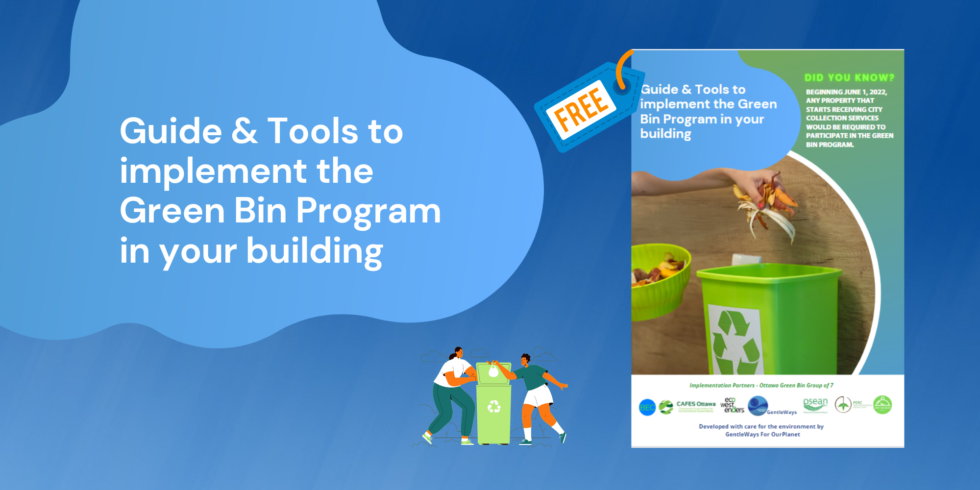
CAFES is proud to be part of a collective led by Gentle Ways for our Planet striving to boost the adoption of green bins and green bin use in multi-unit residential buildings (MURBs).
Are you living in an apartment building? Are you up for an initiative where you reach out to people in your building to do better? Read on, check out the project kit, and welcome to the Green Bin Program. The project aims to reduce waste, prevent the expansion of landfills and greenhouse gas emissions from organics in landfills.
In line with the City's multi-residential waste diversion strategy, as of June 2022, any property that starts receiving the City’s collection services is required to participate in the Green Bin Program. Multi-residential properties already receiving City waste collection can continue to sign up for the program voluntarily for the remainder of 2022, with strenthened directives expected in 2023.
The goal is to progressively reduce the organic waste in our trash to Zero. The kit has communication tools such as a letter to the building’s owner or board of directors, the people you need to engage, and the tools you need for a kiosk in your building to raise awareness about the Program. The kit also includes a beautiful and useful brochure that outlines clearly and succinctly everything one needs to know to start implementing the Program.
Step by Step Guide to Promote the Green Bin Program in your Building
We are continuing our Neighbourhood Canopy Regeneration Initiative! We are aiming to build the capacity of community associations in Ottawa to engage with their residents and to contribute to regenerating the urban tree canopy in their own community.
Sign up your neighbourhood group to participate in growing our urban canopy!
Order your free Trees in Trust promotional cards from CAFES by March 31 2023 (place order here). Distribute them in your neighbourhood to encourage residents to get the City to plant front yard trees on the city-owned road allowance.
In 2021-22 we worked with eight community associations on this initiative: Glebe, Hintonburg, Greater Avalon, Blackburn Hamlet, Champlain Park, Old Ottawa East, Alta Vista, and Queensway Terrace North. Along with the participating community associations, we are utilizing and promoting the existing City of Ottawa tree planting programs (e.g. Trees in Trust) for public spaces, such as front yard street allowance planting, and the Ecology Ottawa Tree Giveaway program for private spaces, such as backyard and side yard planting.
The tree cover (i.e. the total surface area of tree crowns) in the participating neighbourhoods as of 2017 is as follows (neighbourhood boundaries are taken from the 2016 Ottawa Neighbourhood Study and may go beyond boundaries recognized by individual community associations):
*The boundaries have been revised to include the adjacent urban expansion area approved under the new Official Plan - this area includes a large extent of former farmlands.
To view the interactive tree map of the participating neighbourhoods, click here and select "Open in Map Viewer" in the top right corner (instruction video here)!

If you would like to volunteer to help canvass neighbourhoods and promote the regeneration of the urban tree canopy throughout Ottawa in spring 2022, please sign-up here!
Know of a location (e.g. front yard, park, school property) that could use a tree? Help CAFES identify plantable spaces for trees in Ottawa by adding the location to our interactive map!
Check out our Ottawa Urban Tree Manual.

For helpful canopy regeneration resources, click here.
See below for community association specific information:
Glebe Community Association website
Glebe Canopy Regeneration Project website - check out what the GCA is doing!
Glebe Report - Preserving leafy-green Glebe streets for future generations


The Glebe Community Association Environment Committee - Tree Team completed their fall 2021 soft launch of community canvassing, to be continued in spring 2022. Check out their Instagram page for updates!
Champlain Park Community Association website
Champlain Park Canopy Regeneration Project and Champlain Oaks website - check out what the CPCA is doing!


Queensway Terrace North Community Association website


The Queensway Terrace North Community Association Natural Environment Committee will be community canvassing in spring 2022.
Thank you Ecology Ottawa!
We would like to thank Ecology Ottawa, a partner on this initiative, for making trees and tree care information easily accessible to communities in Ottawa. They held three Tree Giveaways with community association's participating in our initiative in October. Tree saplings were handed out to residents in the communities of Greater Avalon, Hintonburg, and Blackburn Hamlet. We would also like to thank Ecology Ottawa for donating the leftover tree saplings from the 2021 Tree Giveaway season to CAFES. Approximately 400 tree saplings were made available to community associations participating in our initiative. These saplings are being used for a variety of activities, including planting on a school property, community canvassing, and planting at a park.

Our Executive Director, Angela and Board Member, Dinah gearing up to canvas the Glebe with Ecology Ottawa saplings!
Little Forests Workshop
Check out our Little Forests Workshop with Rideau 1000 Islands Master Gardener Joyce Hostyn. Learn about Little Forests, an earth-centric approach to landscaping that helps restore our relationship with the natural world.
City of Ottawa Trees in Trust Program


Students from a Carleton University Foundations of Community Engagement course worked with seven community associations on a 15-Minute Neighbourhood Community Engagement Project during the fall 2021 semester. Participating community associations included Glebe, City View, Queensway Terrace North, Navan, Kanata Beaverbrook, Hunt Club, and Action Sandy Hill. Student teams were each matched with a community association to work on a communications project to support them in meeting their goals surrounding 15-minute neighbourhoods. The class created an interactive map of the City of Ottawa, which shows community associations and displays the communications products. Products include, but are not limited to, infographics, social media content, videos, brochures, and surveys that the community associations can use for their own communications and outreach needs.
Student teams presented their final projects to the community association partners in class on December 10th. For more details on the products and testimonials, see below!
"We learned valuable new skills in making the maps and using Canva - both can be used in future community engagement projects of our own. It gave us the knowledge and confidence to participate more in our communities outside this course. Working collaboratively with our community associates helped familiarize us with how community engagement looks in real life."
- Carleton University student, Foundations of Community Engagement course
"The knowledge gained during this process has allowed us to consider community needs through a compassionate lens."
- Carleton University student, Foundations of Community Engagement course
"This project inspired me to get involved in my own community."
- Carleton University student, Foundations of Community Engagement course
Check out the interactive map by clicking the image below!

The student team with the Glebe Community Association worked on the following deliverables:


The student team with the City View Community Association worked on the following deliverables:


The student team with the Queensway Terrace North Community Association worked on the following deliverables:


The student team with the Navan Community Association worked on the following deliverables:
The student team with the Kanata Beaverbrook Community Association worked on the following deliverables:


The student team with the Hunt Club Community Association worked on the following deliverables:


The student team with Action Sandy Hill worked on the following deliverables: