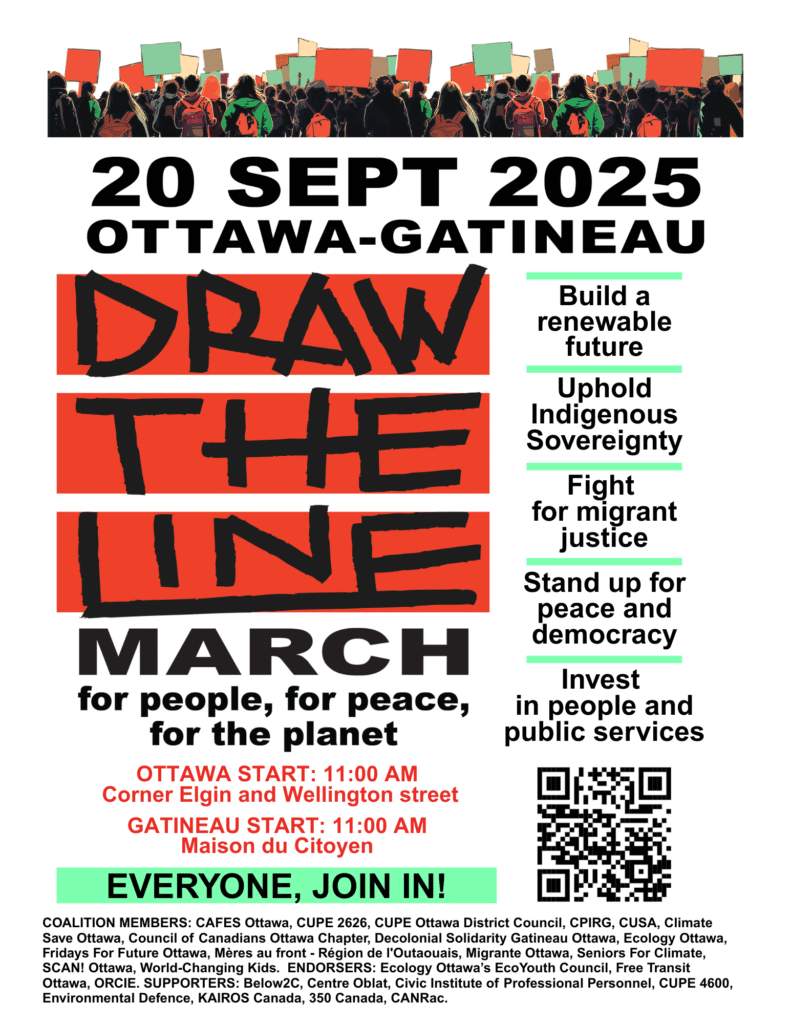
Join CAFES and our members Fridays for Future Ottawa, Seniors for Climate Action Now (SCAN), World Changing Kids and Ecology Ottawa for the Draw The Line March Saturday, September 20th, 2025!
Draw the Line is a national Day of Action taking place on September 20th in communities across Canada. In Ottawa, this action continues the tradition of a September climate march. The Day of Action is also part of a larger international movement calling for climate action and economic justice worldwide. You can find out more about the march and its demands here.
There will be separate start locations in Ottawa and Gatineau, but the contingents will converge in downtown Ottawa. The Ottawa contingent meets at 11 am on the corner of Elgin and Wellington, while the Gatineau contingent meets at 11 am at Maison du Citoyen.
Draw the Line has brought groups together from across different sectors, joining forces to take united action toward the shared call - "For People. For Peace. For the Planet".
In Ottawa, this united approach is bringing together a broad coalition to help organize the march. The growing coalition includes seniors groups, labour unions, student associations, faith organizations, environmental groups, and many others from across the Ottawa-Gatineau region. Working with so many other passionate, action-driven organizations has been an exciting experience, and we are looking forward to sharing more details with you as we get closer to the march.
If you are part of a group that wants to join, or you individually are interested in volunteering, organizing, or making a donation - join up! Email fridaysfutureottawa@gmail.com for all inquiries.
RSVP here to attend the March on September 20th!
On Monday, June 30th, 2025, CAFES' Executive Director, Angela Keller-Herzog, spearheaded a rich feedback submission with the Peoples Official Plan Coalition (POP) to the City of Ottawa on the draft Climate Resiliency Strategy, known as Climate Ready Ottawa (CRO).
The City’s draft CRO provides a critical opportunity to reduce risk, protect health, and strengthen community wellbeing in the face of the climate crisis. The POP feedback document highlighted opportunities to make the CRO more actionable, inclusive, and community-informed. Our detailed feedback submission dove into several strategic outcomes surrounding flood preparation, extreme heat, the economy, resilient buildings, protecting drinking water, stormwater management, tree canopy, wetland conservation, parks, power outages, and more. We additionally addressed suggestions for implementation, best-practice benchmarks, and performance metrics.
Many of our comments, recommendations, and ideas were pulled from the CAFES Climate Resiliency Community Dialogues from 2023, in which we led 11 dialogue sessions with over 300 participants in collaboration with community groups and the City of Ottawa.
Ultimately, CAFES and POP commend the City for its leadership in climate resilience planning. We recognize this climate strategy builds on years of foundational work and cross-departmental collaboration and we look forward to seeing how our recommendations contribute to a more climate-ready Ottawa.
This item is expected to be coming to the October 21st, 2025 City Environment and Climate Change Committee (ECCC). Stayed tuned!
On June 3rd, Angela Keller-Herzog of CAFES delivered an impactful presentation at the Finance and Corporate Services Committee on Capital Asset Management Plans and the Long Range Financial Plan for Water (Rate).
CAFES pointed out that public infrastructure is extremely vulnerable to hazards from climate change and the financial impact of extreme rainfall and extreme heat will be high - citing the Financial Accountability Office of Ontario (FAO) report that states that climate will cause a 16% increase in infrastructure costs. As a solution, pro-active adaptation can significantly lower infrastructure and climate-related costs in the future.
CAFES expressed concern that in the City's Asset Management Plan (AMP), the 2025 budget forecast allocated $155 million less for climate adaptation than 2024, which fails to align with the best practice recommendations of the FAO. The AMP stating that the costs associated with pro-active climate adaptation and resiliency strategies will be incorporated into subsequent iterations of the AMPs, guided by Council-approved policy, essentially represents tactical policy delay and climate denial. This is at odds with the provincial legislation that requires mitigation and adaptation, and Ottawa's own Climate Change Master Plan.
Furthermore, the 2022 Climate Change Vulnerability and Risk Assessment report was vague and missing a list of critical infrastructure; we need more transparency. Comparing the last Long Range Financial Plan for Water (rate) with the current, there's discontinuity. While the AMP tells us that the water infrastructure budget is fair in that it is rising steadily - transit, housing and climate remain in crisis.
Ultimately, it is excellent that the capital AMPs included consideration of climate change impact risks, vulnerabilities and costs. However, while this information is included at a asset management planning level, Ottawa is not making its critical vulnerable infrastructure investments to protect us from extreme weather climate change impacts. Year-on-year, Ottawa's adaptation infrastructure spending has declined despite accelerating evidence of climate instability. The Canadian Climate Institute calculates that every dollar invested in key adaptation measures can yield up to $15 in avoided costs and economic benefits.
Our recommendations included:
In response to one of Councillor Menard's questions, Angela expressed appreciation that a Greenspace and Forests AMP had been undertaken, and that while this report contained information about the value assigned to vehicles of the Forestry Department and the urban count of trees from the tree inventory, it also demonstrates that our forested areas, greenspaces and parks are not truly valued in terms of their contributions to the health and vitality of our city. While there is demonstrated capacity for valuing grey infrastructure, the same is not being put forward for our greenspaces and natural assets - alluding to the need to rebalance our priorities, as mentioned in our third recommendation.