From September to December 2025 CAFES once again partnered with Carleton University on the fifth annual Community Engagement Project with a 2nd year sociology/anthropology undergraduate course. This year, the theme was on Invasive Plant Species. Thank you to Kanata Beaverbrook, Hintonburg, Overbrook, Old Ottawa South, Bel Air, Hunt Club and Riverside Community Associations for participating in this year's project!
The intent for the project was for students to partner with representatives from Community Associations (CA) across Ottawa - who are part of the CAFES network - to gain real-life community engagement experience and create projects/deliverables on the chosen topic.
For the CA leaders, this project was an opportunity to learn and connect with university students and have their neighbourhoods benefit from the deliverables the students are able to create. CA leaders had the opportunity to share expertise on invasive species management in Ottawa and how we can increase public awareness on this important issue. For the students, they were able to analyze insights and experiences gained as they brought their conceptual learning from the course together with their experience working towards real-world objectives in their chosen communities.
Students did an excellent job this year creating videos, posters, artwork, educational brochures, lesson plans, door to door campaigning, event planning, social media posts - all about invasive plant species management and awareness! Stay tuned for a full project post on the CAFES website that will show off the students' amazing projects.
Check out the photos below of some of the students engaging with their community association leaders throughout the course and delivering their final presentations in class on Thursday, November 27th!

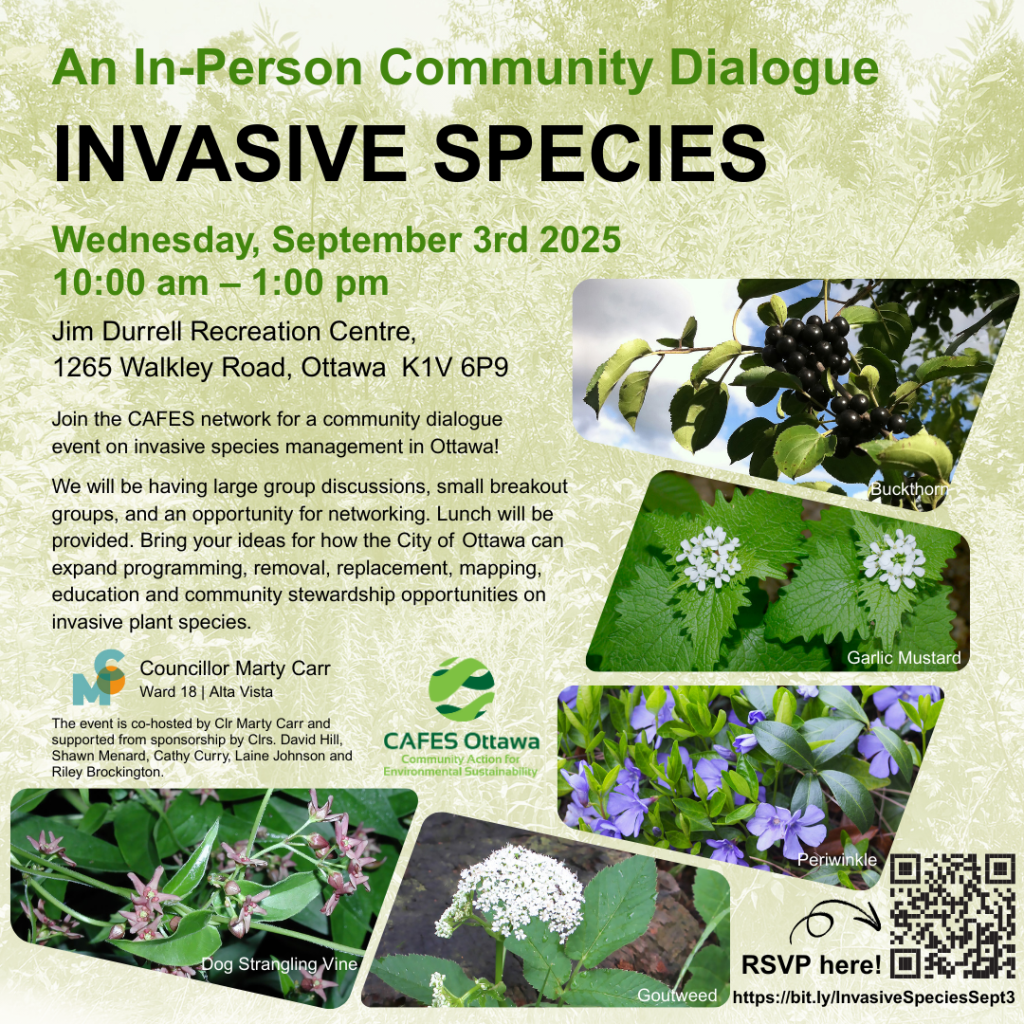
On Wednesday, September 3rd, 2025 CAFES hosted a successful in-person community dialogue event in partnership with Councillor Marty Carr on the management of invasive plant species in Ottawa, at the Jim Durrell Recreation Centre in Alta Vista. Thank you to Councillor Carr for your generous support towards this event, and thank you as well to Councillors Brockington, Menard, Hill, Johnson and Curry for your sponsorship.
This dialogue event followed Councillor Carr's staff inquiry at the February 18th, 2025 Environment and Climate Change Committee (ECCC) meeting to review the City's invasive species programming and community stewardship opportunities. Staff released a report in July 2025 outlining existing invasive species efforts, and plans to hire a new temporary staff position to focus on invasives programming, mapping and reporting, as well as community/stakeholder relationships. This item came to the September 16th ECCC meeting agenda, where CAFES gave a public delegation and presented the outcomes of the September 3rd dialogue.
To follow suit from Councillor Carr's inquiry, the dialogue event gathered community input on invasive species removal/management methods, public education, mapping and tracking, identifying species of concern, volunteer stewardship, and more. We had opening presentations, a community panel, breakout table conversations, table presentations, lunch, and networking.

Below are some of the most widely-shared ideas from the dialogue participants:
At the September 16th ECCC meeting, Councillor Carr gave a direction to staff to consider our report as community input.
Check out our final event report below, which details all the feedback received at the dialogue. You can also see our public delegation presentation, which presented the report. Lastly, you can see the report provided by City staff in response to Councillor Carr's inquiry.
Thank you to all the event volunteers who helped out, and thank you to the participants for sharing your input!
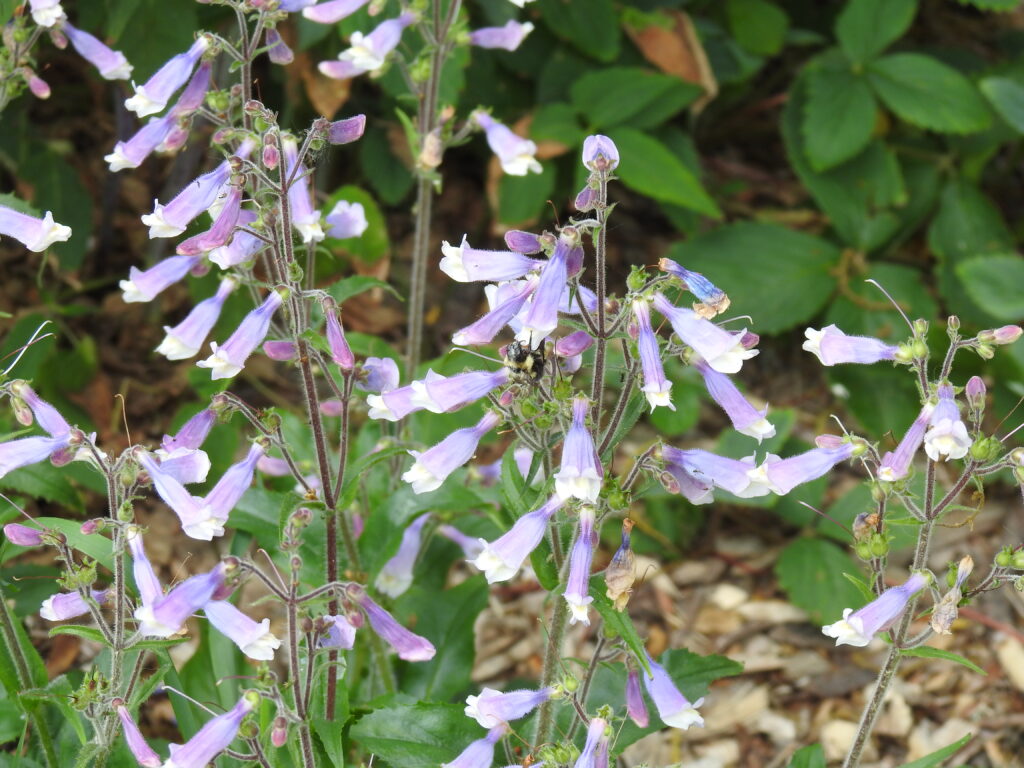
Every city park should have a pollinator meadow!
Wild Pollinator Partners (WPP) is partnering with the Ottawa Stewardship Council (OSC) to establish more pollinator habitat on city land - including parks, hydro corridors, and rights of way. If you or your community organization are near a city park or hydro corridor, WPP and OSC will help you create a wildflower meadow. OSC will handle the permission process, and WPP will provide advice, models, some polliantor plants, and lots of encouragement.
Your job as a project participant will be to:
This last step is not onerous - at Brighton Beach Park, Old Ottawa South's Environment and Climate Action Committee prunes shrubs in fall, digs out dandelions in spring (about 4 hours total), and maintains a mowing strip around the garden. Monitoring is important to see how various species are doing in your location and to stop invasive species early. Visit the link here to read about these two mini-meadows at Brighton.
WPP and OSC already have several individuals/groups who are interested in starting a pollinator mini-meadow as part of this project, but are looking for a few more to join. If you or your organization is interested, please reach out to info@wildpollinators-pollinisateurssauvages.ca
See the document below for a complete project description.
Call Out for Participation
Calling all Community Associations! CAFES and Carleton University are once again partnering to hold the 5th annual Community Engagement Project with a 2nd year sociology/anthropology course this Fall (September to the end of November 2025). This year, the theme will be Invasive Plant Species. We are looking for 6-7 Community Association to sign up to participate (see green button below for the Expression of Interest Form).
Project Description
The intent for this project is for students to partner with representatives from Community Associations/Organizations across Ottawa - who are part of the CAFES network - to gain real-life community engagement experience and create products and deliverables on the chosen topic.
For the Community Association (CA) leaders, this project is an opportunity to learn, engage and connect with university students and have your neighbourhoods benefit from the deliverables the students are able to create for you. For the students, the intent is for them to analyze and discuss insights and experiences gained as they bring their conceptual learning from the course together with their experience working towards real-world objectives in their chosen communities.
This year, both students and community leaders will have the opportunity to learn and share expertise on invasive species management in the City of Ottawa, including municipal programs/policies, local stewardship initiatives, species of concern, how invasive species impact biodiversity and ecological health, and how we can increase public education/awareness on this important issue. If your CA has particular interest and/or experience with invasive species, it would be wonderful to have you on board.
Level of Commitment for Community Associations
-
Is your CA interested in participating? Visit the link below to express your interest!
-
Please read the Project Information Sheet (posted below) for more information on project activities and objectives. Also be sure to check out CAFES’ 2024 project post to see some of the incredible deliverables the students created last year (last year's theme was on pollinator gardening).
For questions or more information, please contact Erica Shardlow at eshardlow@cafesottawa.ca.
Invasive plant species are a serious issue threatening Ottawa's biodiversity and ecosystems. Invasive plant species are classified as non-native plants that have been introduced, whether intentionally or unintentionally, from other geographical regions that outcompete native vegetation.
Invasive species are problematic not just because they outcompete native plants, but because native wildlife - including pollinator insects and birds - do not naturally use them for food and habitat. Since native wildlife evolved to feed off plants that naturally grow in this region, non-natives that have only been introduced relatively recently do not provide the same nutritional value or key characteristics that many wildlife species need to thrive. This threatens the stability of our ecosystem and further endangers at-risk species, such as Bumble Bees and the Monarch butterfly.
On Friday June 27th, Erica Shardlow, the CAFES' Trees and Greenspace Coordinator, was pleased to attend an excellent walk with members of the Ottawa Field Naturalists Club (OFNC) and the Rideau Trail Association. Guide Alan Smith led the group on an informative hike through the Lime Kiln trail while pointing out invasive plants on the rise, some of which are featured below.
Phragmites are a major invasive in Ottawa, reproducing through roots and often seen spreading along waterways. It is being actively controlled in Ontario through conservation authorities, mainly by spraying, as infestations are often extensive. Research has begun to examine biological control methods via two species of moths whose larvae can damage and kill the plant.

Buckthorn is a massive concern due to its aggressive spreading. The two problematic species in Ottawa are Glossy Buckthorn and Common Buckthorn. They are native to Europe, northwest Africa and western Asia and have veiny leaves with round berries that are enjoyed by birds. Interestingly, the seeds in its berries pass through birds' digestive systems unharmed, allowing the seeds to spread widely and rapidly. Several community associations/organizations in Ottawa have been leaders in removing Buckthorn, including Friends of Hampton Park and Action Sandy Hill.

Dog Strangling Vine (DSV) is yet another huge concern due to its ability to spread rapidly and its difficulty to kill. DSV can grow to be 4-5 feet tall by mid-summer, suffocating understory plants and young trees. DSV is actually related to the milkweed family, at times confusing Monarchs who may lay eggs on its leaves, only for the caterpillars to be unable to feed on the plant after hatching. DSV is a priority species that is seeing active removal efforts by the City of Ottawa and Ontario conservation authorities.

This photo below is of Coltsfoot, another invasive that loves gravel and stony areas and is often seen at the edges of car parks. These plants have bright yellow flowers that resemble dandelions. They are native to Europe, and were likely cultivated by settlers for medicinal properties to treat cold, flu, gout, fever and respiratory illness.
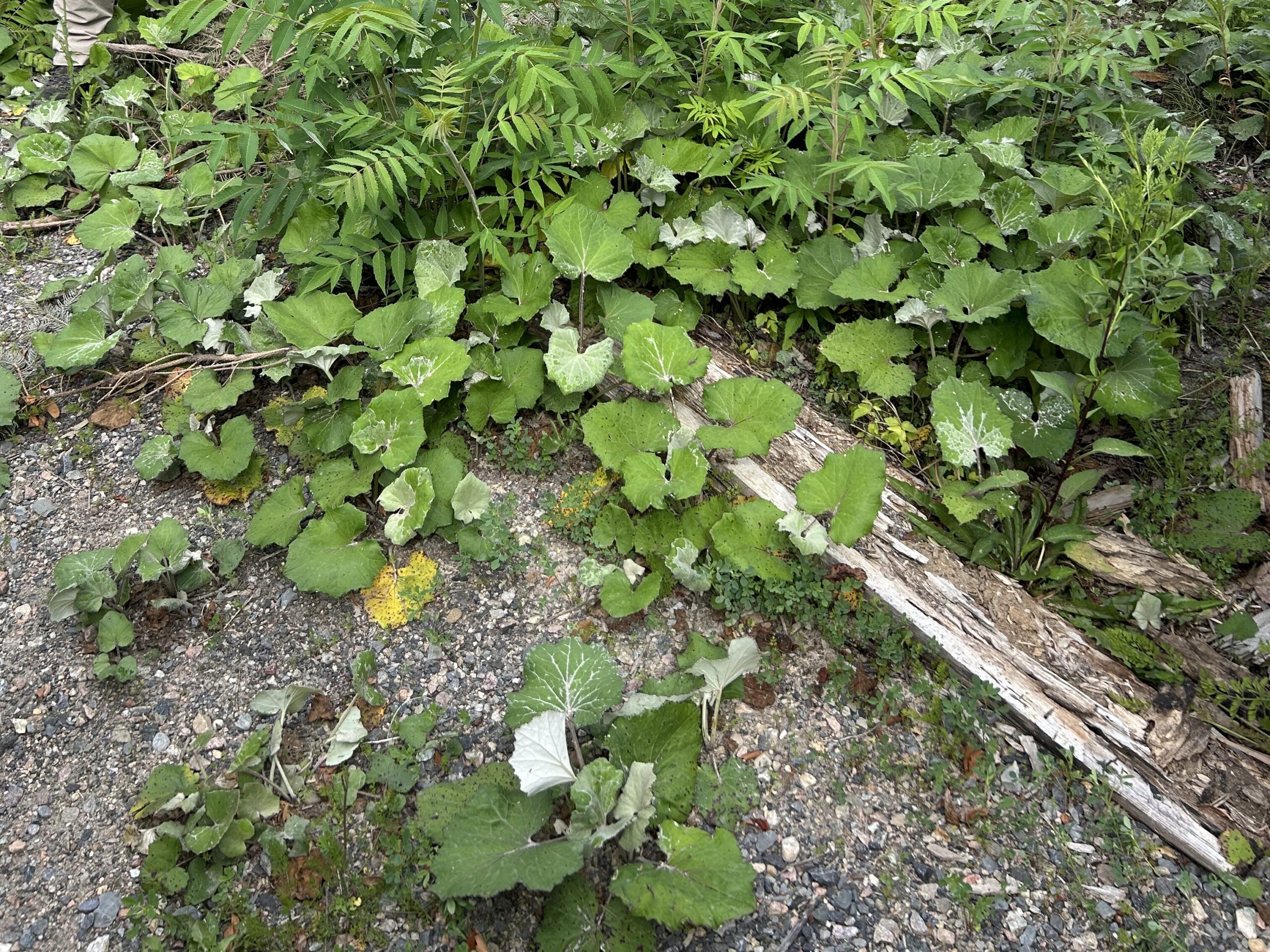
Check out the photos below for some of the other invasives we came across on the walk. Other invasives not seen on the trail but discussed on Friday included Norway Maple, Garlic Mustard, Goutweed, Periwinkle, Russian Olive, Wild Parsnip, Japanese Knotweed, and Giant Hogweed.
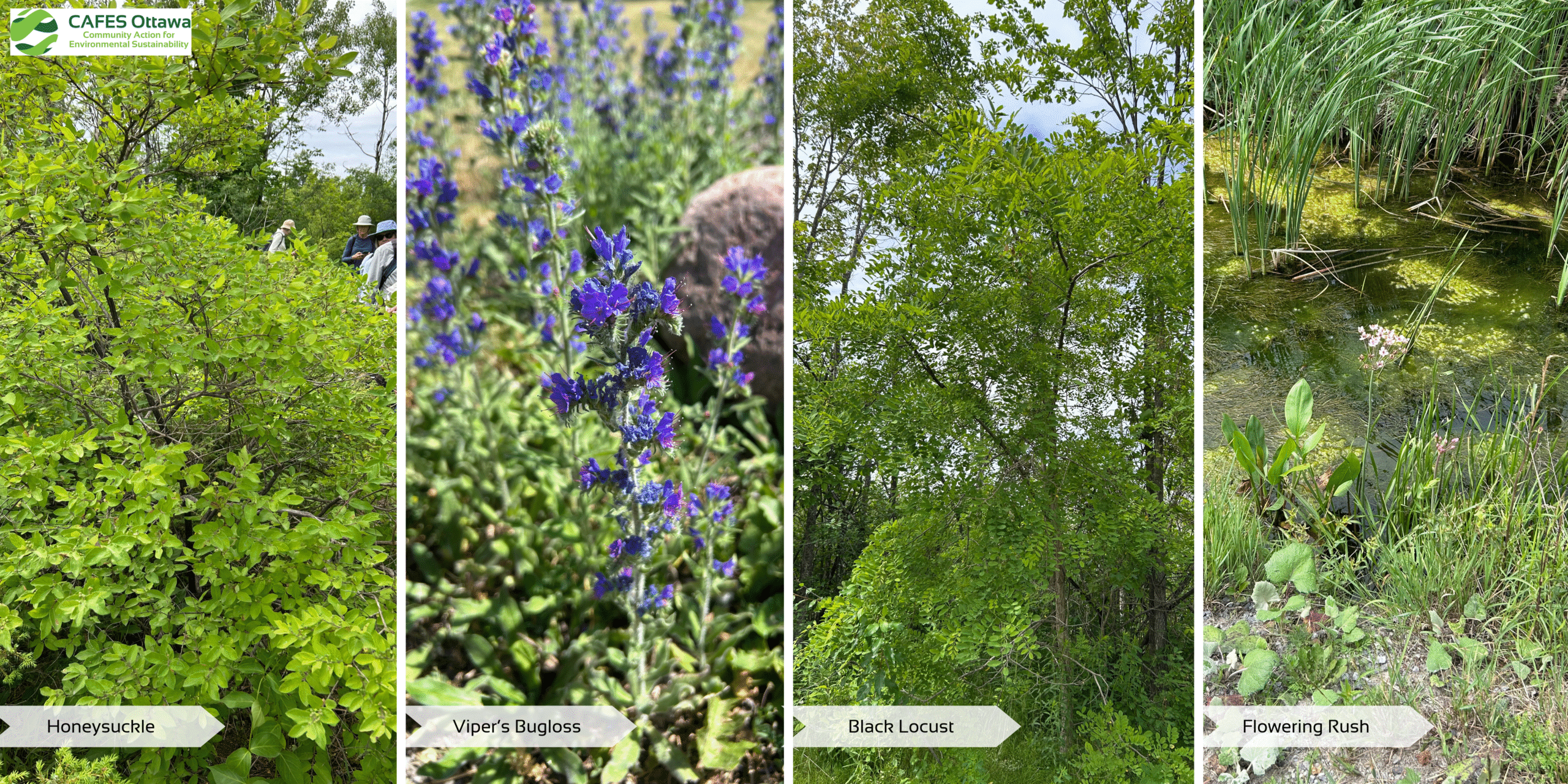
Many of these species were introduced by European settlers, and many more continue to be spread as a result of globalization and transportation of goods. Invasives can also be spread by everyday human activities - like hitching a ride on the bottom of our hiking boots or by transporting fire wood when we go camping. Boot cleaning stations at trailheads - which include boot brushes to remove mud, seeds and brush, complete with informative signage - are gaining traction in Ontario as one way to minimize spread.
Many community organizations in the CAFES network are actively engaged in invasive species awareness, advocacy and removal - pushing for more community/volunteer stewardship opportunities with the City of Ottawa.
In fact, CAFES is once again partnering with Carleton University for our annual Community Engagement project, and our topic this year is on invasive plant species! If you are from a Community Association and interested in learning more / sharing your knowledge, consider participating - see here for info.
Also be sure to check out the Ontario Invasive Plant Council for a comprehensive species list and in-depth guides on how to remove key species. You can also find information on what's being done, and what you can do.
Mark your calendars - Wild Pollinator Partners will once again be celebrating Pollinator Appreciation Day at Fletcher Wildlife Garden on Saturday, June 7th, and CAFES will be there! Come on out between 10am - 2pm to meet with others who have created pollinator gardens, learn from scientists who study pollinators, and connect with organizations that support pollinator projects.
This year’s theme is "EVERY BIT MATTERS". Simple actions like adding native plants to your garden, removing a hard surface, or waiting a couple of weeks to tidy up your yard in spring and fall can help preserve biodiversity and increase natural habitat.
You'll be able to learn how to plan your own garden to provide flowers for pollinators, find out how to start a pollinator garden at your local school or park, learn to identify invasive species, and tour the Fletcher Wildlife Garden to see pollination in action. Games and crafts will also be available for kids.
A variety of experts and volunteers from local organizations will be there to share information, answer questions, and tell you everything you need to know about helping pollinators.
CAFES will be selling perennial plants and herbs!
CAFES is excited to be in attendance to sell some of our native perennial plants, which attract pollinators like bees, butterflies, other important insects and hummingbirds to your garden. We will have Black-Eyed Susan, Wild Blue Indigo, Wild Bergamot, Purple Coneflower, New England Aster, Joe Pye Weed, Oxeye (False Sunflower), and Swamp Milkweed. We will also have some herbs available for purchase including Lavender, Oregano, Parsley, Tarragon, Sage and Dill. Visit our table on June 7th to get yours, or pre-order HERE to pick-up in advance at 166 Glebe Avenue.
Wild Pollinator Partners are also holding a free raffle at the event to give-away a little something for your garden. They are offering pollinator favourites that are sure to attract bees and butterflies to your yard: Serviceberry tree (small), Red Osier Dogwood, Figwort, Flat-topped Aster, Heart-leaved Aster, and more.
More information about the event is available here. No registration is required to attend. See you there!
Volunteer Call Out - we are looking for a couple volunteers with a vehicle to help with the set-up for the event including loading up supplies starting at 8am, and to stay for the morning of the event to help sell plants and speak to attendees visiting the CAFES table. Please contact eshardlow@cafesottawa.ca if interested.