On Saturday, October 18th, 2025, CAFES, the Mechanicsville Community Association and MP Yasir Naqvi are planting 50 new native tree saplings at our Mother's Day Woods site at Tunney's Pasture! We are looking for volunteers to help out - all are welcome, no prior planting experience required. Planting equipment and snacks will be provided.
Date: Saturday, October 18th, 2025
Time: 2:00 pm - 4:00 pm
Location: Tunney's Pasture, Ottawa - we are meeting in the field between Goldenrod Driveway and Kitchi Zibi Mikan, on the North end of the Tunney's Pasture area. We will have signs put up to direct where to go.
Parking: There is a paid visitor parking lot at the corner of Parkdale Avenue and Goldenrod Driveway, near the Brooke Claxton Building. Alternatively, there is street parking on Emmerson Avenue, and on other nearby streets in the Mechanicsville neighbourhood.
This project is part of CAFES' annual Tree Initiative to increase tree canopy in Ottawa neighbourhoods that need trees the most. Read all about the Tree Give-Away we organized earlier this year on Mother's Day weekend to encourage kids and families to plant trees on private properties in the city. This planting event on October 18th is planned as a follow-up activity to support Ottawa residents to participate in tree stewardship.


Thank you to TD Friends of the Environment for your generosity in making this project possible. Thank you to MP Yasir Naqvi for your continued annual partnership with CAFES on tree planting in Ottawa. Thank you to MPP Catherine McKenney for your support towards this event.
-

-
-

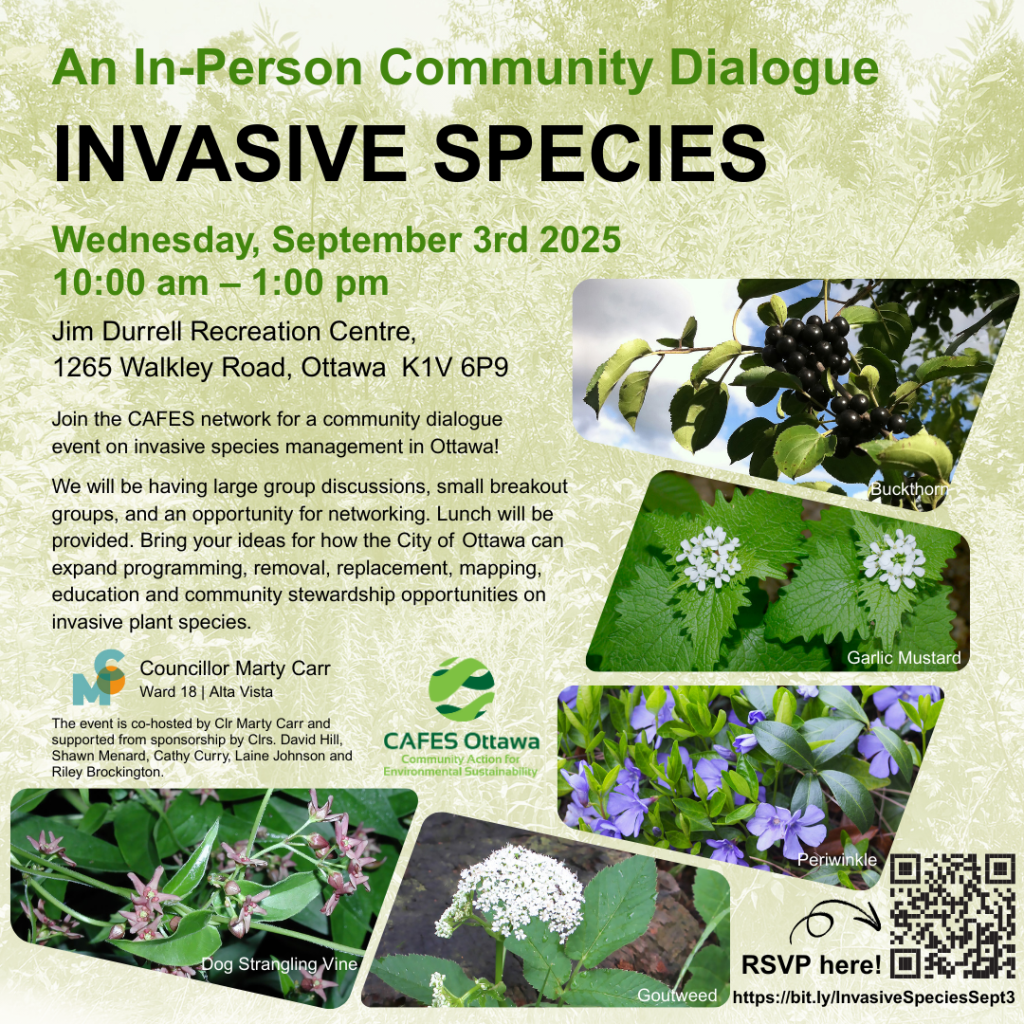
On Wednesday, September 3rd, 2025 CAFES hosted a successful in-person community dialogue event in partnership with Councillor Marty Carr on the management of invasive plant species in Ottawa, at the Jim Durrell Recreation Centre in Alta Vista. Thank you to Councillor Carr for your generous support towards this event, and thank you as well to Councillors Brockington, Menard, Hill, Johnson and Curry for your sponsorship.
This dialogue event followed Councillor Carr's staff inquiry at the February 18th, 2025 Environment and Climate Change Committee (ECCC) meeting to review the City's invasive species programming and community stewardship opportunities. Staff released a report in July 2025 outlining existing invasive species efforts, and plans to hire a new temporary staff position to focus on invasives programming, mapping and reporting, as well as community/stakeholder relationships. This item came to the September 16th ECCC meeting agenda, where CAFES gave a public delegation and presented the outcomes of the September 3rd dialogue.
To follow suit from Councillor Carr's inquiry, the dialogue event gathered community input on invasive species removal/management methods, public education, mapping and tracking, identifying species of concern, volunteer stewardship, and more. We had opening presentations, a community panel, breakout table conversations, table presentations, lunch, and networking.

Below are some of the most widely-shared ideas from the dialogue participants:
At the September 16th ECCC meeting, Councillor Carr gave a direction to staff to consider our report as community input.
Check out our final event report below, which details all the feedback received at the dialogue. You can also see our public delegation presentation, which presented the report. Lastly, you can see the report provided by City staff in response to Councillor Carr's inquiry.
Thank you to all the event volunteers who helped out, and thank you to the participants for sharing your input!
On Saturday, October 18th, the Mechanicsville Community Association in partnership with CAFES volunteers planted over 70 new native tree saplings at our Mother's Day Woods site at Tunney's Pasture! It was a glorious fall day. We were thrilled to share this exciting day with over 30 volunteers. Thank you so much for everyone who came out to help increase Ottawa's urban tree canopy!
This event is part of CAFES' annual tree programming to increase tree canopy in Ottawa neighbourhoods that need it most. Read all about the Give-Away we organized earlier this year on Mother's Day to encourage kids and families to plant trees in backyards.
Thank you to TD Friends of the Environment for your generosity in making this event possible. Thank you to MP Yasir Naqvi for your continued annual partnership with CAFES on tree planting in Ottawa, and to MPP Catherine McKenney for your support towards this event. Thank you to the City of Ottawa CEPGP.
Interested in becoming a tree steward? We are still looking for a few volunteers to return to the Tunney's Pasture planting site periodically to help water the new trees in the spring, summer and fall of 2026 using our on-site water tote. These trees will need weekly waterings next year to ensure their health and survival. If interested, please contact Erica at eshardlow@cafesottawa.ca. A huge thank you to those who have signed up so far.

-

-
On Wednesday, June 11th, 2025 CAFES held a special Joint Caucus meeting to discuss ideas for the City of Ottawa's "A Green and Resilient City" service review feedback opportunity, and on July 29th CAFES submitted a detailed recommendations document to the City. The purpose of the City's service review is to examine municipal services that contribute to creating a greener, more resilience city - while focusing on service efficiency and identifying cost-saving opportunities.
CAFES' Joint Caucus on June 11th was organized in order to gather ideas and insights from our network on city services related to green infrastructure, tree canopy and greenspaces, waste reduction and diversion, the circular economy, urban density, emissions reporting, climate resilience, public transit, environmental stewardship, and equity. Following the caucus discussion, CAFES created a detailed submission outlining our recommendations - including specifying precisely which city services our recommendations fall under, and how they save the city money. Check out our submission below, and please feel free to use these recommendations to inform your own submissions on Engage Ottawa.
Members of the public are currently able to go online to Engage Ottawa and share your ideas - visit the link here to submit your comments. You will have to create an account or login to Engage Ottawa to contribute to this particular opportunity.
Calling on tree-loving volunteers! CAFES will be repotting over 20 trees into larger pots on Wednesday, July 2nd from 5:00 - 7:00 pm at 166 Glebe Avenue, Ottawa. We would love to have a few volunteers come help out if interested.
These trees are intended to be planted in October 2025 as part of our Community Tree Planting Initiative at Tunney's Pasture (see link here for last year's event). We purchased them from Ferguson Nursery this spring in 1-2 gallon pots, and they currently need to be upgraded to larger 4 gallon pots so they can grow throughout the summer. Species include silver maple, cedar, white birch, yellow birch and pine.
This will be a small, casual backyard activity. While we will start repotting at 5:00 pm, you are welcome to drop in anytime until 7:00 pm. Soil, pots, general garden tools, and some extra garden gloves will be available to use. However, if you have your own garden gloves, please bring them along!
If interested in helping out, please email Erica Shardlow at eshardlow@cafesottawa.ca

Today, on Monday, June 30th, led by CAFES, the Peoples Official Plan Coalition (POP), submitted a rich set of recommendations to the City of Ottawa planning team on draft 2 of the New Comprehensive Zoning By-law. A major feat!
The focus of the POP submission is zoning that supports a dense, liveable, walkable, green, 15-minute caring city as an important alternative to sprawl, inequality and lack of connectivity. We want to see this demonstrated though provisions for affordable, equitable housing opportunities that fit the demographic need, enabling zoning for car sharing services, an emphasis on care facilities and amenity areas, emergency and temporary housing options, anti-renoviction and anti-demoviction measures, soil volume and permeable space requirements on residential lots for trees, neighbourhood zone setback minimums, better priority for shade trees in mainstreets, hub zones, minor corridors and mixed-used zones, soft landscaping in parking lots, adequate stormwater services with links to trees, no development in flood-prone areas, and the adoption of a clear food systems lens.
See the full submission at the end of this post. Our most active collaborators in the POP coalition have been CAWI (City for all Women), Ecology Ottawa, the Federation for Citizens Associations (FCA), Greenspace Alliance, Just Food, Strong Towns Ottawa , Walkable Ottawa and Wastewatch Ottawa. Yey team!
The draft 2 public consultation period has been open throughout the months of May and June, with several public open houses taking place in person and online from late May to early June. Some of the major topics discussed at the consultations included changes to Neighbourhood Zones, height transitions in Mainstreet Zones, communal parking lots in neighbourhoods, and changes to permitted uses in Industrial Zones.
You can still submit your written comments on draft 2 before July 1st to NewZoning@ottawa.ca.
Draft 3 is expected to be released on September 8th, 2025 and will go to Joint Committee and Council on December 17th, 2025 and January 28th, 2026, respectively. The final version of the by-law is expected to be enacted in Q1 2026. Visit the Engage Ottawa Zoning page to view draft 2 of the by-law and accompanying documents and to stay updated.
-
CAFES has been engaged in the New Comprehensive Zoning By-law since January 2024 when a group of experienced volunteers formed a working group and co-wrote a recommendations paper on how zoning can regulate trees. We have since taken an active role within POP to lead submissions on draft 1 and draft 2 of the by-law, while continuing to update our own position paper. If you have questions or comments about trees and zoning, please contact Erica at eshardlow@cafesottawa.ca
Invasive plant species are a serious issue threatening Ottawa's biodiversity and ecosystems. Invasive plant species are classified as non-native plants that have been introduced, whether intentionally or unintentionally, from other geographical regions that outcompete native vegetation.
Invasive species are problematic not just because they outcompete native plants, but because native wildlife - including pollinator insects and birds - do not naturally use them for food and habitat. Since native wildlife evolved to feed off plants that naturally grow in this region, non-natives that have only been introduced relatively recently do not provide the same nutritional value or key characteristics that many wildlife species need to thrive. This threatens the stability of our ecosystem and further endangers at-risk species, such as Bumble Bees and the Monarch butterfly.
On Friday June 27th, Erica Shardlow, the CAFES' Trees and Greenspace Coordinator, was pleased to attend an excellent walk with members of the Ottawa Field Naturalists Club (OFNC) and the Rideau Trail Association. Guide Alan Smith led the group on an informative hike through the Lime Kiln trail while pointing out invasive plants on the rise, some of which are featured below.
Phragmites are a major invasive in Ottawa, reproducing through roots and often seen spreading along waterways. It is being actively controlled in Ontario through conservation authorities, mainly by spraying, as infestations are often extensive. Research has begun to examine biological control methods via two species of moths whose larvae can damage and kill the plant.

Buckthorn is a massive concern due to its aggressive spreading. The two problematic species in Ottawa are Glossy Buckthorn and Common Buckthorn. They are native to Europe, northwest Africa and western Asia and have veiny leaves with round berries that are enjoyed by birds. Interestingly, the seeds in its berries pass through birds' digestive systems unharmed, allowing the seeds to spread widely and rapidly. Several community associations/organizations in Ottawa have been leaders in removing Buckthorn, including Friends of Hampton Park and Action Sandy Hill.

Dog Strangling Vine (DSV) is yet another huge concern due to its ability to spread rapidly and its difficulty to kill. DSV can grow to be 4-5 feet tall by mid-summer, suffocating understory plants and young trees. DSV is actually related to the milkweed family, at times confusing Monarchs who may lay eggs on its leaves, only for the caterpillars to be unable to feed on the plant after hatching. DSV is a priority species that is seeing active removal efforts by the City of Ottawa and Ontario conservation authorities.

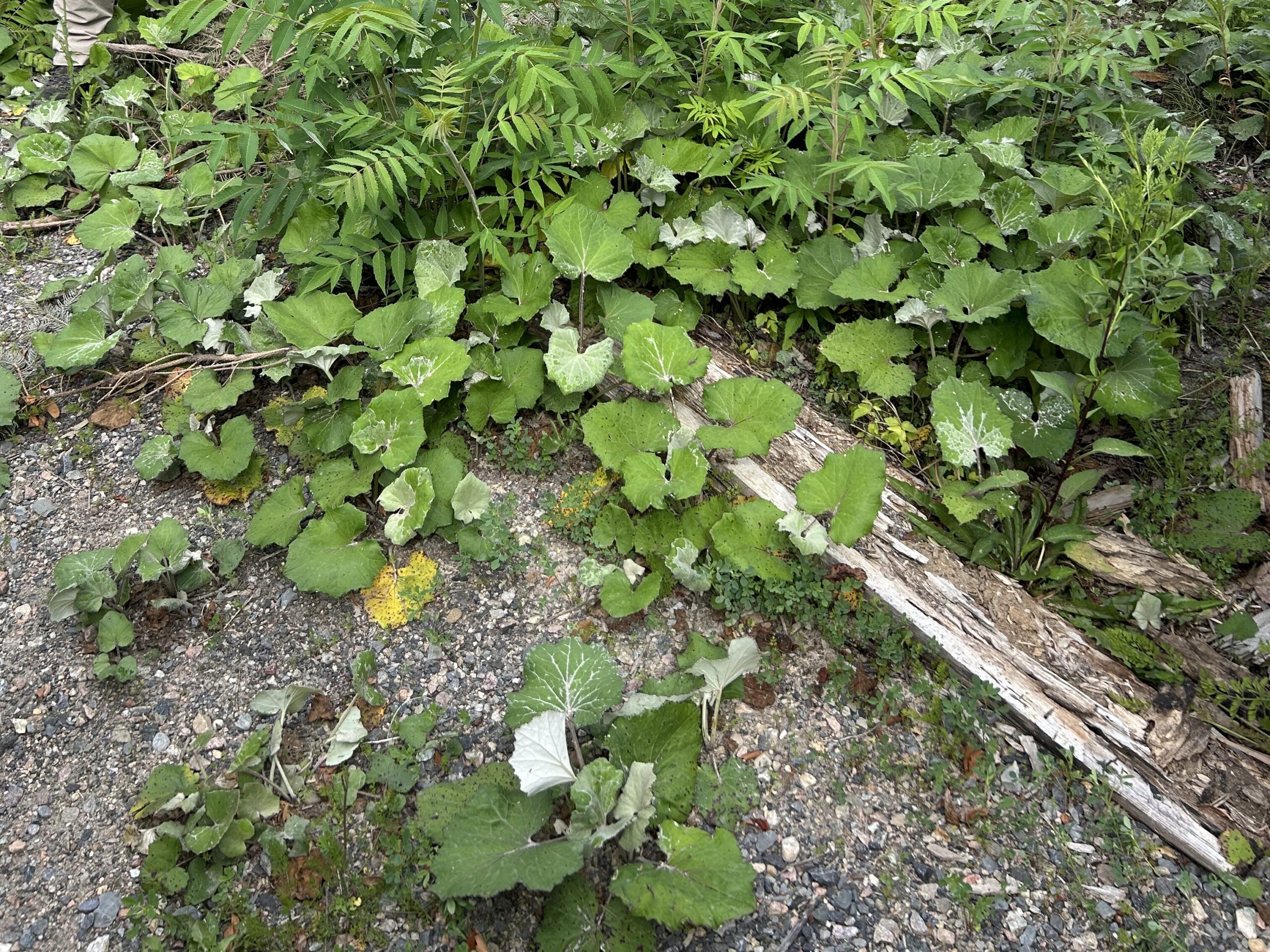
This photo below is of Coltsfoot, another invasive that loves gravel and stony areas and is often seen at the edges of car parks. These plants have bright yellow flowers that resemble dandelions. They are native to Europe, and were likely cultivated by settlers for medicinal properties to treat cold, flu, gout, fever and respiratory illness.
Check out the photos below for some of the other invasives we came across on the walk. Other invasives not seen on the trail but discussed on Friday included Norway Maple, Garlic Mustard, Goutweed, Periwinkle, Russian Olive, Wild Parsnip, Japanese Knotweed, and Giant Hogweed.
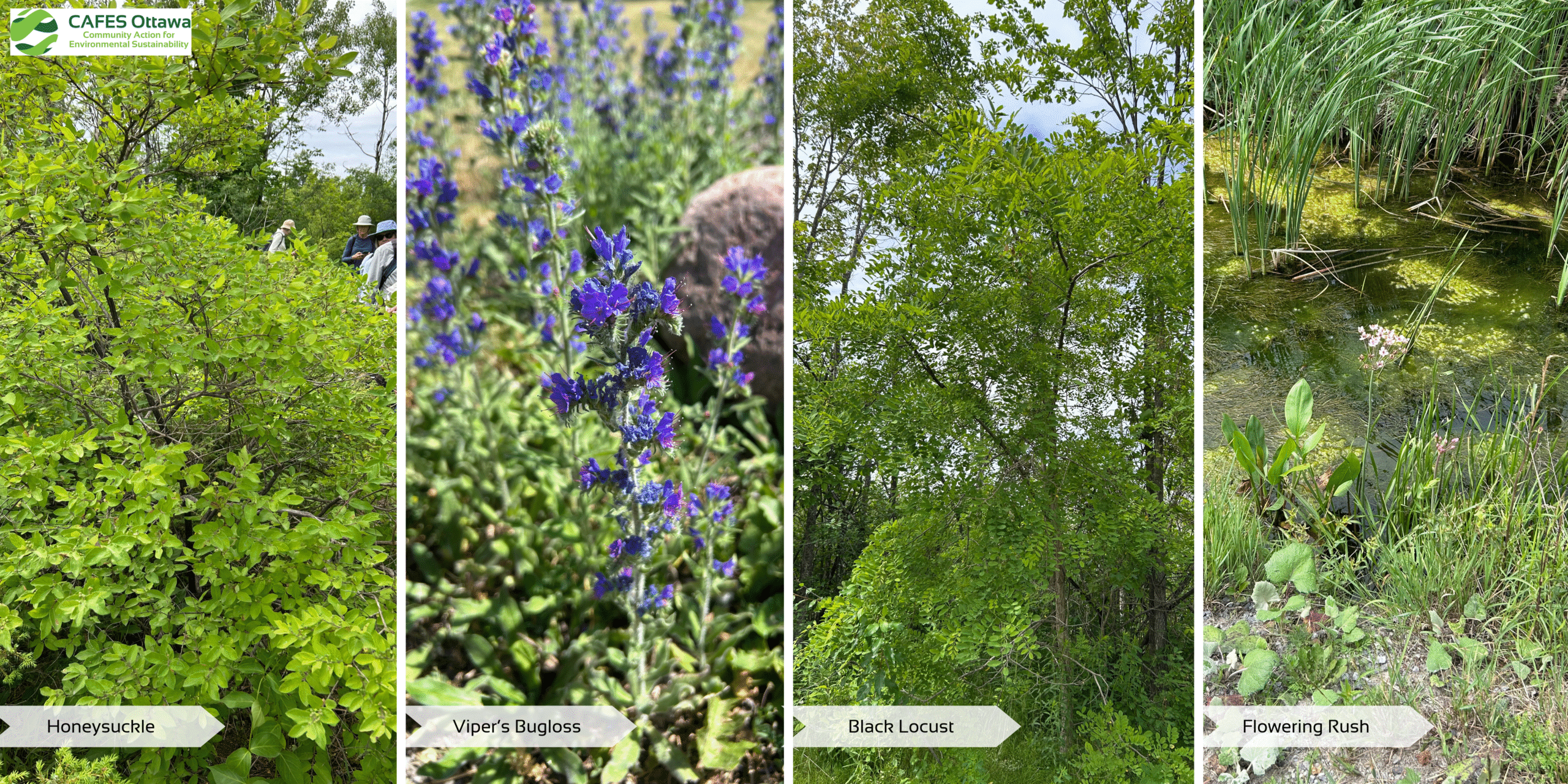
Many of these species were introduced by European settlers, and many more continue to be spread as a result of globalization and transportation of goods. Invasives can also be spread by everyday human activities - like hitching a ride on the bottom of our hiking boots or by transporting fire wood when we go camping. Boot cleaning stations at trailheads - which include boot brushes to remove mud, seeds and brush, complete with informative signage - are gaining traction in Ontario as one way to minimize spread.
Many community organizations in the CAFES network are actively engaged in invasive species awareness, advocacy and removal - pushing for more community/volunteer stewardship opportunities with the City of Ottawa.
In fact, CAFES is once again partnering with Carleton University for our annual Community Engagement project, and our topic this year is on invasive plant species! If you are from a Community Association and interested in learning more / sharing your knowledge, consider participating - see here for info.
Also be sure to check out the Ontario Invasive Plant Council for a comprehensive species list and in-depth guides on how to remove key species. You can also find information on what's being done, and what you can do.
On June 3rd, Angela Keller-Herzog of CAFES delivered an impactful presentation at the Finance and Corporate Services Committee on Capital Asset Management Plans and the Long Range Financial Plan for Water (Rate).
CAFES pointed out that public infrastructure is extremely vulnerable to hazards from climate change and the financial impact of extreme rainfall and extreme heat will be high - citing the Financial Accountability Office of Ontario (FAO) report that states that climate will cause a 16% increase in infrastructure costs. As a solution, pro-active adaptation can significantly lower infrastructure and climate-related costs in the future.
CAFES expressed concern that in the City's Asset Management Plan (AMP), the 2025 budget forecast allocated $155 million less for climate adaptation than 2024, which fails to align with the best practice recommendations of the FAO. The AMP stating that the costs associated with pro-active climate adaptation and resiliency strategies will be incorporated into subsequent iterations of the AMPs, guided by Council-approved policy, essentially represents tactical policy delay and climate denial. This is at odds with the provincial legislation that requires mitigation and adaptation, and Ottawa's own Climate Change Master Plan.
Furthermore, the 2022 Climate Change Vulnerability and Risk Assessment report was vague and missing a list of critical infrastructure; we need more transparency. Comparing the last Long Range Financial Plan for Water (rate) with the current, there's discontinuity. While the AMP tells us that the water infrastructure budget is fair in that it is rising steadily - transit, housing and climate remain in crisis.
Ultimately, it is excellent that the capital AMPs included consideration of climate change impact risks, vulnerabilities and costs. However, while this information is included at a asset management planning level, Ottawa is not making its critical vulnerable infrastructure investments to protect us from extreme weather climate change impacts. Year-on-year, Ottawa's adaptation infrastructure spending has declined despite accelerating evidence of climate instability. The Canadian Climate Institute calculates that every dollar invested in key adaptation measures can yield up to $15 in avoided costs and economic benefits.
Our recommendations included:
In response to one of Councillor Menard's questions, Angela expressed appreciation that a Greenspace and Forests AMP had been undertaken, and that while this report contained information about the value assigned to vehicles of the Forestry Department and the urban count of trees from the tree inventory, it also demonstrates that our forested areas, greenspaces and parks are not truly valued in terms of their contributions to the health and vitality of our city. While there is demonstrated capacity for valuing grey infrastructure, the same is not being put forward for our greenspaces and natural assets - alluding to the need to rebalance our priorities, as mentioned in our third recommendation.
On Sunday May 4th, in partnership with the Riverview Park Community Association and with funding contribution from TD Friends of the Environment Foundation, CAFES Ottawa saw an incredible turn out of over 60 attendees on our Tree Walk in Coronation Park as part of the annual Jane’s Walk initiative!
Tree expert Owen Clarkin lead the beautiful 1km walk to share his in-depth knowledge on native tree species, identification, the importance of trees and urban forests, tree health, and much much more.
The Coronation Park woodlot has a wonderful diversity of tree species and was a lovely spot to get outside and enjoy some spring fresh air with fellow neighbours. At the end of the walk, Shelley Crabtree, Director of Forêt Capitale Forest, provided an excellent planting demonstration of a Pin Cherry tree to share best practices for planting, watering and caring for young trees.
Thank you to all for joining us for such an invigorating morning, and a special thank you to Sharron Edwards for coming out to photograph our walk!
-

-

On Saturday May 10th, the Hintonburg Community Association (HCA) hosted a wonderful spring tree give-away in partnership with CAFES Ottawa and the Hintonburg Community Centre. With one of the lowest canopy cover percentages of Ottawa's urban neighbourhoods, the HCA successfully distributed 80 free tree saplings to residents living directly in the Hintonburg neighbourhood for planting on private property.
The trees given out were entirely native to this region, and came in either 2 gallon pots or bare-root. Planting instructions were given out with each tree to guide recipients on best planting practices. Species included Yellow and Grey Birch, Maple, Pussy Willow, Red and White Oak, Red Osier Dogwood, White Cedar, White Spruce and Pin Cherry.
The HCA is continuing to work with recipients to ensure the trees have the best chance at survival. Please feel free to contact freespringtree@gmail.com is you have any questions, and visit the link here for a great resource on tree care.
Thanks to everyone who participated in this fantastic initiative to grow the neighbourhood's canopy!